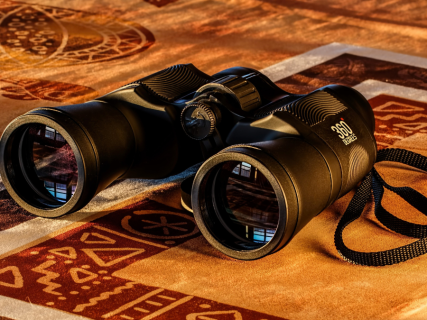
The most curious laws in the world: why Ethiopia controls even the binoculars that tourists carry

Entering Ethiopia with binoculars is not as simple as it seems. Some are prohibited, others need authorization, and the regulation classifies them according to their power.

5 minutes

ILUSTRACIONES TEMAS (27)

ILUSTRACIONES TEMAS (27)

Add DEMÓCRATA to Google

Ask FREN

Published

5 minutes

Most read

There are laws that surprise the traveler when they encounter them for the first time. One of them appears in Ethiopia and features seemingly harmless objects: binoculars. What in many countries is part of the usual luggage of a tourist, especially those traveling to observe birds or wildlife, is subject in Ethiopia to specific security checks.

And it is not a simple recommendation for travelers. Ethiopian authorities establish different categories based on the characteristics of the device. Some binoculars cannot enter or leave the country; others require prior permits and security authorization; and there is a third group that also needs authorization to be used. Given this, any tourist attempting to enter the country with binoculars will be detained.

Any tourist attempting to enter the country with binoculars will be detained at the border

The restriction is included in a specific circular about the types of binoculars allowed and prohibited in Ethiopia, disseminated to inform international passengers entering or leaving the country. Ethiopian Airlines maintains this documentation within its customs regulation information.

Are all binoculars prohibited in Ethiopia?

No. This is the first nuance that should be made. The regulation establishes a classification based on magnification capacity and objective diameter. The models considered to be of higher risk appear within a category of “very high security risk”, identified with the red level.

Among them are binoculars of 12x50, 15x15, 22x50, 30x60, 35x70, 20x80, 40x60, and 60x70, in addition to those exceeding those capacities within the classification. The circular indicates that these models are prohibited from entering, leaving, or being used in Ethiopia.

To understand the nomenclature, a 10x42 model, for example, offers ten magnifications and has an objective of 42 millimeters. The greater the observation capacity at a distance, the greater the security consideration that the device receives.

And that is where a tool designed for observing birds can end up sharing regulatory space with much less innocent devices.

Other binoculars can enter, but with permission

The Ethiopian regulation also establishes a second category, considered of high risk. In it appear models such as 7x30, 8x30, 7x50, 8x32, 8x42, 8x56, 10x25, 10x30, 10x32, 10x42, 10x50, 10x56, and 12x42.

In these cases, the traveler is not faced with an absolute prohibition. The circular requires having permission from the Ethiopian Space Science Society and with an agreement and security authorization from the Information Network Security Administration (INSA).

There is even a medium risk category, identified as green level. For certain lower power binoculars, the regulation allows their entry and exit from the country as long as the corresponding authorization from INSA is available.

The recommendation for a tourist, therefore, is simple: do not assume that personal binoculars can cross the border just like that. The British government currently includes binoculars among the items whose import or export requires prior authorization, while the U.S. Department of State warns that they may be confiscated if introduced without the necessary authorization.

Why does Ethiopia consider binoculars a security issue?

The regulation does not provide an extensive explanation in the circular about the specific reason for each category. What it does make clear is the criterion used: binoculars are classified as equipment subject to different levels of security risk and the authority responsible for the authorizations is INSA, the agency responsible for information security and technologies.

The connection to security is not exclusive to binoculars. The official recommendations for traveling to Ethiopia place within the same prior authorization regime other devices such as satellite phones, night vision goggles, walkie-talkies, radios, GPS devices, transmitters, and drones.

Additionally, in 2022 a representative of INSA explained that certain devices, including surveillance cameras, drones, satellite phones, communication equipment, and high-capacity binoculars, could pose security risks and be subject to controls.

Therefore, the most reasonable explanation is that the regulation does not treat binoculars as a simple tourist object, but as optical instruments that, depending on their features, can have applications for surveillance or remote observation. This last one is an interpretation of the meaning of the regulation, not a literal explanation provided in the circular.

An especially important precaution for tourists

The peculiarity of this norm takes on special importance in a country that attracts numerous travelers interested precisely in nature and the observation of wildlife and birds.

The problem is not limited to carrying binoculars in the backpack. Official U.S. documentation states that personal optical instruments, including binoculars, require prior authorization from Ethiopian authorities and warns that unauthorized items may be confiscated.

The British government offers a similar recommendation and expressly states that the import and export of binoculars requires prior authorization.

Ethiopian Airlines' own documentation refers to a specific circular regarding the restrictions on binoculars, which shows that we are not facing an anecdotal peculiarity of a specific airport, but a formal regulation that affects international passengers.

Ethiopia and other laws that surprise the traveler

The regulation on binoculars fits into a category of norms that often bewilder visitors: laws that regulate everyday objects that in other countries receive little attention from authorities.

One of the most well-known examples is in Singapore, where the importation of chewing gum is prohibited with exceptions for certain dental or therapeutic products and some specific cases. The prohibition is included in the import and export regulations and remains in effect in 2026.

The comparison serves to understand an important issue: many of these norms do not necessarily mean that the object is completely prohibited within the country. They may refer only to its importation, exportation, use in certain circumstances, or need for prior authorization.

In Ethiopia, that is precisely what happens with binoculars. The surprise for the traveler arises from encountering an everyday object included in a security classification. And the key is that not all binoculars are prohibited, but none should be assumed to be allowed without first checking their characteristics and the required permits.

For those preparing a trip, a rule that seems so small can become an important practical matter: before packing the binoculars in the suitcase to observe birds, landscapes, or animals, it is advisable to first check if the specific model is allowed and if it needs authorization.

Because in Ethiopia, looking from afar can also require permission.

More key points, information and questions with FREN

AI-GENERATED CONTENT

In which phase of the parliamentary processing was the Ethiopian regulation governing the entry and use of binoculars approved?

I do not have specific, verified, and structured information about the Ethiopian regulation governing the entry and use of binoculars, nor about the specific phase of the Ethiopian parliamentary procedure in which that regulation was approved. Furthermore, my area of expertise is focused on the Spanish political and institutional system (Cortes Generales, regional parliaments, Spanish regulations, and, in general, the Spanish public sphere), so I do not have internal tools aimed at accurately reconstructing the legislative process details of laws from other countries, such as Ethiopia, beyond what can be generally known from non-specialized open sources.

This has several fundamental implications. On the one hand, to rigorously answer your question I would need direct access to the corresponding Ethiopian legislative file, the official version of the regulation (ideally in the official gazette or government bulletin of that country), and a system that orders the internal processing phases of its Parliament or legislative body. These phases are not necessarily equivalent to the categories we usually use in Spain — for example, "bill," "proposed law," "amendments," "committee report," "approval in Plenary," "referral to the other Chamber" — although there may be certain parallels in terms of committee reading, plenary voting, or promulgation by the head of state. The absence of stable and systematic access to these sources would prevent me from giving a punctual and reliable answer, so it would be very easy to incur errors or undue simplifications if I tried to deduce the answer only by analogy with other systems.

On the other hand, it is also worth noting that, in many legal systems outside Europe, the specific regulation of objects such as binoculars, cameras, or other optical devices is not always articulated through a "law" approved by Parliament in the strict sense. Sometimes it consists of:

  • Regulations or administrative provisions issued by a ministry (for example, Interior, Defense, or Tourism), without direct parliamentary intervention.
  • Legal norms integrated into customs laws, national security, border control, or wildlife protection laws, where the reference to binoculars is only an aside within a broader regime of controlled objects.
  • Orders or directives from security and defense forces applied at borders or sensitive areas (military installations, critical infrastructures, protected natural areas), without specific regulatory development for that particular object.

All this means that, even if there were an Ethiopian provision expressly mentioning the entry and use of binoculars, it would not be easy, without native access to that country's legislative system and its official databases, to determine whether:

  • We are facing a formal law approved by Parliament and, in that case, at which reading or exact moment the decisive vote took place.
  • It is rather an executive regulation issued by the government power, whose "approval phase" does not correspond to a classic parliamentary procedure but to an internal procedure of the Ethiopian Council of Ministers or equivalent body.

Since my design is aimed at providing precise and usable information, especially about Spain, it is more honest to tell you that I cannot identify either the specific Ethiopian regulation or the phase of the parliamentary procedure in which it was approved, if it was indeed subject to such parliamentary processing, which might not be the case.

However, I can help you indirectly if what interests you is to understand:

  • How the entry and use of certain objects at borders or sensitive places are regulated in Spain, and what types of norms are involved (organic laws, customs regulations, private security regulations, etc.).
  • How a law affecting border controls, national security, or prohibitions of certain goods is processed in the Spanish Parliament.
  • What basic differences exist between the processing of a formal law in a parliamentary system like Spain's and the approval of regulations or administrative provisions by the Government.

If you reformulate your question towards any of these axes related to the Spanish context — for example, how a hypothetical law restricting the entry of binoculars or other optical equipment to specific areas would be approved in Spain — I can provide you with a detailed, step-by-step explanation of the parliamentary phases, the bodies involved, the types of majorities required, and the practical implications for affected citizens or companies.

What are the competencies and functions of the Information Network Security Administration (INSA) in Ethiopia according to current legislation?

I have not been able to locate, in the sources I have access to, the text of the Ethiopian legislation that expressly regulates the competencies and functions of the Information Network Security Administration (INSA), nor a reliable summary of those competencies citing specific articles of the proclamation that creates it or its possible amendments. The documentary and press bases I handle focus on Spain and the European Union, and do not include the systematic repertoire of Ethiopian proclamations nor its recent internal administrative law.

This means that if I were to answer “according to current legislation INSA does X, Y, or Z” citing articles, proclamation numbers, or detailed competencies, I would necessarily be speculating, which is not acceptable in such a technical and legal matter. Therefore, I cannot offer you a list of functions with concrete normative backing (for example: “art. 5 of Proclamation no. …/… provides that…”), nor guarantee that a description of competencies is accurate and up to date.

The only thing that can be stated with some certainty, based on general references, is that INSA is the Ethiopian state agency specialized in network and information infrastructure security, framed within the institutional architecture of national security and cybersecurity of the country. In practice, in many states with comparable agencies (for example, national cybersecurity or information security agencies) the laws regulating them usually assign blocks of functions of this type:

  • Protection of critical information infrastructures: defining which systems and networks are considered critical and establishing technical and organizational security requirements for the operators managing them.
  • Prevention, detection, and response to incidents: operation of a national CERT/CSIRT or, at least, coordination of the response to serious incidents affecting the public administration or strategic sectors.
  • Development of technical standards, guides, and norms in information security, cryptography, vulnerability management, and continuity of digital services.
  • Supervision and compliance auditing of certain subjects (especially public bodies, and sometimes private operators in key sectors), with inspection powers and, in some legal systems, sanctioning authority.
  • Technical support to other security and defense institutions, for example in technical counterintelligence, protection against cyberespionage, or securing government communications.
  • Training, awareness, and international cooperation in cybersecurity, including training programs, public campaigns, and participation in regional or global incident response networks.

However, it is very important to emphasize that the above list reflects common patterns in cybersecurity agencies of various countries, not a transcription of the current Ethiopian proclamation nor an authorized summary of INSA's legal functions. To answer with legal precision what you are asking — that is, “what are the competencies and functions of INSA according to current legislation” — it would be necessary to:

  • Locate the proclamation creating and regulating INSA (and its possible amendments) in the Ethiopian official gazette.
  • Verify if there have been subsequent reforms that have changed its mandate, organizational rank, or powers (for example, after government changes or reforms of the national security architecture).
  • Extract from those texts the exact list of functions and powers, including any supervision, inspection, sanctioning, issuance of binding guidelines, or inter-institutional coordination competencies, and cite them with their article and precise wording.

Since these steps require direct access to updated Ethiopian normative sources (official gazette, official compilations, or specialized legal databases in Ethiopia), and I do not have them, my answer can only be negative: I cannot offer you, with the degree of rigor that a legal reference demands, a reliable list of the competencies and functions of INSA according to current Ethiopian legislation.

If you need this information for professional or academic purposes, my practical recommendation is:

  • Consult the official website of the Government of Ethiopia or the INSA agency itself, where the founding proclamation and its reforms are often linked.
  • Access, if possible, an Ethiopian or regional legal database (for example, through universities, international organizations, or African institutions specialized in comparative public law).
  • If you cannot find the text, contact the Ethiopian embassy or an expert in Ethiopian law, who can provide the exact reference (number and year of the proclamation, and consolidated version).

If you obtain the normative text (even if in English), I can then help you read, structure, and summarize it, always making clear what each provision exactly says.

If I provide you with the text of the proclamation regulating INSA, can you summarize its competencies and functions article by article? What differences usually exist between a "civil" national cybersecurity agency and one integrated into the security and intelligence apparatus, as seems to be the case of INSA? How do the typical functions of INSA generally compare with those of European bodies like ENISA or the Spanish National Cryptologic Center?

What legal requirements must be met to obtain authorization to import binoculars into Ethiopia?

I cannot give you a reliable and detailed answer about the legal requirements to obtain an import authorization for binoculars in Ethiopia, because I specialize in politics and public institutions of Spain (Spanish regulations, parliamentary processing, government activity, and related political actors) and not in customs or commercial law of third countries.

Ethiopian regulations on imports, licenses, and customs controls are specific to that country and may change frequently. For something as specific as importing a particular product (in this case, binoculars) into Ethiopia, it is prudent to consult official Ethiopian sources or professionals specialized in international trade with that destination.

What I would recommend you do
  • Consult the Ethiopian customs authority: the institution equivalent to the customs agency (for example, the Ethiopian Customs Commission or the body currently responsible) usually publishes:
    • The applicable tariff code (HS code) of the product.
    • Whether a license or prior import authorization is required.
    • Specific restrictions or controls for optics or material with possible dual use (civil and military).
  • Contact the Ethiopian embassy or consulate in your country: they usually provide first-hand information or refer you to:
    • Guides for importers.
    • Requirements to register companies or local representatives.
    • Lists of customs agents or freight forwarders that regularly operate with Ethiopia.
  • Talk to a customs agent or freight forwarder specialized in Ethiopia: these companies usually know:
    • Minimum required documentation (commercial invoice, packing list, certificate of origin, etc.).
    • Whether a specific import permit for optics is necessary.
    • Applicable exemption regimes or tariffs.
  • Review bilateral or regional agreements that may affect tariffs or market access conditions to Ethiopia (for example, African trade frameworks or association agreements with your country), always with the support of an international trade expert.

Since an inaccurate answer in customs matters can have consequences (goods retention, sanctions, or loss of shipments), it is important to rely on official and updated information, something I cannot guarantee for Ethiopian legislation.

What I can help you with

Although I cannot clarify Ethiopian import regulations, I can help you with any issue related to:

  • Spanish politics and regulations: laws, royal decrees, ministerial orders, public consultations, and their processing in Spain.
  • Activity of the Congress and Senate in Spain: parliamentary initiatives, votes, debates, and positions of political groups.
  • Public policies and sectoral regulation in Spain (for example, trade, industry, energy, health, housing, digital, etc.), as well as their legislative evolution.
  • Spanish political actors: parties, spokespersons, ministers, senior officials, and their public or parliamentary activity.

If you are interested, for example, in knowing what requirements Spain imposes on the import of a certain product, or what trade or tariff agreements affect companies operating from Spain, I can help you by researching the Spanish normative and institutional framework and explaining it to you in detail.

If you reformulate your question towards some aspect connected with Spanish politics, regulations, or institutions, I will be happy to help you in depth.

Play

Test your knowledge with FREN!

How much do you know about this topic? Answer the following 3 questions.

Which organization in Ethiopia is responsible for authorizing the entry and use of binoculars considered high risk?

Question 1 of 3

What happens if a tourist tries to enter Ethiopia with binoculars without the necessary authorization?

Question 2 of 3

What is one of the main reasons Ethiopia regulates the import and use of binoculars?

Question 3 of 3