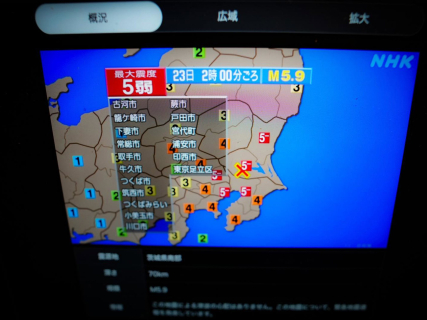

A preliminary magnitude 5.9 earthquake on the Richter scale struck early Sunday morning in eastern Japan, affecting mainly the Tokyo region and the neighboring prefectures. More than thirty people have been injured and disruptions have occurred in several railway services. The Japan Meteorological Agency (JMA) has ruled out the risk of a tsunami at all times.
So far, the number of injured stands at 37 spread across five prefectures: 15 in Tokyo, nine in Saitama, eight in Kanagawa, four in Chiba, and one in Ibaraki, according to data from regional officials and the Fire and Disaster Management Agency cited by the Japanese newspaper 'Yomiuri'.
The majority of the victims suffered injuries from falling to the ground or hitting furniture and doors. The tremor surprised many while they were sleeping, causing them to get up abruptly and, amid fear and confusion, end up suffering domestic accidents.
The earthquake was recorded around 2:00 a.m. (local time) on Sunday in the southern part of Ibaraki Prefecture, at a depth of about 68 kilometers. The movement reached a maximum intensity of 5 weak on the Japanese seismic scale, which consists of seven levels, in various points of Ibaraki, Saitama, and Chiba, as well as in some districts of the capital.
After the earthquake, several railway operators reported incidents. JR East and other companies have communicated delays in the start of operations on some lines while necessary safety inspections were completed.
Emergency services have also confirmed several additional injuries. Among them are a young man and a woman around 70 years old in Saitama Prefecture, north of Tokyo, while in Kawasaki, south of the capital, three people have also been injured, according to local firefighters.
In the Tokyo district of Koto, a main water pipe has broken. Metropolitan authorities have opened an investigation to determine if the damage is directly related to the tremor.
The maximum intensity of 5 weak has also been recorded in specific areas of Saitama and Chiba. In Tokyo, the Adachi district has reached that same level, while in other neighborhoods of the capital the shakes have been of lesser intensity.
The authorities have indicated that, so far, no problems have been detected in the nearby nuclear facilities. The operators of the Tokai number 2 plant, in Ibaraki, and of the Fukushima Daiichi and Fukushima Daini plants, in the northeast of the country, have not reported any anomalies linked to the earthquake.
In this context, the Japanese Prime Minister, Sanae Takaichi, has indicated that the Executive has activated the coordination mechanisms to assess possible damages and keep the public informed.
In a statement released immediately after the earthquake, she noted: "Today, around 02:00 (hours), an earthquake occurred with its epicenter in the south of Ibaraki Prefecture, and strong tremors were observed with a maximum intensity of 5 weak in the 23 districts of Tokyo, Ibaraki Prefecture, Saitama Prefecture, and Chiba Prefecture."
The Prime Minister has also assured that "there is no concern about tsunamis" and explained that, at that moment, there was no information about personal or housing damages, although emergency teams continued to verify the situation on the ground.
In the same vein, she indicated that the Executive established a contact room immediately after the earthquake at the Crisis Management Center of the official residence and revealed that the Government "set up a contact room at the Crisis Management Center of the official residence" immediately after the occurrence of the earthquake and I myself have given instructions to gather the damage situation, provide timely and accurate information to citizens, and take the corresponding measures."
State support to repair earthquake damages in Kumamoto
At the same time, the Japanese Government has announced that it will use public funds to cover part of the repair costs of private water wells damaged by the earthquake recorded in Kumamoto Prefecture, in the southwest of the country, as announced by Prime Minister Takaichi Sanae.
The measure seeks to alleviate the difficulties that many residents of the area continue to face more than three weeks after the tremor, due to persistent problems accessing drinking water supply.
Takaichi presented this proposal on Friday during a meeting of the committee in charge of coordinating the response to the disaster, in which the demands of the affected localities were reviewed.
Among the requests conveyed to the Executive are those related to the repair of wells in the city of Yatsushiro, used by the population both for water consumption and to meet other basic daily needs.
The Prime Minister has also requested the Minister of Land, Infrastructure, Transport and Tourism, Kaneko Yasushi, to ensure the availability of machinery and sufficient personnel to carry out the restoration works of the supply networks and the wells themselves.
In addition, Takaichi has demanded the preparation of a specific aid package and has assured that the Government will provide the necessary support to accelerate the recovery of the living conditions of the affected and facilitate that the population returns to normalcy as soon as possible.
In light of the possibility of new tremors, the Japan Meteorological Agency has urged citizens to remain alert in the coming days. The agency considers the interval of the next 48 to 72 hours to be especially critical and warns that another earthquake of similar magnitude could occur.
The tremor was felt over a wide area of the country, from northeastern regions to central Japan. The meteorological agency also activated the emergency earthquake alert system immediately after detecting the movement.