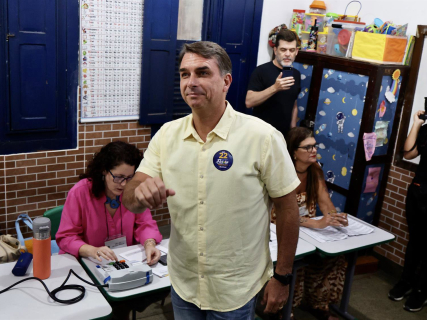

The far-right presidential candidate of Brazil, Flávio Bolsonaro, has communicated that he will not accept the result of the second round held this Sunday, in which the current head of state, Luiz Inácio Lula da Silva, has been reelected. Furthermore, he has announced that his party will demand the annulment of the elections due to the controversy generated by the extension of the voting hours.
In a public appearance after Lula's victory was confirmed with 51.79% of the votes against the 48.21% obtained by him, the leader of the Liberal Party (PL) has labeled what happened during the electoral day as "unacceptable." His reproaches are directed at the decision of the judge of the Federal Supreme Court, Cristiano Zanin, to extend the voting by two hours across the territory due to incidents recorded in public transportation.
Bolsonaro has blamed Zanin – whom he referred to as "Lula's former lawyer" – for altering "the rules of the game in the middle of the game" and for "trampling on specialized electoral justice" by issuing the resolution at 5:01 PM (local time), the moment when the closure of the polling stations was scheduled. "This has never happened in the history of Brazil, there was a total break of equality among Brazilians from various cities and states," the candidate criticized.
The conservative leader added that the interveners from his party were "removed from the safe room" (the center where the data is processed) since the measure was adopted. "It is impossible to recognize the election data in the context of how these things happened. We are going to undertake legal actions and request the annulment of these elections," Bolsonaro emphasized, calling on his supporters to "not give up."
The extension of the hours was ordered by the Supreme Court after complaints about the lack of transportation for voters, primarily at the request of Lula da Silva's campaign. However, Bolsonaro's candidacy had also previously requested a limited extension to five states (Sao Paulo, Santa Catarina, Paraná, Minas Gerais, and Rio Grande do Sul). Zanin's decision forced the initial count to be suspended and was adopted despite the express opposition of the Electoral Public Ministry.
The Electoral Justice admits technical problems but defends the counting
The president of the Superior Electoral Tribunal (TSE), Kassio Nunes Marques, has addressed the controversy and pointed out that, although the Constitution grants the tribunal exclusive competence over the organization of elections, the precautionary measure of the Supreme Court after the official closure "generated difficulties in the electoral process." Nunes Marques has emphasized that "never in the history of the TSE has there been any extension of this type" and has warned that any alteration of schedules "has to be thought out, calculated, and structured" due to its technological implications.
The magistrate has detailed in a public statement that the ruling was issued at 5:00 PM (local time), when "thousands of (electronic) ballot boxes in Brazil were already closed and their programming prevents reopening." To avoid irregularities and leaks, the TSE was forced to activate an urgent "block" in the system for receiving bulletins, so that no electoral justice official could access the content of the votes in advance. This decision resulted in an "extraordinary retention" of information on a national scale and in technical doubts about the capacity of the servers.
Despite the fact that the context was completely "unusual," the president of the TSE has assured that, thanks to the administrative and technical work of the agency, the problems were resolved and the flow of data was restored from 7:00 PM (local time) with guarantees. "There was no alteration resulting from the judicial decision (...) Therefore, we have absolute certainty of the entire electoral process," he has maintained.
With the aim of reinforcing the credibility of the result against the accusations of bolsonarism, Nunes Marques has offered operational figures. Of the 499,248 electronic ballot boxes used in this second round, only 1,551 had to be replaced, which amounts to 0.31% of the total. He has also highlighted the work of national and international observation missions, which had full access to the audit mechanisms and formally certified the "absence of external interference in the electoral process."
Highest participation since 2006
The Brazilian electoral authority has reported that participation in this second round was at 80.78%. Of the more than 158 million citizens called to vote (in a country where voting is mandatory), 128 million turned out, leaving abstention at 19.22%, a little over 30 million people.
With this data, the 2026 presidential elections become the most mobilized since 2006, when participation reached 83.25% in the first round and 81.01% in the second.
In those 2006 elections, precisely, Luiz Inácio Lula da Silva renewed the mandate obtained in 2002 by defeating Geraldo Alckmin at the polls, who today holds the Vice Presidency of Brazil.