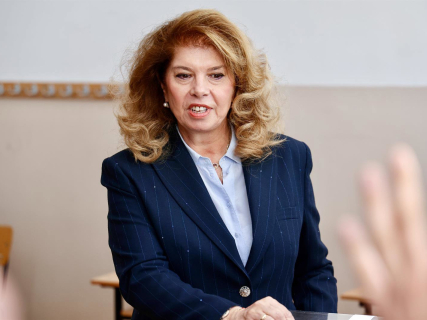

The president of Bulgaria, Iliana Iotova, has won the presidential elections held this Sunday by achieving 34.6% of the votes, a result insufficient to reach an absolute majority and which forces a second round against the pro-Western candidate Andrei Giurov, who has just over 32% of the votes, according to official data.
With 95.3% of the ballots already counted, the Central Electoral Commission (CIK, for its acronym in Bulgarian) places in third position the candidate of the nationalist and pro-Russian party Revival (Vazrazhdane), Kostadin Kostadinov, who obtains just over 12.6% of the support, after an intense campaign at the head of a formation integrated into the same political group in the European Parliament as the German far-right Alternative for Germany (AfD, for its acronym in German).
Further back is Radostin Petev, from the populist conservative Moral Party, Unity and Honor (PP MECh), who reaches 4.6% of the votes, while the rest of the candidates have fallen below the option "I do not support anyone," which has concentrated 4.4% of the ballots cast.
The distance between Iotova —backed by the ruling center-left party Bulgaria Progressive (PB)— and Giurov, an economist by profession, has been much closer than anticipated by previous polls, which granted the current head of state, in office since the resignation in January of now Prime Minister Rumen Radev, more than 40% of the votes, compared to just over 28% for her main opponent.
The final results will be known within a maximum of 48 hours from the closing of the polling stations, but if there are no significant changes, both candidates will face each other in a second round on November 1.
The question now is whether Giurov will manage to gain more support in this new encounter with the ballot boxes and, if so, to what extent. The 50-year-old candidate has the backing of the liberal-conservative opposition, favorable to reforms. It also remains to be determined the fate of the votes obtained by the candidates already excluded from the presidential race.
In any case, one of the most striking elements of the day has been the very low turnout, which has barely reached 22% of the nearly 6.5 million Bulgarian citizens eligible to vote to elect the head of state for the next five years, in elections where 27 candidates were running.
A president elected at the polls but with limited powers
Although the president of Bulgaria is elected by direct suffrage, his powers are relatively limited. Unlike the French model, the head of the Bulgarian State cannot dismiss the prime minister, although he holds the position of commander-in-chief of the Armed Forces.
From Sofia, the Presidency has the authority to grant or revoke Bulgarian citizenship and to appoint, at the proposal of the Government, the ambassadors and representatives of the country to international organizations.
The head of State also has the right of veto, which allows him to return to Parliament the approved bills. For this reason, according to the opposition, the president and the prime minister should not belong to the same political bloc.