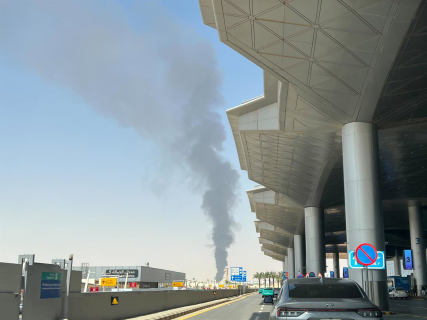

The Houthi rebels announced this Saturday that they have carried out attacks against the Saudi capital, Riyadh, as well as against facilities of Saudi Aramco, the largest oil company in the world and controlled by the Government of Saudi Arabia, located on the western coast of the country.
The military spokesman for the Houthis, Yahya Sari, detailed in a statement that they have executed "two successful military operations using a large number of ballistic and cruise missiles, as well as drones."
According to Sari, "The first targeted strategic points in the Saudi capital, Riyadh, and the second was directed against Aramco facilities in Yanbu," before emphasizing that in both actions there were "large fires."
The Houthis have not specified which infrastructures have been hit in Riyadh, although images and recordings have circulated on social media showing dense columns of black smoke rising in the vicinity of King Khalid International Airport in the Saudi capital.
The insurgency claims that these attacks are a retaliation for the accusations made this Wednesday, which attribute to them an attack against Mecca, something that Sari has described as a "great slander," as well as for the bombings against the areas under their control in Yemen.
In this regard, the spokesman has denounced that "The false propaganda spread by the media of the Saudi enemy, which claims that we attack civilians, is unfounded; such assertions are simply the result of failed interceptions by the enemy's defense systems," and has insisted that the Houthis will continue to respond "until the aggression ceases and the blockade on" Yemen is lifted.
Riyadh accuses the Houthis of "hostile and terrorist" behavior
Hours later, the military coalition led by Saudi Arabia, which supports the internationally recognized Yemeni government, reported that the Saudi air force "successfully intercepted and destroyed a ballistic missile launched by the Houthi terrorist militia against the city of Riyadh in the early morning of Saturday, September 19."
This was indicated by its spokesman, General Turki al Malki, in a statement in which he recalled that more than eight million people live in the capital, something that, in his opinion, "highlights the intransigence of the militia and its persistent, deliberate, and systematic attack against civilians and civilian targets, reflecting hostile and terrorist behavior."
The general has added that the Houthis have "attempted to attack civilians and civilian assets in the cities of Baish, Taif, Farasan, and Yanbu," although he has assured that all these attempts have been "frustrated" by the Saudi air defense systems.
Consequently, Al Malki has emphasized that the coalition reserves the right to adopt the measures it deems appropriate, based on International Humanitarian Law, in order to "deter the behavior of the Houthi terrorist militia."
In parallel, Saudi authorities issued several emergency alerts on Friday night in eight cities across the country, including Riyadh, due to the risk of new attacks from the Houthi militia, although hours later they declared those alerts to be over.