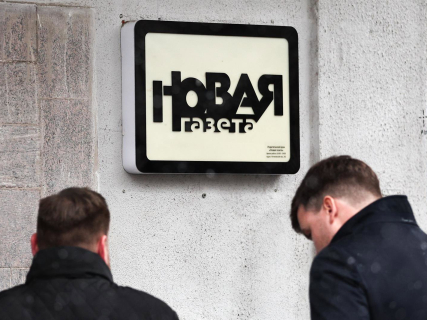

The Russian independent newspaper 'Novaya Gazeta', considered a pillar of critical journalism in Russia for more than thirty years, announced this Friday that it will completely cease its activity next November 9. The decision comes after years of pressure and measures against its staff by the Russian authorities, who at the beginning of September included it on the list of "foreign agents".
"They have killed us," begins the farewell statement issued by the newsroom, which directly holds the Russian Government and the Intelligence services responsible for its disappearance. "On November 9 we will turn off the lights in our house, where we have lived for 30 years, we will disconnect the servers and we will leave. The newspaper has disappeared. The Russian authorities and intelligence services have forced the editorial team to cease its operations," the text states.
The newspaper's management maintains that the closure is the result of a chain of actions aimed at making its continuity unviable: the withdrawal of publication licenses, the blocking of its digital platforms and the seizure of its printing press, in addition to various administrative procedures against its managers and the suppression of its sources of financing.
According to the team, at the same time they received the order to vacate their headquarters, the readers' donation system was disabled: "They have deprived us of any funds. Completely," the newsroom laments.
The outlet presents this set of actions as a "coordinated operation" and rejects the claim that the banks acted on their own. "They are external rules, established by the repressive state apparatus, by FSB (Federal Security Service) officials who have infiltrated all organizations," continues the statement, which accuses these officials of behaving as if they "considered the country their property".
'Novaya Gazeta' underscores the progressive deterioration of the conditions for practicing journalism since the start of the Russian invasion of Ukraine, in February 2022, and denounces the tightening of legislation, which has reinstated censorship and has restricted coverage of events linked to the war.
"We have been deprived of the opportunity to report on the most important and tragic events of our time," the statement notes, adding that the restrictions have ended up encompassing practically all areas of life.
Added to this is the cancellation of its registration as a media outlet, which prevents it from operating legally, and the persecution of its professionals. The newsroom notes that several journalists have had to leave Russia and that numerous employees and contributors have been included in the list of "foreign agents". In September, this designation was extended to the entire editorial staff and to more than a hundred journalists and authors linked to the newspaper.
The current situation is part of a long history of threats and reprisals against the outlet and its workers. Founded in 1993, the newspaper recalls in its farewell that it has lost six professionals killed for political reasons or for their reporting work.
'Novaya Gazeta' —whose editor-in-chief, Dmitri Muratov, received the Nobel Peace Prize in 2021 together with the Filipino journalist Maria Ressa for their defense of freedom of expression— had already suspended its publications in March 2022, after warnings from the authorities for not having registered in the foreign agents register.
After that, part of the team launched a new project in Europe. In 2023, the authorities classified the activities of 'Novaya Gazeta Europa' as undesirable in Russia and, that same year, included Muratov in the list of foreign agents, which led Sergei Sokolov to assume the direction of the newspaper.
UN reaction to the closure of Novaya Gazeta
The United Nations High Commissioner for Human Rights, Volker Turk, has expressed his deep rejection of what happened, which he considers a new example of the censorship exercised by the Kremlin.
"I am deeply concerned, and saddened, by the announcement today by the much-respected and fiercely independent newspaper 'Novaya Gazeta' that it is being forced to close," Turk stated, who denounced "another devastating blow to the independent media that still remain in the Russian Federation".
"Independent journalism in the country has faced growing restrictions and pressures for many years, but these have significantly intensified since Russia's full-scale invasion of Ukraine, through increasingly restrictive legislation, stricter state controls, and the harassment and persecution of journalists," he adds.
Turk calls on the Russian authorities "to stop applying measures that suppress information about serious issues of legitimate public interest" and to allow "a free and open debate with diverse voices, both in the media and in the public sphere, in accordance with international standards".
Condemnation by journalists' associations
The International Federation of Journalists (IFJ) and the European Federation of Journalists (EFJ) have denounced the closure of the 'Novaya Gazeta' newsroom in Moscow and have described it as "a profoundly sad day for Russia and independent journalism".
The IFJ maintains that what happened "represents one of the most shameful attacks against one of Russia's most respected independent media outlets" and has highlighted its track record, during which, despite the threats, assaults and murders of colleagues, "they have bravely demanded accountability from those who hold power".
In the same vein, the EFJ recalls that the professionals of 'Novaya Gazeta' "never abandoned their struggle to inform the public and hold power to account", and highlights the "extraordinary work" that the newspaper and its staff have carried out over three decades "in almost unimaginable conditions".
Both organizations firmly condemn the Government of President Vladimir Putin's "continuous intimidation" against independent voices and underline that democracy needs these media so that the powerful are held accountable. "This is precisely what 'Novaya Gazeta' has always done", they conclude.