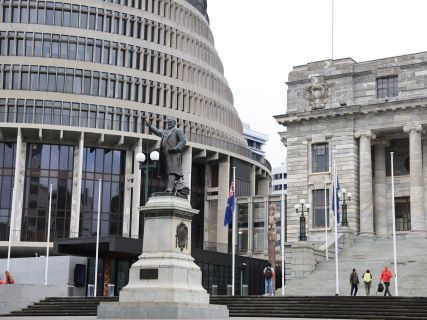

The National Party of the current New Zealand prime minister, Christopher Luxon, has prevailed in the legislative elections held this Sunday, with it being confirmed that it could achieve a slim parliamentary majority if it manages once again to secure the support of its two partners, Association of Consumers and Taxpayers (ACT) and New Zealand First (NZP).
In detail, the National Party has obtained 29.2% of the vote and 42 seats in the New Zealand House of Representatives, which is made up of 132 seats. ACT adds 10.9% and 13 members, and NZP reaches 9.8% and 12 representatives, so the three parties would add up to 67 seats, which would give them an absolute majority.
In the progressive bloc, the Labour Party of the former prime minister Chris Hipkins stands as the second force with 29.4% of the votes and 36 seats. Next come the Green Party, with 13.3% and 16 MPs, the Opportunity Party, which obtains 6% and 7 representatives, and the Māori Party Te Pati Maori, which enters with 0.6% and 5 seats.
"National is again the biggest party in Parliament and we have a path to form the next government, but I have to tell you right now that it’s too tight," Luxon said in his first remarks after the final count became known.
The conservative leader has also expressed the "incredible honor" that it represents for him to receive the backing received at the polls. "A lot of energy has come to me," he said.
For his part, the Labour leader, Chris Hipkins, admitted that "we may take a bit longer to know exactly" the final outcome. "Every vote counts and they have to all be counted," he emphasized, before calling on all political forces "to work together and seek common ground."
The counting of these general elections is also marked by the so-called 'overhang' or surplus representation, a peculiarity of New Zealand’s mixed-member proportional system that can raise the usual 120 MPs up to 131, setting the absolute majority at 66 seats.
In this scenario, National and Te Pati Maori could win more seats by constituencies than they would strictly be entitled to based on their vote percentage in the national lists.
In the case of the conservatives, the first projections left out veteran figures such as the Finance Minister, Nicola Willis, and the President of Parliament, Gerry Brownlee.
The Greens denounce "manipulation of the system"
Within the progressive bloc, the co-leader of Los Verdes, Chloe Swarbrick, has denounced that "the system has been manipulated" and has called for opening a constitutional debate on how New Zealand's democracy works.
Although she has admitted that her party starts from a complicated position in order to form a government, she has stressed that "it is too early to sing victory," noting that special votes still need to be counted.
Swarbrick has also criticized the changes promoted by Luxon's Executive in the electoral enrolment rules, stating that some people encountered obstacles to registering and exercising their right to vote. She has further said that the Government "lied" about the reasons for these changes and that uncertainty and legal reforms have conditioned the outcome of the elections.
From the green formation, they have claimed their work during the campaign and have taken aim at the outgoing Executive's management. "New Zealanders deserve something better," they concluded, calling for a policy capable of overcoming divisions.
The electoral contest represents a challenge for Luxon, whose party has not managed to fully convince citizens of its ability to ease the cost of living and energize the economy. In turn, Chris Hipkins's Labour Party also has not managed to shape an alternative solid enough, while part of the vote has shifted to minor forces.