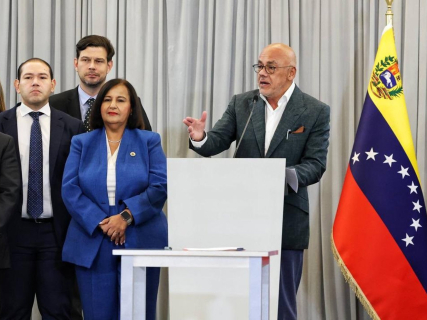

The delegations of the Government of Venezuela and the National Assembly (AN) elected in 2015 announced this Wednesday the conclusion of the third cycle of negotiations to advance in the stabilization and democratic opening of the country, closing key commitments that encompass the review of political disqualifications and the establishment of a joint commission to manage the recovery of the gold held at the Bank of England.
In a joint statement read by the chief negotiators, Jorge Rodríguez, representing the Executive, and Dinorah Figuera, for the AN of 2015, both parties presented the agreements reached after six days of work held in Caracas.
On the political front, the central point of the understanding is the commitment to "initiate a process of deep review" of various legal instruments in order to strengthen democratic coexistence. Among these texts is the Organic Law of the General Comptroller of the Republic, which has been agreed to specifically review "what is inherent to the process of disqualifications" that has prevented numerous opposition leaders from running for elections. It has also been agreed to open the debate on the Political Parties Law to ensure pluralism, as well as on the classification of the crime of terrorism in the current regulations.
Likewise, the delegations have communicated the start of discussions for the creation of a "Defender of political guarantees and citizen participation," conceived as a mechanism for the protection of political rights, which could be realized through a new law or as a direct result of the dialogue table itself.
In the economic and humanitarian sphere, the Government and the opposition have decided to establish a "parity delegation" that will manage before the authorities of the United Kingdom the "necessity and urgency" of recovering the Venezuelan gold reserves deposited at the Bank of England. The purpose, according to the document, is to allocate those resources to "address the needs of the population affected by the double earthquake" that shook La Guaira and areas near Caracas last June, in addition to contributing to the recovery of the deteriorated public services of the country.
On this matter, Figuera defended in a press conference the role of the AN of 2015 in the protection of those assets against the Government of former president Nicolás Maduro, and celebrated that gold "is worth double today." The opposition representative confirmed that the commission will be made up of three emissaries from the interim Government (headed by Delcy Rodríguez) and three from the Assembly, with the aim of facilitating the arrival of funds and offering a "social and livability response" to the most vulnerable sectors.
Electoral debate and control of oil revenues
During her intervention, Figuera was asked about the electoral calendar and the recent speculations suggesting that the presidential elections could be postponed until 2027 or early 2028. The negotiator specified that the setting of the date is the exclusive competence of the National Electoral Council (CNE), although she insisted that "the political will" is for the country to resume electoral normality once the process of reinstitutionalization of public powers is completed. "Adjacent announcements that create uncertainty do little service to the political will that both parties have," she concluded.
For his part, Jorge Rodríguez responded emphatically to the versions that indicate that the United States controls Venezuelan oil revenues. "Of course Venezuela controls everything related to the resources it obtains from the sale of oil to all countries in the world," he stated, attributing that information to the campaign climate in the United States ahead of the upcoming midterm elections, scheduled for November 3.
The Government representative also claimed the recent signing of "the most important oil agreement that has been signed in the last 100 years," an understanding that, in his opinion, benefits both Washington and Caracas and guarantees resources to meet the needs of the Venezuelan population.
The next cycle of conversations, which has the explicit backing of the U.S. Administration of Donald Trump, is scheduled to take place between November 11 and 15.
In parallel, the Venezuelan opposition leader and Nobel Peace Prize winner, María Corina Machado, denounced a few days ago that the U.S. Administration has not included her in these political conversations held this week in Caracas. Machado thus emphasized the distancing from the White House after months in which Washington has kept her on the sidelines to favor the continuity of the acting president, Delcy Rodríguez, after the capture of Nicolás Maduro last January.