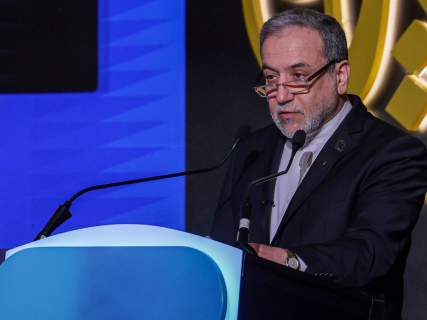

The Iranian Foreign Minister, Abbas Araqchi, lashed out this Thursday against France, which he accuses of "obvious hypocrisy" for "giving lessons to the world about Human Rights" while, he claims, "supporting Israel's genocide in Gaza" and "the aggression" against Tehran. His words come after the Élysée joined, through a joint statement, about thirty countries that have condemned the executions of protesters and opponents in the Persian country.
"Countries like France should stop giving lessons to the world about 'Human Rights' and International Law. The hypocrisy is flagrant and shameful," the Iranian official wrote in a message on social media in which he stated that France's "support" for "Israel's genocide in Gaza" and "for the aggression against Iran" has "destroyed any moral superiority" they claim to have.
Araqchi's statements were known hours after the High Representative of the European Union for Foreign Affairs, Kaja Kallas, along with nearly thirty States --including Spain, France, the United Kingdom, Sweden, and New Zealand-- expressed their rejection "with the utmost firmness" of the "continuous executions of protesters and the use of the death penalty" by Iran.
"The use of the death penalty to silence dissenters, intimidate communities, and punish those exercising their fundamental rights cannot be justified under any circumstances," reads the text disseminated by the French Foreign Ministry, which emphasizes the importance of the Iranian people being "free to exercise their rights to freedom of expression and peaceful assembly without any fear."
In the same vein, the signatory countries of the declaration urge the Islamic Republic to put an end "immediately" to the "use of the death penalty," to release "all arbitrarily detained persons," and to heed "the voice of its people" which, the document argues, "demands change."
Specifically, the text is supported by France, Canada, Albania, Germany, Australia, Austria, Belgium, Cyprus, Denmark, Spain, Estonia, Finland, Iceland, Latvia, Lithuania, North Macedonia, Montenegro, New Zealand, the Netherlands, Portugal, the Czech Republic, Romania, Slovakia, Slovenia, Sweden, and the United Kingdom, in addition to Kallas herself.
In parallel, the French Foreign Minister, Jean-Noël Barrot, denounced on social media that the "unbearable and inhumane repression" that, he emphasized, is being carried out by Iran against its own population "must cease."
"Seven months after the mass crimes committed against the Iranian people, who rose up to demand justice and dignity, the regime continues to spill blood by multiplying executions," Barrot pointed out, advocating for those responsible to be held accountable and for political prisoners to be released.
The head of French diplomacy was referring to the executions of Iranian citizens accused of alleged crimes linked to the anti-government protests recorded in Iran between late December and early January.
According to data released by the Iranian leadership, during those dates 3,117 people died, mostly civilians and members of the security forces. However, the NGO Human Rights Activist in Iran, based in the United States, raises the death toll to more than 7,000.