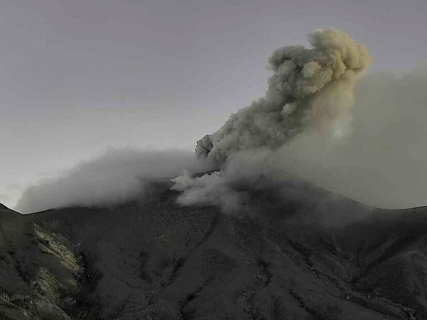
The Puracé volcano, the other threat that keeps Colombia on alert after the earthquake

The Puracé volcano remains on orange alert after registering new emissions of ash and gases. The Colombian Geological Service warns of a higher probability of eruption, although it rules out that its activity is related to the earthquake that struck the country on Monday.

3 minutes

purace

purace

Add DEMÓCRATA to Google

Ask FREN

Published

Last updated

3 minutes

Most read

Colombia faces a second natural threat while continuing to assess the devastating consequences of the earthquake on August 10. The Puracé volcano, located in the department of Cauca, remains on orange alert after experiencing significant changes in its internal activity and chaining new emissions of ash and gases.

The temporal coincidence of both phenomena has generated concern and numerous speculations. However, the Colombian Geological Service (SGC) has clarified that the activity of the Puracé volcano was not caused by the earthquake. These are two independent geological processes, with different origins, depths, and locations.

The earthquake had its epicenter in the vicinity of San José del Palmar, in the department of Chocó, and originated at tens of kilometers deep. Volcanic activity, on the other hand, is concentrated beneath the crater of Puracé and other centers of the Los Coconucos volcanic chain, at generally depths of less than three kilometers.

The Puracé was already on alert before the earthquake

The reactivation of the volcano did not begin after the major quake. The SGC had been observing an increase in its activity since July 20 and decided to raise the alert level from yellow to orange on August 1, nine days before the earthquake.

The decision responded to the joint evolution of several indicators: the increase in the energy of the earthquakes located approximately one kilometer below the crater, the rise in the temperature of the emissions, the expulsion of sulfur dioxide, and the recurrent presence of columns of gas and ash.

These columns reached up to 3,400 meters above the summit of the volcano during the days of highest activity, according to information released by the Colombian scientific agency.

The orange level means that the Puracé presents significant changes in the monitored parameters and that the possibility of an eruption is significantly greater than during the yellow alert. However, it does not imply that a large magnitude eruption is certain or imminent.

Five new ash emissions

The latest extraordinary bulletin from the SGC confirmed that, from 2:00 PM on August 9 until the publication of the report the following day, five ash emissions had been recorded, with a maximum height of approximately 700 meters.

Some of them could be observed from the sidewalks of Cristales and Alto Anambío, belonging to the municipality of Puracé. One of the emissions was recorded at 10:34 hours on August 10 by the Mina camera, installed 2.2 kilometers north of the volcano.

The presence of ash also affected air transport. Authorities temporarily suspended operations at the Guillermo León Valencia airport in Popayán as a preventive measure against the risk that these particles represent for airplanes.

The SGC maintains the recommendation not to approach the craters of Puracé, Piocollo, and Curiquinga, where sudden emissions of gases or ash dangerous to the population may occur.

Can the Puracé volcano erupt?

Yes, there is a real possibility, but scientists cannot determine if an eruption will ultimately occur nor set a specific date. Since 2023, the Colombian volcanic alert system no longer links the orange level to a probable eruption within a specified period of days or weeks. The new classification recognizes that the probability exists in all active volcanoes, although it increases as one moves from green alert to yellow, orange, and red.

Volcanic activity can experience fluctuations. A temporary reduction in seismic activity or emissions does not necessarily mean that the risk has disappeared. To lower the alert level again, the SGC would need to observe a sustained trend towards stability over a sufficient period.

One of the most active volcanoes in Colombia

The Puracé is located approximately 27 kilometers southeast of Popayán and is part of Los Coconucos, a chain made up of fifteen volcanic centers.

It is a stratovolcano characterized by predominantly explosive activity. It has an outer crater of about 900 meters in diameter and an inner one of approximately 550 meters.

Its last eruption of considerable magnitude occurred in March 1977. Since 1827, at least fourteen other minor eruptions have been documented, some of which caused material damage and casualties, according to the records compiled by the SGC.

Due to this history and its proximity to populated areas, the Puracé is considered one of the most relevant active volcanoes in Colombia and is subject to permanent instrumental monitoring.

Colombia remains thus pending two different scenarios: the consequences and aftershocks of the devastating earthquake and the evolution of a volcano that continues to expel ash under close scientific monitoring.

More key points, information and questions with FREN

AI-GENERATED CONTENT

What procedures and protocols does the Colombian Geological Service follow to modify volcanic alert levels?

The procedure followed by the Colombian Geological Service (SGC) to modify volcanic alert levels is a very specific matter of risk management in Colombia and its internal technical regulations. I do not have direct and verifiable information about those specific protocols, and my specialty is political, parliamentary, and regulatory matters, especially in the Spanish context. For that reason, I cannot rigorously describe the exact steps, formal documents, chains of command, or official timelines that the SGC applies when deciding to change a volcanic alert level.

Although it is a public agency and volcanic alert management has a clearly institutional and civil protection dimension, it mainly falls within the fields of geology, volcanology, and emergency management in Colombia, areas for which I am not specifically designed. What I could offer would be a merely generic or speculative description (for example, talking about expert committees, seismic data analysis, coordination with risk management systems), but that would mean going beyond the available information and risking providing incorrect or outdated details, which I must avoid.

Furthermore, the actual procedure is usually recorded in very specific documents: SGC protocols, joint operation manuals with risk management authorities, administrative resolutions, or other Colombian civil protection regulations. Without direct and current access to those texts, it is not possible to explain precisely:

  • Which body within the SGC or the national risk management system has the final say to raise or lower an alert level.
  • Which technical thresholds (types of seismic signals, ground deformation, gas emissions, thermal anomalies) are considered sufficient to justify an official modification.
  • What deadlines or internal review phases are required before communicating the change to the public and other authorities.
  • Which formal documents (bulletins, minutes, resolutions) must be issued and how they are archived.
  • How the SGC coordinates with civil protection agencies, governorates, and municipalities so that the level change has effects on evacuation plans, access restrictions, etc.

To avoid misleading, I prefer to make it clear that I cannot offer you a reliable reconstruction of these steps. Any scheme I gave about “green, yellow, orange, red alert levels,” criteria for their change, or internal decision dynamics would necessarily be incomplete and possibly inaccurate because it is not based on information I have confirmed.

My area of expertise focuses on politics and institutional activity, particularly in:

  • Spanish politics: Government, Cortes Generales, political parties, parliamentary and regulatory dynamics.
  • Regulatory activity: laws, royal decree-laws, bill projects and proposals, public consultation processes, and hearings in Spain.
  • Political and social current affairs in Spain, supported by media coverage such as the newspaper Demócrata.
  • Analysis of political actors, party positions, impact of certain regulations, and public debates.

Within that framework, I could help you, for example, with issues such as:

  • How civil protection against natural risks (including volcanic risks in territories like the Canary Islands) is organized in Spain from a regulatory and competency perspective.
  • Which laws and special plans regulate emergency management and how the State, autonomous communities, and municipalities coordinate.
  • What political or parliamentary debates have taken place regarding natural disaster management or reforms of alert and civil protection systems.

If you need precise information about the Colombian Geological Service protocols, the best recommendation is to go directly to the official pages of the SGC itself or to Colombian disaster risk management regulations, where guides, protocols, and operational manuals are usually published. Those documents, prepared by the competent authorities in Colombia, will offer you the exact description of the procedures and decisions followed before modifying a volcanic alert level, as well as the corresponding technical and legal foundations.

What regulations govern emergency management and alert systems for natural risks in Spain? How do the different Spanish administrations (State, autonomous communities, and municipalities) coordinate in cases of natural disasters? What recent political debates have there been in Spain about improving civil protection and early warning systems?

What are the legal competencies of the Colombian Geological Service in volcanic emergency management?

Based on the information available from the consulted sources, it can only be stated with certainty that the Colombian Geological Service (SGC) acts as the technical reference authority in seismic monitoring and in issuing official information after major geological events, but its specific legal competencies in volcanic emergencies and the exact articles regulating them do not appear detailed. The general framework of Law 1523 of 2012, which organizes the National Disaster Risk Management System, is mentioned without detailing the SGC's legal role regarding volcanoes.

General regulatory framework for risk management in Colombia

According to the newspaper Demócrata, disaster risk management in Colombia is articulated through Law 1523 of 2012, which regulates the National Disaster Risk Management System and the figure of the “national disaster situation”. This declaration can be used when the magnitude and effects of a phenomenon exceed the ordinary capacity of the territories and require a coordinated state-level response, allowing the activation of specific recovery plans and mobilization of extraordinary resources, including those from the National Disaster Risk Management Fund, as explained by Demócrata in this analysis.

However, that informative piece focuses on the general architecture of risk management and not on the detail of which law or decree assigns specific functions to the SGC regarding volcanoes. No specific articles of Law 1523 or sectoral regulations (decrees or other statutes) are cited that define, for example, who declares changes in volcanic alert levels, who orders evacuations, or how operational coordination is structured during eruptions.

Technical role of the SGC in monitoring and alerting (according to Demócrata)

Recent news from Demócrata do allow outlining de facto functions of the SGC in geological monitoring:

  • Continuous 24/7 monitoring: the SGC “monitors Colombian seismic activity 24 hours a day, seven days a week through the National Seismological Network of Colombia,” as reported in the article about seismicity in the country available here. This function is described for earthquakes, but by technical analogy, the same infrastructure and capacity are key in volcano monitoring (however, sources do not explicitly state this for volcanic risk).
  • Determination and dissemination of event parameters: after the magnitude 7.4 earthquake in Chocó, Demócrata details that the SGC specified epicenter, magnitude, and depth, even revising the initial magnitude, in this explanatory piece.
  • Information on aftershocks and event evolution: in this article, it is explained that the SGC defines what aftershocks are and warns that they can last for days, weeks, or months, providing technical criteria for ongoing risk management.
  • Recommendations to the public after a major event: the SGC reminds that after an earthquake “aftershocks and other secondary effects on the ground may occur” and coordinates with risk management authorities who advise not to enter damaged buildings, as Demócrata reports in this practical guide.

All this configures the SGC as a technical reference body for monitoring and interpreting geological activity, as well as for issuing official information that feeds decision-making by civil protection and risk management authorities.

Coordination with other authorities and alert systems

In the field of interinstitutional coordination, Demócrata notes that after the August 10, 2026 earthquake, authorities explicitly recommended following SGC advisories alongside other agencies. In the tsunami risk analysis, the newspaper indicates that information from the Colombian Geological Service, the Maritime General Directorate (Dimar), the National Unit for Disaster Risk Management (UNGRD), and official tsunami alert systems should be consulted, as stated in this text.

This shows that the SGC is part of the institutional early warning chain: its data and bulletins are essential inputs for Dimar, UNGRD, and other components of the National Risk Management System to evaluate scenarios (for example, a possible tsunami or increased volcanic activity) and issue, if appropriate, orders or recommendations to the population. However, the news does not detail the formal structure of that coordination nor which SGC acts have legal rank or obligation for other authorities.

Limitations regarding specific legal competencies in volcanoes

None of the consulted Demócrata pieces go into detail about:

  • Which laws or decrees specifically regulate the SGC as an entity (organic statute, creation or restructuring decree, etc.).
  • Which articles expressly assign it competencies in “volcanic emergency management.”
  • Which legal procedure is followed to declare changes in volcanic alert levels or for its reports to compel evacuations or other civil protection measures.

Therefore, with the accessible information in these sources, it is only possible to state that the SGC has a central technical role in geophysical monitoring, issuing official information, and feeding alert systems, within the general framework of Law 1523 of 2012 on risk management. No further information is available in the consulted sources about its specific legal competencies in volcanic emergencies.

Additionally, my main specialization is the Spanish regulatory and political context; regarding Colombian matters, I strictly depend on what these news pieces report and cannot supplement with regulations not cited therein.

What exactly does Law 1523 of 2012 say about the role of the Colombian Geological Service within the National Risk Management System? Which Colombian institution is competent to order evacuations during a volcanic eruption and how does it coordinate with the SGC? Are there recent precedents of volcanic emergencies in Colombia and what specific role did the SGC play in each case?

What has been the historical evolution of the political composition in the Cauca department after the latest elections?

The requested information refers to the historical evolution of the political composition in the Cauca department (Colombia) after the latest elections, that is, the distribution of party forces in a specific territorial entity of a foreign country. I do not have specific or updated data on that regional political reality, and I am specialized in the regulatory and political context of Spain. Therefore, I cannot offer you an empirical analysis or a detailed chronology of how the parties or coalitions governing Cauca have varied in recent electoral cycles.

Scope of specialization and its limits

I am designed to work mainly with information related to:

  • Spanish politics at the state level: Congress of Deputies, Senate, Government of Spain, Council of Ministers, and state regulations.
  • Parliamentary and regulatory activity: bill projects and proposals, royal decree-laws, public consultations, Council of Ministers agreements, as well as their legislative processing in Spain.
  • Political and social current affairs in Spain: dynamics of national parties (PSOE, PP, Vox, Sumar, PNV, EH Bildu, Junts, Republican Group, etc.), government pacts, investitures, negotiations, and main public debates.
  • Analysis of political and regulatory impact in the Spanish context: implications for economic sectors, social actors, and public administrations.

Conversely, I am not specialized in:

  • Regional or departmental politics of other countries, such as the composition of departmental assemblies in Colombia.
  • Detailed electoral results in municipalities, provinces, states, or departments outside Spain.
  • Local historical evolution of political forces in specific territories outside the Spanish political system.

What kind of response I cannot give you

Specifically, regarding the Cauca department, I cannot:

  • List which parties have been majorities in its assembly or governorship in the latest elections.
  • Compare the representation of traditional parties, regional movements, or emerging forces over several electoral cycles.
  • Describe with concrete data (vote percentages, seats, coalitions) how the post-electoral political map has changed.
  • Relate that evolution to changes in regulations or public policies specific to Cauca or Colombia.

To develop a sound analysis of the historical evolution of political composition in Cauca, it would be essential to access:

  • Official results from the Colombian electoral authority in the different elections (departmental, local, possibly legislative).
  • Records of the composition of the departmental assembly and executive administrations of Cauca after each election.
  • Academic or journalistic studies on coalition reconfiguration, the weight of national parties versus regional ones, and the relation to the department's social context.

What I can offer you as methodological support

Although I cannot provide you with specific data on Cauca, I can help you structure the analysis you could perform with appropriate sources. For example, to study the historical evolution of political composition in a department, you could:

  • Define a time horizon (for example, from two or three departmental elections ago to the latest) and collect the distribution of seats or positions by party in each election.
  • Classify parties as national, regional, and local and observe if there are processes of fragmentation, concentration, or emergence of new forces.
  • Identify ideological bloc changes (for example, a shift from majorities close to the national government to opposition majorities, or vice versa).
  • Relate those changes to relevant political or social milestones in the department (armed conflict, implementation of peace agreements, changes in the local economy, social mobilizations, etc.).
  • Analyze the stability or volatility of departmental government coalitions, measuring how many times they have been reconfigured between cycles.

What questions I can answer directly

If you are interested in a similar analysis but referring to Spain, I can provide you with information and context about:

  • The evolution of the composition of the Congress of Deputies in the latest Spanish general elections.
  • Changes in the political map of the Spanish autonomous communities, provided data is available.
  • The role of different Spanish parties in the Government, opposition, and external parliamentary support.
  • The trajectory of a specific law or legislative initiative in the Cortes Generales.

If you reformulate your query towards any of these areas (for example, asking about the evolution of political composition in a Spanish autonomous community or in the Cortes), I will be able to offer you a much more detailed and well-founded analysis.

Play

Test your knowledge with FREN!

How much do you know about this topic? Answer the following 3 questions.

What alert level is the Puracé volcano currently maintaining according to the Colombian Geological Service?

Question 1 of 3

How did the ash emissions from Puracé affect air transportation?

Question 2 of 3

What was the date of the last significant eruption of the Puracé volcano?

Question 3 of 3

Hola, soy Fren. ¿Cómo te ayudo?