
High representatives from Iran, Saudi Arabia, Turkey, and Pakistan have agreed this Monday to open a permanent dialogue channel to "strengthen cooperation" in security matters, with the aim of reducing regional tension amid the 'impasse' of the war launched by the United States and Israel last February.
According to a joint statement released after the meeting, "the participants agreed to continue discussions to strengthen cooperation among the four countries in the region, including in the area of peace and security in the region."
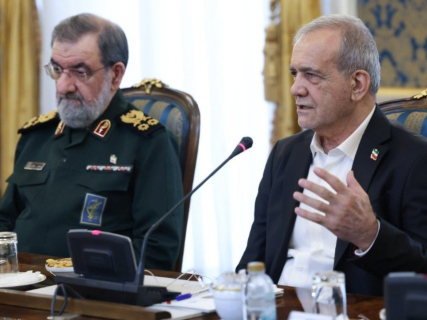
The meeting, held in Tehran, marked the first gathering between Iran and the members of the so-called Mecca Pact, the defensive alliance formed by Pakistan, Saudi Arabia, and Turkey. The host country was represented by the president, Masud Pezeshkian, and the secretary of the National Security Council, Mohsen Rezaei.
During his speech, the Iranian president defended the need to promote regional cooperation and emphasized that the Islamic Republic "is willing to take steps to deepen" such cooperation, in order to "resolve differences and leverage the common capabilities of Islamic countries, and to support any understanding that leads to strengthening unity, cohesion, security, and development in the region."
Pezeshkian insisted on the importance of "the unity and cohesion of the Islamic world" and criticized the "violent acts and widespread crimes" of Israel and the United States in the region. "These actions lack legal, human, or rational justification, and make more evident than ever the need for Islamic countries to adopt a common approach to confront aggression and insecurity," he pointed out.
In this regard, he urged Muslim countries to reach "a common understanding of their goals, outline a clear vision, and continue the implementation of agreements with mutual commitment until the expected results are achieved," demanding "tangible results and generating a true transformation in regional relations."
In the face of the military offensive, the head of the Iranian state emphasized that "unity and internal cohesion" have been strengthened and that national "solidarity" has grown. "The people of our country, despite the losses and difficulties suffered, defended their land with strength and firmness. The idea that the Iranian nation can be forced to surrender is false and unfounded," he indicated.
Pezeshkian has also warned that Washington and Tel Aviv are trying to "create a division between Muslim nations and gradually weaken the main Islamic countries," so he has argued that the response must involve intensifying cooperation and mutual support among them.
In the Saudi delegation, the presence of the Minister of Defense, Khalid bin Salman, has stood out; from Pakistan, the Chief of the Armed Forces, Asim Munir, has attended, while Turkey has been represented by the head of Intelligence, Ibrahim Kalin.
This meeting represents the first initiative of this kind promoted by the Mecca group to alleviate regional tensions and marks, in the case of Saudi Arabia, the first visit of a high-ranking official to Iran since the outbreak of the war launched by Donald Trump and Benjamin Netanyahu.