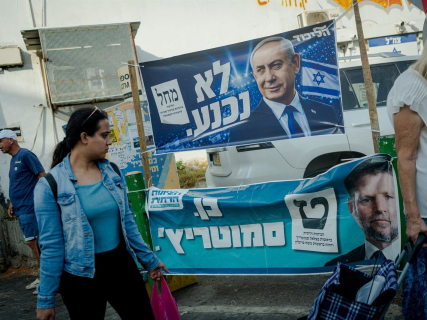

More than 7.3 million Israeli citizens are called to the polls this Tuesday in an election in which Prime Minister Benjamin Netanyahu is risking his position after four years in office, marked by the terrorist attack by Hamas on October 7, 2023. On the other side is a diverse bloc of forces led by former Chief of Staff Gadi Eisenkot, determined to oust him from power and put an end to the most right-leaning government since the founding of the State in 1948.
Netanyahu aims to renew his mandate despite a significant part of society considering him the main responsible for what happened on 7-O, even more so after reports from several media in recent weeks suggesting that he was warned in advance that Hamas was planning an attack and did not act to prevent it. Also weighing against him are the democratic deterioration of recent years, the wear on Israel's international image, and the pending corruption trial.
His main strategy is to reestablish the current coalition with his ultranationalist allies Itamar Ben Gvir and Bezalel Smotrich, as well as the ultra-Orthodox parties Shas and United Torah Judaism, and even incorporate some other far-right formation to reach the 61 seats that mark the majority in the Knesset.
"It is important for the State of Israel that we win," says Amichai Chikli, Minister for the Diaspora and member of Likud, who claims that the Prime Minister has demonstrated "true leadership" and "guts," in contrast to opposition leaders who, in his opinion, were willing to surrender to Hamas and opposed attacking Hezbollah in Lebanon or Iran.
In a meeting with journalists organized by Fuente Latina, Chikli acknowledges that he does not have "a crystal ball" to anticipate the outcome, but he is confident in a favorable outcome. "In many elections, we have seen surprises, some good and some bad," he recalls.
Opposing Netanyahu is Eisenkot, Chief of Staff from 2015 to 2019 and now leader of the center-right party Yashar (Straight). The former military has managed to gather around him a broad front united mainly by their rejection of Netanyahu, the leader who has held the position of head of government in Israel the longest.
In this opposition block, the B'Yachad alliance (Together, center-right) is also integrated, formed by Naftali Bennett and Yair Lapid, who already held the head of Government in the so-called 'change government' of 2021; The Democrats, the result of the union of the historic Labor Party and Meretz (left); as well as the secular right-wing party Yisrael Beitenu, led by Avigdor Lieberman, former Foreign Minister with Netanyahu himself.
"Either the country continues to be led by Netanyahu, with the dangerous path he has taken and that does not represent the spirit of Israel, or we win and bring the change that is needed," summarizes Lianne Pollack-David, candidate of the Eisenkot list, who declares herself confident in victory due to the forecast of high participation and the support of the young vote that is coming to the polls for the first time.
The polls indicate an advantage for the opposition
The polls do not yet depict a clear picture of the composition of the Knesset after the electoral date of October 28. In recent days, Yashar would have surpassed Likud and Eisenkot appears to be better rated than Netanyahu as prime minister, but neither of the two blocks would reach the 61 seats necessary on their own, although the opposition seems to have more avenues to achieve it.
The key could be in the hands of the two Arab-Israeli parties: the Joint List —which groups Hadash, Taal, and Balad— and the United Arab List, which already participated in the coalition led by Bennett and Lapid in 2021. The first formation shows a willingness to offer external support, while the second, more pragmatic in nature, does not rule out re-entering the Government, although imposing conditions.
The obstacle is that Eisenkot has made it clear that he does not want the support of the Arab-Israeli parties, possibly influenced by the demonization campaign driven by Netanyahu and by the bad image that these parties have carried since the Hamas attack. Among his partners, there is also no special enthusiasm for that support, not even external, with the exception of The Democrats, who are more open to collaborating with the United Arab List.
Netanyahu, for his part, could only add the four seats that the polls attribute to the People of Israel party (right), led by General Ofer Winter, as long as it surpasses the threshold of 3.25% of the votes, something that is not guaranteed. For this reason, the prime minister has publicly urged this formation to withdraw, without success.
Scenarios of agreements and minority government
In a political board as changing as the Israeli one, where parties and coalitions reconfigure every few years, the possibility that alliances break at the moment of the investiture vote in the Knesset is also contemplated.
Eisenkot himself has suggested that, if he does not reach 61 seats, he will ask for the support of Likud and the rest of the Zionist parties, and he has not ruled out a "strategic abstention" by some of the ultra-Orthodox formations.
However, Pollack-David clarifies that none of the ultra-Orthodox parties support the principles that articulate the opposition block, among them the obligation of military service. "As long as that is the case, they will not be able to be part of the Government," he emphasizes.
From Together, they insist that they are working to avoid having to "look at either of the two extremes," neither towards the Arab-Israeli parties nor towards the ultra-Orthodox. Former minister Eitan Ginzburg, a candidate for the Knesset, proposes a third way, according to which "a part of Likud says it does not want more Netanyahu" and joins the opposition, although he avoids specifying. "We will have to go case by case," he states at another meeting organized by Fuente Latina.
In reality, the leader of Yashar only needs a simple majority —more votes in favor than against— to advance a minority Executive, presumably fragile. Even so, it would allow him to gain political margin and consolidate his figure, after having lost one of his sons in the first days of the offensive against Gaza after 7-O, before facing possible new elections.
Debate on a possible unity government
To avoid a scenario of blockage in the absence of a clear winner, in the final stretch of the campaign, voices have emerged calling for a unity government between Netanyahu and Eisenkot as a way out for a deeply polarized country.
"I unequivocally promise that I will not serve under Netanyahu in a rotation agreement, period," he declared last week on a radio station, ruling out repeating a similar model to that of Bennet and Lapid with "Bibi" inside, although without closing the door to an understanding with Likud.
The idea, however, does not convince the majority of the population. According to a survey published on Friday by the Israel Democracy Institute, the preferred option for citizens is to return to the polls rather than a unity Executive or a minority government.
According to this poll, 35% of Jews and 46% of Arabs lean towards repeating elections, compared to 28% of Jews and 9% of Arabs who opt for a unity government with rotation in the leadership of the Executive, and 23% of Jews and 25% of Arabs who show support for a minority government.