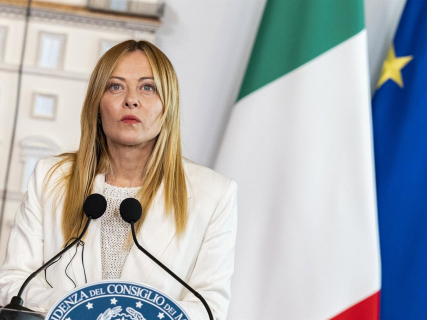

The Minister of Foreign Affairs of Italy, Antonio Tajani, has described the decision of the President of the Spanish Government, Pedro Sánchez, to reestablish border controls for travelers coming from Italy as “disproportionate.”
In an interview with the newspaper La Stampa, Tajani has described the Spanish measure as a “reprisal” for the Italian suspension of the Schengen agreement with Spain. The head of Italian diplomacy argues that Rome acted to protect its borders after the migratory crisis in Ceuta and in light of the possibility of a new attempt at mass entry from Morocco on August 15.
Italy keeps the date of August 15 on the radar
Tajani has explained that Italy expects to reverse its controls when “the danger” that, in his opinion, this possible second mass incursion in Ceuta represents ends.
The date of August 15 is circulating on social media as a possible new call to cross the border. The Spanish Government is aware of these messages, as pointed out last Thursday by the spokesperson of the Ceuta Government, Alejandro Ramírez, and Rome has incorporated them into its risk assessment.
Rome points to sub-Saharan migrants
The Italian minister has defended that the main risk for Italy does not come from Moroccan citizens who crossed into Ceuta, but from non-Moroccan people coming from sub-Saharan Africa.
According to Tajani, this group would likely have Italy as their destination, considering that Italy is the “most exposed” country. The minister has also added that these people “pose a jihadist threat,” a statement with which he justifies the enhanced surveillance and the decision to temporarily suspend the ordinary application of Schengen with Spain.
“Spain has not been as vigilant as it should be”
Tajani has insisted that Italy has acted at all times “in accordance with the treaties of the European Union” and has criticized the Spanish response.
In his opinion, Sánchez's policy of “everyone enters and regularizes” conveys “a negative message that puts the security of all at risk.” The Italian minister argues that this concern is shared by other European countries and has deemed the reaction of Spain “incomprehensible and totally unacceptable.”
Schengen, at the center of the diplomatic clash
The dispute between Madrid and Rome revolves around the space Schengen, the European system that allows free movement between member states but also contemplates the possibility of re-establishing temporary controls at internal borders in exceptional situations.
Italy activated controls on travelers coming from Spain after the massive entry in Ceuta. Spain responded this Saturday with border controls on passengers arriving from Italy, a measure that the Spanish Government presents as temporary and aimed at defending the dignity of Spanish citizens against the Italian decision.
A migration crisis with a European dimension
The crisis in Ceuta has ceased to be a strictly bilateral issue between Spain and Morocco to become a European problem. Italy's reaction, Spain's response, and Brussels' follow-up have placed the case at the center of the debate on internal borders, security, and free movement.
Tajani defends that Rome must anticipate possible secondary movements of migrants towards Italy. Madrid, on the other hand, rejects that the situation has constituted a violation of Schengen and recalls that the majority of the people who entered Ceuta have already returned to Morocco.
The standoff will continue until after August 15
The immediate key is on August 15. Italy maintains its controls out of fear of a new massive entry in Ceuta and possible subsequent displacements towards its territory. Spain, meanwhile, has applied reciprocal controls on travelers coming from Italy and defends that its borders and the Schengen space remain guaranteed.
The diplomatic clash thus remains open at least until after the date marked by the calls on social media. If a new crisis does not occur, Rome could lift its controls; if the tension persists, the standoff between both governments may prolong within the European framework.