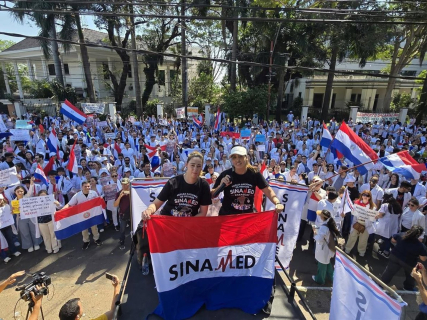

More than 300 doctors from the public hospital network of Paraguay have submitted their resignations en masse as a gesture of support for the health strike that began a week ago, with which they demand a profound improvement of the public health system of the South American country.
"This is not extortion, this is a manifestation of dissatisfaction from the medical union. What we want is for them to react, to give a response, for the population and also for us," said the general secretary of the National Union of Doctors (Sinamed), Rosanna González, quoted by the Paraguayan press.
The union leader, accompanied by other doctors, went this Monday to the headquarters of the Ministry of Public Health and Social Welfare to formally register a resignation letter.
"I have my office, I am going to be a neighborhood doctor and I am going to earn more than what this people pay me," stated pediatric surgeon Ernesto Waldemar Argüello Duarte, who works at the Trauma Hospital and at the Acosta Ñu Hospital, justifying his stance with the idea that "there is money where there is no theft."
In light of this situation, the director of the Public Health Cabinet, Juan Marcelo Estigarribia, indicated that they will have to review the submitted documentation and emphasized that collective resignations will not be accepted, given that there is no collective labor contract that supports them.
Furthermore, Estigarribia has questioned the "arbitrary" attitude of the Paraguayan Society of Anesthesiology, which has warned of the possible expulsion of those members who accept the positions that remain vacant after the wave of resignations.
The medical collective demands a salary increase and an improvement in working conditions, including more supplies and equipment in hospitals, as well as payment for worked holidays. Specifically, they propose raising the salary from 5 to 8 million guaraníes --from 724 to 1,163 euros-- and reducing the temporality and precariousness of contracts. The Minister of Public Health, María Teresa Barán, has maintained that this demand is "hardly applicable."