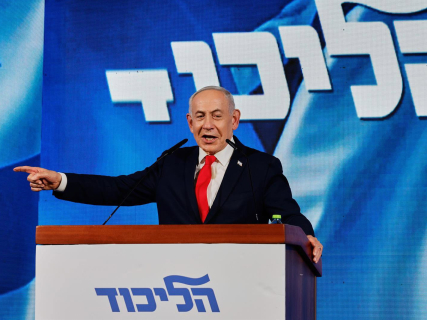

The acting Israeli prime minister, Benjamin Netanyahu, has insisted on his willingness to open a process of dialogue to try to form a "broad national Government" after the latest legislative elections, but he has flatly ruled out any coalition or governability formula that depends on the support of the Arab parties.
In a message posted on his social media profiles, the Likud leader maintained that Israeli citizens "do not want a Government that depends on the United Arab List and the Joint List," which he accused of "supporting terrorism and denying the existence of the Jewish State".
"From day one, our hand has been extended to establish a broad national Government. A clear majority of the public chose Likud as the most-voted party and me as prime minister to lead the next Executive," Netanyahu said, who said he was "open to dialogue" with any party that does not support terrorism.
The conservative leader's stance comes amid a political deadlock after an election in which his right-wing bloc — made up of Likud, far-right formations and ultra-Orthodox parties — won 53 seats, compared with the 48 deputies of the opposition alliance led by Gadi Eisenkot, leaving the Arab lists, with 19 seats, as the decisive force for forming a majority.
In this context, the President of Israel, Isaac Herzog, is scheduled to begin on Wednesday the round of formal consultations to appoint a candidate tasked with trying to form a Government within a maximum period of 28 days, while the opposition parties analyze different combinations to forge an alternative majority.