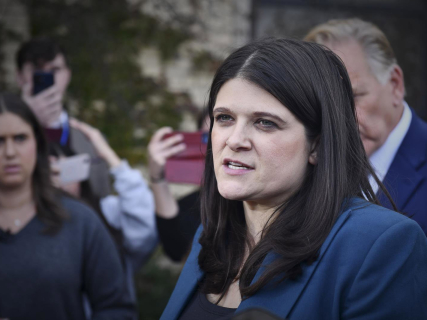

The congresswoman defended before Anderson Cooper her support for Mike Rogers, but did not identify the fact that led her to withdraw her support for the Democrat Abdul El-Sayed. On ABC News she assured that she did not intend to «hurt anyone». El-Sayed replied with four words: «None of this matters».
On Saturday night, Haley Stevens was celebrating that Abdul El-Sayed had rejected the content of an ad about Israel that had pitted them against each other. On Sunday morning she appeared in a church in Detroit alongside Mike Rogers, the Republican who is disputing a Senate seat from El-Sayed. And on Sunday night, when the congresswoman went to CNN, Anderson Cooper wanted to know what had happened between those two moments. Stevens spoke about her differences with the Democratic candidate, about her neighbors and about how she felt upon waking up. She did not point to any specific episode that explained the turn.
"I wanted to see if you wanted to fill in the silence, but you don't" -- OOOOOF this Haley Stevens interview on CNN is BRUTAL https://t.co/CCyEg64fnX
— Aaron Rupar (@atrupar) November 2, 2026
Cooper insists: the disagreement over Israel already existed on Saturday
Stevens had an explanation for her unease. A group outside El-Sayed's campaign had aired an ad linking U.S. aid to Israel with the rising cost of buying. The congresswoman considered it offensive and had demanded a clearer condemnation. On Saturday, El-Sayed distanced himself from the ad and Stevens publicly welcomed his words. That sequence was precisely what interested Cooper: if the two had moved closer together, why did they break hours later?
The host put on the table the most visible new development of that weekend: Stevens had stopped being invited to an event in a church that she was going to attend with El-Sayed. He wanted to know whether that had been decisive. The congresswoman rejected Cooper's taking that interpretation for granted and maintained that the problem went beyond a campaign event. She said that when she woke up she was clear about her decision and that announcing it had lifted a weight off her shoulders.
The most revealing exchange came when Stevens recalled that she still had not voted. Cooper then asked her whether she could change her mind again. This time the answer was unequivocal: her decision had been made. Her support for Rogers was firm; what still remained unclear was why she had decided to make it public precisely that Sunday.
On ABC, El-Sayed refuses to prolong the fight
On ABC News, Stevens addressed the personal consequences of her decision. She assured that she did not intend to «hurt anyone». El-Sayed, who defeated her in the Democratic primaries in August, responded that «none of this matters». The two were pursuing different goals before the cameras: she wanted to defend her right to support a Republican without renouncing her Democratic identity; he was trying to keep the last day of the campaign from revolving around his former rival.
Democratic Rep. Haley Stevens told ABC News she isn't trying to "cause anyone pain" after announcing on Sunday her decision to endorse GOP candidate Mike Rogers in the Michigan Senate race. Democratic nominee Abdul El-Sayed responded by saying "none of this matters." https://t.co/FSFzIvTduz
— ABC News (@ABC) November 1, 2026
For Stevens, the problem with the television tour is that explaining a discrepancy is not enough to explain a change of vote. His objections to El-Sayed were known when he still supported him. For Rogers, on the other hand, the immediate benefit is simpler: a Democratic congresswoman has defended on two national networks that she prefers to see him in the Senate. How many Michigan voters will accompany her is another matter. The latest poll by The New York Times and Siena, which gave El-Sayed an eleven-point lead, finished its interviews on the very Sunday of the rupture.