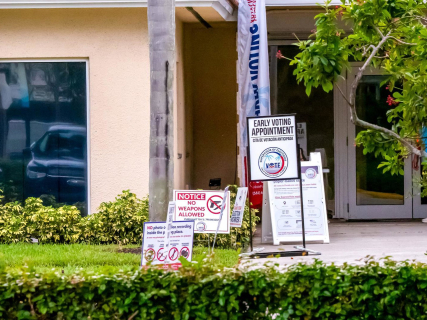

Trump's Republicans are counting on Tuesday, when a larger proportion of their voters traditionally goes to the polls.
More than 55 million Americans have already voted before this Tuesday, November 3, when the country decides who will control the House of Representatives and the Senate. The tracking by CNN, Associated Press and Catalist counts 55,351,558 mail-in or in-person early ballots in its Monday, 2 update. To get an idea of the scale: in the previous midterm elections, those of 2022, some 57 million early votes were recorded throughout the cycle.
For the White House, the most relevant signal is who has mobilized. According to CNN, in several states with decisive contests those registered as Democrats weigh more among early voters than at this same point in the 2024 presidential election. The unknown is whether they are bringing in voters who otherwise would have stayed home or whether part of their supporters have simply moved up to the weekend a vote that they would have cast on Tuesday.
Texas and Maine accelerate amid the battle for the Senate
Texas offers a measure of how much the pace has changed. Five days before the elections, more than 6.3 million ballots had already been cast there, 50% more than at the same point in the 2022 midterms, according to Associated Press. In Maine the increase was 44%; in Kansas, 34%, and in Michigan, 32%. These are increases in the total number of early voters, regardless of party.
What makes those figures politically important is the map. In Texas, Democrat James Talarico is challenging Republican Ken Paxton for a seat from his party. In Maine, Republican Senator Susan Collins is seeking re-election against Democrat Troy Jackson. In Michigan the opposite is happening: it is the Democrats who are defending the seat. An increase in turnout in the three states says a lot about the interest the elections arouse, but it does not have to favor the same party in all of them.
What the electoral register reveals and what remains secret
In the United States, it can be known that a person has voted without knowing which candidate they have chosen. Some states allow turnout to be cross-referenced with the party in which the voter is registered. If a registered Republican votes for a Democrat, they will still appear as a Republican in turnout statistics. And where there is no party registration, it is not even possible to make that direct comparison.
Florida illustrates why that distinction matters. On Sunday morning, Republicans held a three-point lead over Democrats among those who had already voted in the state, despite having an eleven-point larger share in the party-registration census, according to Axios. What was troubling for Republicans was that their numerical superiority was translating into a smaller-than-expected early margin. Those three points were not an advantage for their gubernatorial candidate in a count.
What margin do Republicans have left on Tuesday
The most useful precedent is 2022. According to the federal data compiled by CNN, approximately half of the votes in those midterms were cast on Election Day itself. In the 2024 presidential elections the distribution changed: both in-person early voting and in-person voting on Election Day each exceeded one third of the total. Mail ballots were slightly below both. Comparing 2026 with either year therefore answers different questions.
The 55.3 million show that a large part of the electorate has already made up its mind. They do not set a ceiling for Republicans or guarantee a Democratic wave. The missing figure will come after polls close: how many more voters each party manages to bring out on Tuesday and whom independents and voters who depart from their affiliation have chosen. Until then, the United States has an exceptionally detailed turnout record, but it still does not have a result.