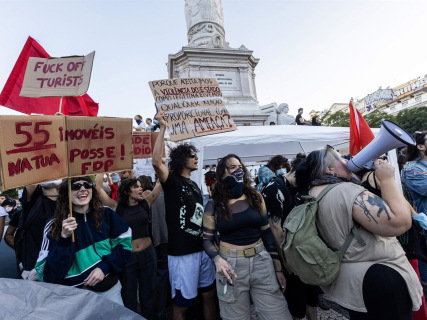

The activists demanding answers to the housing crisis in Portugal have decided in a popular assembly to set up their tents again in the central Rossio square in Lisbon starting this Wednesday, thus standing up to the police eviction carried out early Tuesday and the harsh warnings issued by the Portuguese Government.
The determination to resume the camp in the capital was adopted at the end of the afternoon, after an open floor session in which the return to the square was put to a vote, according to the Portuguese news agency Lusa. At the same time, in Porto, more than a thousand people gathered in D. João I square — where in the morning the Police had also ordered the tents to be removed — and, after a concert, marched to the City Hall, forcing the security forces to cut traffic on the upper section of Avenida dos Aliados.
These protest actions take place a few hours after the Public Security Police (PSP) Intervention Corps forcibly dismantled the camp in Lisbon. The morning operation ended with 55 arrests and two minor injuries for "disobedience and resistance" to leaving the public road. The parallel eviction in Porto, on the other hand, concluded without arrests, after those gathered voluntarily obeyed the agents' orders.
In light of the increasing social tension, fueled by difficulties in accessing housing and by the echo of similar protests in France, Spain, or Italy, the Minister of Internal Administration of Portugal, Luís Neves, has issued a serious warning to the participants, declaring the camps concluded.
"If anyone thinks that there are other mimetic effects that will impact our country with violence and seek to sow chaos, they are completely mistaken, because the strength, firmness, and decisiveness of the security forces to restore public order will be an absolute reality," the minister asserted. Although Neves emphasized that the right to protest is "absolutely legitimate," he urged the organizers not to let themselves be "infiltrated by extremists," reminding that "any extremist and criminal behavior will be repressed."
In the same line, the department led by Neves has issued a statement praising the "professionalism" of the PSP in restoring legality. The Ministry maintains that the agents prioritized dialogue and persuasion "to the greatest extent possible," resorting to force only after exhausting attempts to achieve a voluntary withdrawal from the squares. "The exercise of this right does not exempt from compliance with the law," concludes the note, emphasizing that respect for the rules is an inseparable pillar of a democratic rule of law.