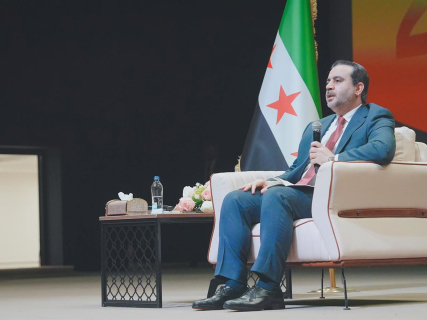

The Syrian Foreign Minister, Asaad al Shaibani, announced this Sunday that the Syrian Embassy in Libya is operational again after almost fourteen years without activity, while emphasizing the boost this represents for relations between Damascus and Tripoli.
"Today we announce the resumption of activities of the Embassy of the Syrian Arab Republic in the sister Republic of Libya, after a disruption that lasted nearly fourteen years," the head of Syrian diplomacy pointed out in a message shared on social media.
Al Shaibani explained that this measure will strengthen bilateral ties between both States, which he described as "brothers," and will also facilitate "providing the services they deserve" to Syrian citizens residing in Libyan territory.
The minister also specified that "we have signed an agreement to reactivate the Joint Higher Committee between the Syrian Arab Republic and the State of Libya, in line with the political evolution of both countries," and expressed his "satisfaction" with the meeting held with members of the Syrian community in Libya. He indicated that dialogue with the diaspora constitutes a "fundamental pillar in the construction of a new Syria worthy of all its citizens."
The official ceremony for the reopening of the Syrian diplomatic headquarters in Tripoli was also held this Sunday, with the participation of the Libyan Foreign Minister, El Taher El Baour, who highlighted that the event represents a key opportunity to review and relaunch various areas of joint cooperation.
The head of Libyan diplomacy also praised the role of the Libyan-Syrian Joint Higher Committee, which he considered one of the most effective instruments for articulating collaboration between the two countries, and announced that this body will hold meetings periodically, according to information released by the Libyan news agency LANA.
In his speech, El Baour also reiterated Tripoli's commitment to the security, independence, and full sovereignty of Syria over its territory, expressing his support for Damascus "against Israeli aggression" and his "rejection of Israeli violations," which he described as a "threat" to regional and international stability.
In recent days, the Israeli Army has again carried out incursions into Syrian territory, advancing through the province of Quneitra, a usual scene of Israeli operations and patrols, and firing two projectiles at a rural area in the Damascus Countryside, located about 50 kilometers from the capital.
These actions, repeated with relative frequency by Israeli forces, violate the Separation Agreement signed in 1974 after the Yom Kippur war, which was broken years later when Israel penetrated the area of the Golan Heights under UN supervision, according to the Israeli Government itself as a preventive measure against the internal instability that Syria was experiencing.
Since then, the Israel Defense Forces have made arrests, set up checkpoints, and destroyed properties using bulldozers, in addition to carrying out artillery attacks.
The Syrian authorities demand the complete withdrawal of Israeli forces from their territory and maintain that all decisions and actions by Israel in the area are "null" and "lack legal validity" under International Law.