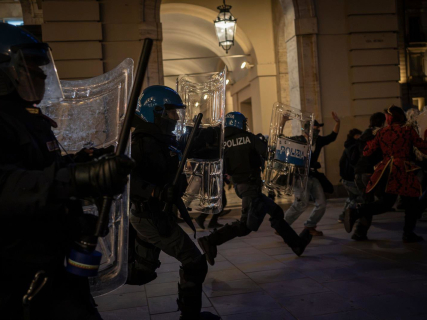

Personnel from the Special Operations Unit (DOES) of the Police have carried out 60 searches in 23 municipalities spread across all of Italy, linked to the incidents recorded on Friday during more than 40 marches called by workers and students throughout the country.
The searches are directed "against individuals who, in chat rooms and social media platforms, incited violence during the recent street demonstrations," the Police has stated, according to the news agency ADN Kronos.
The authorities estimate that more than 255,000 people took part in the protests, while the USB (Unión Sindical de Base) maintains that participation would have exceeded one million. The organizers put the number of attendees in the capital alone at 100,000, while in Milan more than 50,000 people would have joined the mobilization.
In cities such as Turin and Rome, moments of tension and clashes with law enforcement were recorded. At least thirteen officers were injured, according to the union Coordinación para la Independencia Sindical de las Fuerzas de Policía (COISP).
"Eleven police officers and two carabinieri were injured, one of them with an open fracture in the hand that will require surgery: this is the final balance of yesterday's demonstrations. Once again, the uniformed officers paid the price of the violence in the streets," said COISP general secretary Domenico Pianese.
"The violent groups separate themselves from the demonstrations and move in small groups, multiplying the points of pressure to exhaust the security devices," Pianese added, who underlines that the aim is to cut roads and reach institutional headquarters.
In Rome, 369 people have been identified and complaints have been filed against seven of them: two for aggravated resistance to authority, two for appearing disguised in a public place and carrying offensive objects, one for blocking a public road, one for carrying offensive objects and one for appearing disguised in a public place.
The Police is considering issuing expulsion orders for those who do not reside in the city. The officers resorted to the use of water cannons in the face of the throwing of bottles, stones, Molotov cocktails and firecrackers by a group that was trying to first reach the Colosseum and later the seat of Parliament.
In Bologna, the Police estimate that more than 20,000 demonstrators gathered. "Approximately 300 people were identified" and "a preventive arrest" was carried out, according to the security forces.
In Turin, shouting "Meloni, here we come!", alluding to the Italian prime minister, Giorgia Meloni, thousands of people once again took to the streets at night to denounce the rising cost of living and rearmament. Leading the march was a banner with the slogan "Every campus will be a barricade. We will not pay for the war".
"We are fed up with this life, with not being able to buy food or gasoline, fed up with a collapsed health system, schools in ruins and a university where job insecurity is devastating," proclaimed one of the attendees through a megaphone. "This is a new movement that will take to the streets every Saturday until things change. We are not tired, and we will not get tired. Today, like the coming Saturdays, we must be ever more numerous, until we block all the arteries of this country," they have stated.
In Milan some 25,000 people took part in the mobilization behind a banner with the slogan "Gen Maranza", alluding to the youth of the neighborhoods. "We are all Maranza, if you prefer it (...). The State pisses on us and the media say it is raining," they have denounced, quoting the one considered to be the leader of the Movimento 17 de Octubre, Youssef Siher.
The Minister of the Interior, Matteo Piantedosi, has highlighted the "balance and effectiveness" shown by the security forces in the face of the "dozens of demonstrations". "This demonstrates that security must be a fundamental guarantee for the exercise of all freedoms. All the measures deployed were distinguished by their balance and effectiveness: qualities that have allowed us to protect a fundamental right of citizens, the right to demonstrate peacefully, despite the attempts by some individuals to provoke disorder and violence," he maintained.