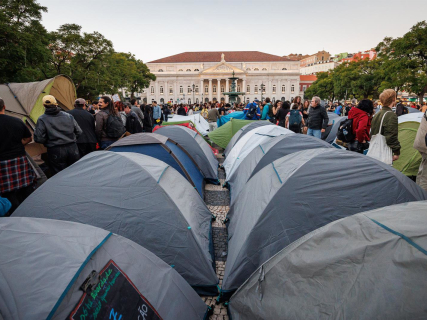

After several hours of prior warnings, the Portuguese Police proceeded this Sunday to dismantle the camps that demanded solutions to the housing access problem in Lisbon and Porto, arguing that it was an "illegal settlement," an action that ended up resulting in confrontations between agents and protesters.
About 200 tents were set up in Pedro IV Square in Lisbon and in John I Square in Porto. In just ten minutes, the Portuguese agents broke the human cordons organized by those gathered and reached the camp, in an operation described as "hard, but quick and effective," according to the Portuguese media 'Diario de Noticias.'
The Police had reiterated on numerous occasions that they considered these camps as "illegal" and that, starting at 00:30 (local time) this Sunday, they had the order to remove them, while insisting that the protesters could remain in the area, but without the camping structures.
In Porto, the eviction was carried out more immediately, with agents using their shields to quickly push those gathered out of the square. The organization reported 37 minor injuries, a figure similar to the intervention on October 15, when 39 injuries were recorded, although on this occasion, scenes of such intense violence would not have been repeated. After the tents were taken down, ambulances arrived with medical personnel and specialists in psychological support to assist those affected.
In Lisbon, the operation was more complicated and the police intervention has been described as more "forceful." Some protesters roamed several streets of the city causing material damage, overturning containers and damaging terraces of certain restaurants. With part of the furniture from one of these establishments, several activists attempted to attack the agents, according to authorities, and later a larger group threw stones and bottles at the Police trying to disperse them.
As a result of these incidents, around ten people have been detained and face charges of disobedience for refusing to dismantle the tents when ordered. The escalation of tension in the streets —which already left 55 detained on Tuesday during the dismantling of the first camp in Lisbon and nearly 40 injured after a police charge in Porto on October 15— has increased pressure on institutions to find political responses to the rising cost of living.
In light of this situation, the president of Portugal, António José Seguro, has decided to intervene by calling on all parties with parliamentary representation on October 29, in what will be the first round of contacts of this kind since he assumed the Presidency last March. The head of State intends to promote a broad state pact among the different political forces that allows for the consensus on urgent measures and also structural ones.
"A specific and human problem demands equally specific and human responses," recently defended the Portuguese president, who has asked all parties to exchange proposals to find points of agreement that contribute to alleviating the housing emergency that the country is experiencing.