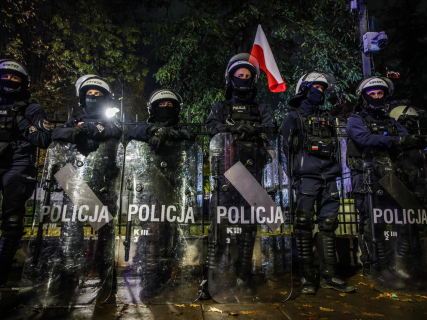

The Polish Police have defended that the recent operations carried out in the vicinity of the Constitutional Tribunal, in Warsaw, were carried out in accordance with the current regulations and respecting the principles of Ethics. These actions, carried out on Friday and Saturday, have generated intense public debate and numerous criticisms over the large deployment of personnel in the area, in a context marked by the outbreak of a latent crisis over the composition of the court's top leadership.
In a letter released this Sunday through social media, the chief commander of the Police of Poland, Marek Boron, has maintained that the police presence was essential both to safeguard the people who were inside the tribunal and the thousands of citizens gathered outside in the face of eventual dangerous situations.
"All of the recent actions by the Police in the vicinity of the Constitutional Tribunal were fully in accordance with current legislation," the top official of the force has assured. He has emphasized that the mission of the officers is to carry out the functions set forth in the Police Law and not to pronounce on the functioning of the tribunal. Among these obligations he has mentioned the protection of life, health and property, as well as the preservation of safety and public order.
Boron has likewise underscored the autonomy of the institution in the face of political pressures or private interests and has emphasized that "the Police is never part of any conflict, but rather constitutes a guarantee for the protection of security". He has taken the opportunity to thank the officers for their professionalism and has reiterated that wearing the uniform implies setting aside personal opinions and political affinities.
In this context, the commander has promised to act as "a protective shield" against any attempt to instrumentalize the force to carry out illegal actions or favor private interests. At the same time, he has highlighted the need for transparent procedures and to ensure the legal protection of police officers in the performance of their duties.
In the final part of his message, Boron has called for strengthening the internal cohesion of the force and has recalled the Police's responsibility in the defense of national security. In his view, "undermining the unity of the formation and fostering internal divisions" seriously hinders the fulfillment of this mission.
Escalation of the crisis at the top of the Constitutional Tribunal
The dispute surrounding the Polish Constitutional Tribunal dates back to the beginning of this year, when the country's president, Karol Nawrocki, refused to swear in three of the six judges appointed by Parliament. The president of the court, Bogdan Swieczkowski, also refused to allow the judges elected by the current parliamentary majority to take office.
The situation worsened with the appointment before Parliament of Maciej Berek, the chief legal adviser to Prime Minister Donald Tusk's executive, as a new judge of the Constitutional Tribunal. President Nawrocki again refused to swear him in, which increased institutional tension.
This Friday afternoon, the official Polish news agency PAP reported that Swieczkowski and his deputy, Bartlomiej Sochanski, had been suspended for a month and that their names had been removed from the court's website by order of judge Anna Korwin-Piotrowska. Shortly afterward, the magistrate appeared on Polish television to announce that she had become the new president of the court.
Minutes later, after the changes on the website, the court itself stated on its social networks that the page had been subjected to an "illegal takeover," that Korwin-Piotrowska does not represent the body, and that anyone involved in these actions "is committing the crime of a coup d'état".
In parallel, the prime minister, Donald Tusk, stated that the recovery of the rule of law "is a duty" and that "after years of arbitrariness" a "difficult, sometimes painful process, which requires decisive action" has begun because "there is no other path".