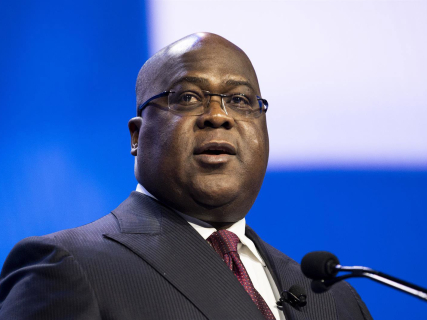

The president of the Democratic Republic of the Congo (DRC), Félix Tshisekedi, has harshly criticized his predecessor, Joseph Kabila, after the latter took command of the Front for the Refoundation of the Nation, a split from the Alliance of the Congo River (AFC-M23). The head of state has called on his majority in Parliament to unite in the face of the political and military challenge the country is facing.
During a meeting held this Saturday in Kinshasa with representatives of the Sacred Union of the Nation, the political and parliamentary platform that supports the Government, Tshisekedi has accused Kabila of turning against the country he led for 18 years. "Joseph Kabila is a coward," he declared, according to Congolese media.
The president explained that the intelligence services had been warning for more than two years about the intentions of his predecessor and interpreted his recent move as proof that he "never really loved" the nation. He added that military pressure and international sanctions would have forced the former president to step out of the shadows to give a Congolese appearance to an offensive that Tshisekedi attributes to Rwanda.
In this line, the president has also lashed out at the Rwandan head of state, Paul Kagame, whom he blames for having damaged the external image of the DRC for decades, undermined its institutions, and facilitated the plundering of its natural resources.
Despite the seriousness of the moment, Tshisekedi has emphasized that the Government is keeping the situation under control and has demanded discipline and cohesion from his partners in the Sacred Union. At the same time, he has called for additional financial effort to sustain military operations in the east of the country and to advance the projects planned for his current five-year term, in a context already strained by the motion of censure against the Minister of Agriculture for alleged mismanagement.
On the political front, the president has announced that next week the team responsible for organizing the national dialogue will be appointed. Furthermore, he has left the door open to continue in office beyond 2028, when his term expires, as long as he has the support of the citizenry. "If the people want it," he stressed, defending that his mission is "to guide the country on the right path, to establish true and lasting peace."
In mid-October, Joseph Kabila was appointed leader of a new political-military movement that integrates the March 23 Movement (M23) and succeeds the Congo River Alliance (AFC): the Front for the Refoundation of the Nation (FRN). With this, he has consolidated his role on the insurgent stage against his successor in the Presidency, Félix Tshisekedi.
The founding declaration of the FRN states that "the crisis that the DRC is going through is essentially endogenous and derives from the irresponsibility and bad choices of Kinshasa, on the one hand, and its illegitimacy due to the chaotic elections of 2023." The document also points to Tshisekedi as responsible for the "fragilization of institutions, the persistence of insecurity (...) and the continuous deterioration of the living conditions" of the population.
The return of Kabila to the forefront
The launch of the FRN marks the return to the frontline political scene of Kabila, 55, who led the DRC from 2001 to 2019, when he transferred power to Tshisekedi, then the main figure of the opposition, after elections postponed for years amid accusations that he was trying to perpetuate himself in office.
Kabila accessed the Presidency in 2001 after the assassination of his father, Laurent Kabila, at the hands of one of his bodyguards. In 2006 he won the first democratic elections held since Belgium's independence, although his time in power was surrounded by allegations of human rights violations and repression of activists and opponents.
Later, Tshisekedi accused Kabila of supporting the M23 after the rebel group took control of Goma and Bukavu, in the context of its rapid advance through the east of the country, which raised tensions over the risk of a direct confrontation between the DRC and Rwanda.
Kabila left the country in 2023 and returned in 2025 to Goma, a city currently under the control of the M23. He was subsequently sentenced in absentia to death by the Military High Court of the DRC for war crimes, treason, and participation in an insurrection, being considered the "undisputed leader" of the AFC, the political arm of the M23 now replaced by the RFN.