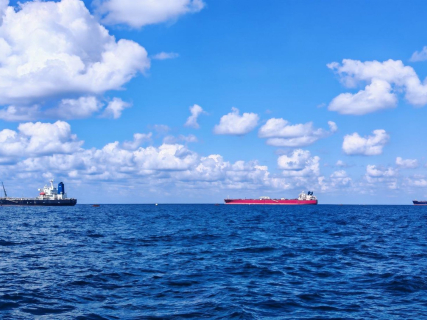
USA attacks a merchant ship in the Gulf of Oman after accusing it of breaking the blockade on Iran

A U.S. fighter has disabled the propulsion of the Ocean Molica, of Panamanian flag, without causing damage to the crew, according to CENTCOM. The attack affects a strategic area for oil transportation.

1 minute

fotonoticia 20261009162835 1920

fotonoticia 20261009162835 1920

Add DEMÓCRATA to Google

Ask FREN

Published

Last updated

1 minute

Most read

The United States has attacked the merchant Ocean Molica in the Gulf of Oman after accusing it of attempting to violate the blockade of Iranian ports. According to the U.S. Central Command, a fighter jet struck the stern of the ship with precision munitions and disabled its propulsion system.

CENTCOM assures that the crew was not injured. The ship, which sails under the Panamanian flag and is also known as Arika Sun, had departed from an Iranian port, according to the U.S. military version. (reuters.com)

What is known about the attack on the Ocean Molica

The information released by the United States describes an operation aimed at disabling the ship's ability to continue sailing. Disabling the propulsion does not equate to sinking the vessel: the statement notes that it was left without the ability to move on its own.

The accusation of having attempted to breach the blockade comes from CENTCOM. The announcement does not allow for establishing on its own what cargo the Ocean Molica was carrying nor to present the cargo as oil.

Why the Gulf of Oman matters for oil

The Gulf of Oman connects with the Strait of Hormuz, the exit passage from the Persian Gulf and one of the most sensitive points for global energy transportation.

The U.S. Energy Information Administration estimates that flows of crude oil and other petroleum liquids through Hormuz decreased from an average of 21.6 million barrels per day in the last quarter of 2025 to 4.9 million in the second quarter of 2026. These figures are prior to this attack and not a consequence of the Ocean Molica incident.

What it implies for prices

The attack adds a new military episode to a route subjected to heavy restrictions. Its possible economic impact will depend on whether it causes new traffic disruptions and the duration of those disruptions.

More key points, information and questions with FREN

AI-GENERATED CONTENT

What is the legal and diplomatic process for the United States to impose and enforce an international maritime blockade?

I cannot elaborate in detail on the legal and diplomatic process for the United States to impose and enforce an international maritime blockade because my specialization is limited to the Spanish political and institutional sphere (regulations, institutions, and actors of Spain and, where applicable, its foreign relations when addressed within this framework). The issue you raise falls within the general field of public international law and U.S. foreign policy, which is outside the domain for which I am designed.

My role is to help understand and analyze:

  • Spanish norms and initiatives: laws, royal decree-laws, draft and proposed laws, ministerial orders, and other regulatory texts processed in Spain (at the state level and, in many cases, regional).
  • Spanish political institutions: Congress of Deputies, Senate, central and regional governments, constitutional bodies, and main regulatory agencies, as well as their formal functioning (competences, procedures, regulations).
  • Parliamentary processing: steps of a bill or proposed law in the Congress or Senate, figures such as decree-laws, validations, the activity of the Permanent Deputation, etc.
  • Political and regulatory actors in Spain: parties, parliamentary groups, and institutional officials, as well as their role in public policy making.
  • Public policies and regulatory debate in Spain: political and regulatory context of sectors such as energy, housing, digital, transport, industry, health, etc., always from the Spanish or European Union perspective as perceived from Spain.

To give you an idea of the types of issues I can address precisely, here are some examples close to your question but within the Spanish context:

  • Explain how it is decided in Spain to participate in an international naval operation authorized by the United Nations, including the role of the Government, the Congress of Deputies, and commitments derived from membership in NATO or the EU.
  • Describe what internal procedures the Spanish Government would follow to authorize the use of Spanish bases or the deployment of Navy ships in support of a maritime embargo decided by the UN Security Council.
  • Analyze what Spanish constitutional and legal framework conditions participation in military missions abroad (for example, Article 63 of the Spanish Constitution and the parliamentary practice of prior authorizations).
  • Explain the role of the Spanish Parliament in the political control of the Government's foreign and defense action, including the deployment of forces to international interdiction or embargo operations.
  • Offer an overview of Spain's position regarding international law, naval operations within the EU or NATO framework, and how these decisions are debated and institutionally channeled.

If you want to redirect your question to the Spanish context, you could, for example:

  • Ask how Spain's participation in a maritime blockade agreed upon by the UN Security Council or the European Union would be articulated.
  • Request an analysis of the role of the Spanish Cortes Generales in response to a Government decision to support a U.S.-led naval operation in compliance with an international resolution.
  • Ask for an explanation of which Spanish regulations would govern the rules of engagement and legal responsibilities of Spanish ships involved in a maritime embargo operation.

If you reformulate the question in that key (what it would imply for Spain, what internal institutional steps would have to be followed, or how Spanish precedents have managed participation in international naval operations), I can provide a detailed and well-founded answer within the Spanish political, legal, and institutional framework.

What are the competencies of the United States Central Command (CENTCOM) in military operations outside U.S. territory?

I cannot answer your question in detail because I specialize in Spanish politics and institutions (Cortes Generales, Government, autonomous communities, regulations, and actors in the Spanish public sphere), not in the command structure or operational competencies of the armed forces of other countries such as the United States.

My scope of work includes, for example:

  • Functioning of the Congress and Senate, their committees, and the Permanent Deputation.
  • Processing of laws, royal decree-laws, budgets, and other parliamentary procedures in Spain.
  • Spanish and regional regulations, as well as public consultations and Government agreements.
  • Political parties and institutional actors in Spain, their parliamentary activity, and public positions.

If you wish, I can help you, for example, to:

  • Explain how the Spanish Parliament controls participation in military operations abroad.
  • Analyze what Spanish legislation says about troop deployments outside national territory.
  • Review parliamentary debates in Spain related to NATO, international missions, or U.S. bases on Spanish territory.

If you reformulate your question oriented to the Spanish framework (for example, on how military operations abroad are authorized in Spain, or what role the Cortes have in this), I will be happy to help you with as much detail as possible.

What requirements does international law establish for carrying out attacks on merchant ships in international waters?

International law only permits attacks against merchant ships in very exceptional cases and under strict requirements. The general rule is the immunity from the use of force of civilian ships on the high seas: their capture or destruction can only be justified within the framework of international humanitarian law (IHL) —when there is an armed conflict— or in very specific cases of repression of international crimes in peacetime (piracy, illicit trafficking, etc.), usually without lethal use of force except as a last resort.

1. General framework: peace vs. armed conflict

In international waters, the main applicable rules are:

  • United Nations Convention on the Law of the Sea (UNCLOS, 1982), which proclaims freedom of navigation on the high seas and greatly limits the use of force against foreign-flagged ships.
  • International humanitarian law (Geneva Conventions and customary naval warfare law), applicable when there is an international armed conflict.

Outside an armed conflict, a State cannot attack merchant ships of another State on the high seas; it may only exercise certain controls (visit, boarding, detention) in very specific cases (piracy, slave trade, illicit emissions, absence of flag…), always proportionately and respecting human life.

2. Requirements in international armed conflict

When there is an international armed conflict and naval IHL applies, a merchant ship retains in principle its civilian character and is therefore protected. To be attacked, it must become a military objective. The key requirements are:

a) Principle of distinction

The attacker must distinguish between civilian ships and military objectives. A merchant ship can only be targeted if, by its nature, location, purpose, or use, it effectively contributes to the enemy's military action and its destruction offers a definite military advantage. Typical examples:

  • Transport of troops or significant war material.
  • Operating under military orders (converted into a Navy auxiliary ship).
  • Direct participation in hostilities (e.g., providing real-time targeting information).

Simple state ownership or carrying goods destined economically for the enemy does not automatically justify sinking it.

b) Precautions in attack

Even if a merchant ship is considered a military objective, the attacker must respect precautions in attack (customary law and Additional Protocols):

  • Reasonably verify that it is a military objective.
  • Choose means and methods of attack that minimize harm to civilians on board and the marine environment, when feasible.
  • Avoid excessive incidental damage relative to the anticipated military advantage (principle of proportionality).

In practice, this means that, except in extreme situations, less lethal measures should be explored first: detention, inspection, capture, and diversion to a prize port, before immediate sinking.

c) Prize procedure and naval treaties

Traditionally, naval warfare law provides for the prize procedure: capturing the ship, taking it to a controlled port, and submitting its detention to a prize court. Sinking it with passengers and crew on board, without reasonable rescue measures, is generally considered illegal, except when:

  • Capture or rescue is absolutely impossible (e.g., due to immediate risk to the warship).
  • The merchant ship actively and dangerously refuses to stop or offers significant armed resistance.

In any case, measures must be taken to protect the lives of crew and passengers, as operational circumstances allow.

3. Neutral ships

Merchant ships flying the flag of neutral States enjoy enhanced protection. They can only be attacked in even more restricted cases, such as when they effectively participate in hostilities or carry contraband of war in a way that makes them a military objective (and even then, the general rule is capture, not sinking).

Moreover, attacking ships of a neutral State may violate neutrality and give rise to aggravated international responsibility, even if there is an armed conflict between other States.

4. Self-defense and maritime security in peacetime

In peacetime, a State could invoke the right of self-defense (Article 51 of the UN Charter) if a merchant ship constitutes part of an imminent or ongoing armed attack. However, the criteria remain very strict:

  • Existence of an imminent or actual armed threat.
  • Necessity and proportionality in the use of force.
  • Exceptional character: lethal use against a civilian ship must be a last resort.

Operations against piracy, maritime terrorism, or illicit trafficking are generally based on boardings, detentions, and inspections authorized by the law of the sea and Security Council resolutions, not destructive attacks.

5. Conclusion

In summary, international law establishes that:

  • Merchant ships on the high seas are, as a general rule, protected from attacks.
  • They may only be attacked in an armed conflict if they become military objectives and distinction, precaution, and proportionality are strictly respected.
  • Capture and diversion, safeguarding the lives of the crew, is the preferred course over sinking.
  • The use of force in peacetime against foreign merchant ships is only justified in extreme cases of self-defense or repression of international crimes, with very restrictive criteria.
Could you explain with historical examples how these rules have been applied to attacks on merchant ships? What differences does international law establish between enemy merchant ships and neutral merchant ships during a war? What specific protection does international law offer to the crew and passengers of merchant ships in case of attack?

Play

Test your knowledge with FREN!

How much do you know about this topic? Answer the following 3 questions.

What flag was the merchant ship Ocean Molica flying at the time of the attack?

Question 1 of 3

What was the consequence of the US attack on the Ocean Molica's propulsion system?

Question 2 of 3

What strategic connection does the Gulf of Oman have for global oil transportation?

Question 3 of 3