

The migration crisis in Ceuta has entered a second phase. Most of the adults who crossed from Morocco have returned to the neighboring country, but almost 1,100 children and adolescents remain under the care of the protection services of the autonomous city, many of them after having arrived alone, by swimming and with no more belongings than the clothes they were wearing.
Before July 1, Ceuta was caring for about 180 unaccompanied migrant minors. The latest count raises that figure to 1,098, an increase that has forced improvisation of accommodations in industrial warehouses, expanding existing resources and enabling two schools to urgently host more than a hundred girls.
El Tarajal, turned into a major emergency resource
The industrial area of El Tarajal, near the border with Morocco, has become one of the main points of attention. There, a warehouse managed by the Fundación SAMU has been reopened, an entity that was already participating in the minor protection system of Ceuta and had closed that resource weeks earlier, when the pressure had decreased.
The massive arrival forced the facilities to be put back into operation against the clock. During the first hours, some minors ended up sleeping by the entrance of one of the warehouses while spaces were organized, clothing was distributed, food was provided, and its subsequent distribution among the different available spaces was arranged.
Although social organizations manage the centers and take on daily care, the guardianship corresponds to the Autonomous City of Ceuta. Teams of educators, social workers, and health personnel must cover basic needs, but also identify each minor, understand their family circumstances, and detect possible situations of special vulnerability.
The situation on the ground is even more serious than what the official figures reflect. A report from El Mundo describes hundreds of minors crowded on the sidewalks and around the old warehouses of the El Tarajal industrial area, many barefoot, dirty, with wounds on their legs or still dressed in the wetsuits used to cross the border. Under temperatures exceeding 35 degrees, they sleep on cardboard, pallets, rubble, and abandoned furniture, while trying to protect themselves from the sun with blankets and waiting for hours for the arrival of water or food.
The newspaper also reports the presence of children as young as seven, eight, or nine years old who would have crossed accompanied by their parents, but who now remain alone, not knowing if their relatives are still in Morocco, managed to enter Ceuta, or are missing.
More than a hundred girls housed in two schools
The emergency has particularly affected girls and younger minors. Ceuta has enabled the public schools Príncipe Felipe and Reina Sofía to temporarily house more than a hundred girls who were without adequate resources.
As of this Tuesday, 114 girls, many of them between 11 and 14 years old, had been welcomed. The opening of the schools was coordinated with the ministries of Youth and Childhood and Education, as well as the Prosecutor's Office, due to the impossibility of attending to them in ordinary centers.
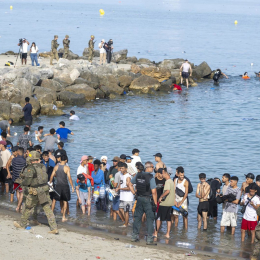
The use of schools and industrial warehouses shows the provisional nature of the device. The Ceuta authorities are working on preparing two larger facilities to regroup the minors and improve their conditions, while continuing to search for those who may still be on the streets.
A system sized for 29 places
The ordinary capacity officially assigned to Ceuta for unaccompanied foreign minors is 29 places. On Monday, when the balance was still 862 welcomed, the occupancy had already reached 2,872%. The update to 1,098 minors further aggravates a situation that local authorities consider impossible to sustain solely with their own resources.
The pressure is not limited to accommodation. Each minor needs an initial assessment, medical assistance, clothing, food, psychological support, and an individual interview. In cases where there are doubts about age, the Prosecutor's Office must intervene and authorize the corresponding tests.
It is also necessary to check if they have relatives in Spain or in another European country, document their identity, and determine what the most appropriate protection resource is. The accumulation of files has forced the Ceuta Prosecutor's Office to request reinforcements of prosecutors and officials.
Transfers to the Peninsula, pending
Ceuta has once again claimed the transfer of minors to other autonomous communities. The mechanism approved in 2025 allows for the declaration of an extraordinary migratory contingency when a territory exceeds three times its ordinary capacity and activates transfers based on criteria of solidarity among communities.
The procedure, however, is not automatic or collective. Each minor must be registered in the corresponding registry, interviewed, and heard during the process. The Public Prosecutor's Office also intervenes and the best interest of the child must be assessed before resolving their transfer. The regulations establish a maximum period of fifteen days from registration to complete the relocation, provided that all the required procedures are fulfilled.
During the first days following the avalanche, no extraordinary transfers to the Peninsula had been made. The City plans to request them, but while they are being processed, immediate attention continues to fall on completely overwhelmed local resources.