The PP maintains its pressure on the Government and summons Marlaska, Robles, and Albares in the Senate for the Ceuta crisis.

The Upper Chamber advances over the Congress and sets the appearances of the ministers of Interior, Defense, and Foreign Affairs so that they explain the management of the Government during the crisis of Ceuta.

2 minutes

fotonoticia 20260807114207 1920

fotonoticia 20260807114207 1920

Add DEMÓCRATA to Google

Ask FREN

Published

Last updated

2 minutes

Most read

The Senate has officially summoned the three appearances requested by the PP for the ministers of the Interior, Defense, and Foreign Affairs to explain the Government's actions during the Ceuta crisis. The first will be Fernando Grande-Marlaska on August 12; Margarita Robles will appear on the 13th and José Manuel Albares on the 17th.

The decision keeps the confrontation between the PP and the Government regarding the management of the crisis open. The Executive has scheduled the appearances of the aforementioned ministers, but in Congress before their respective committees and in the last week of the month. The Popular Party has gotten ahead and scheduled them in the Upper House, also before the committees of their portfolio. All will be at 11:00 hours in the Clara Campoamor Room.
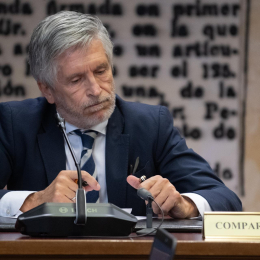
Marlaska will open the round on August 12

The Interior Commission will be the first to receive a member of the Government. Fernando Grande-Marlaska will appear on Wednesday, August 12, to report on the actions carried out by his department in the scope of its competencies in matters of citizen security and the direction and coordination of the State Security Forces and Corps.

The appearance will also address the competencies of the Ministry of the Interior in matters of immigration in the context of the Ceuta crisis, as well as the measures being adopted to prevent a similar situation from occurring again.

One day later, on Thursday, August 13, it will be Margarita Robles' turn. The Minister of Defense must explain before the Defense Commission the mission assigned to the Armed Forces during the Ceuta crisis.

Albares will close the round on August 17

The third appearance will take place on Monday, August 17, in the Commission of Foreign Affairs. José Manuel Albares must account for the actions of Spanish foreign policy during the crisis.

In this case, the Senate demands explanations about the State's Foreign Action in relation to a situation that, according to the very summons, would have affected the image of Spain both in the European Union and in the international arena.

With the three dates now officially set, the PP thus maintains its strategy of bringing the Government's explanations about the Ceuta crisis to the Senate, with a round of appearances that will allow addressing the episode from its different aspects: security and immigration, actions of the Armed Forces, and foreign policy.

More key points, information and questions with FREN

AI-GENERATED CONTENT

What parliamentary procedures are necessary for a minister to be obligatorily summoned to the Senate in response to a unilateral call by the opposition?

In the Senate, there is no “unilateral call” by the opposition that, by itself, automatically and immediately obliges a minister to appear. The Rules regulate this obligation through agreements of the Chamber's bodies (especially the Board of Spokespersons and the Committees) and control instruments (appearances in Plenary, questions in committee, and interpellations). The opposition can force the processing and voting of the request, and even chain control mechanisms if the Government resists, but the key point is always to transform the request into a formal agreement of the competent body.

1. Appearances in Plenary by Government members

The basic regime is in article 182 of the Senate Rules (amended in 2023):

  • Prime Minister: “at their own request or by agreement of the Board of Spokespersons, shall appear before the Senate Plenary to report on a specific matter.” That is, the legal obligation to appear arises when the Board of Spokespersons adopts the agreement.
  • These appearances “may be requested by two parliamentary groups or by one-fifth of the members of the Chamber.” The opposition, if it reaches these thresholds, can force the discussion of its request in the Board of Spokespersons.
  • Other ministers: “at their own request or by agreement of the Board of Spokespersons, may appear before the Plenary. These appearances must meet the same requirements as in paragraph 1.” Again, the key is the agreement of the Board, also based on a request from two groups or one-fifth of the Senate.

In practice, therefore, the opposition turns its initiative into an obligation to appear if:

  • It submits a request for appearance that meets the requirement of 2 groups or 1/5 of senators.
  • The Board of the Senate qualifies it and includes it in the agenda of the Board of Spokespersons.
  • The Board of Spokespersons adopts the appearance agreement. From that moment, the verb in art. 182 (“shall appear”) establishes a genuine regulatory obligation.

2. Appearances in committee and oral questions

The Rules do not contain a specific provision stating that “at the request of X groups the minister shall appear in committee” as in article 182 for the Plenary. The clearest mechanism to oblige the Government's presence in committee are questions for oral response in Committee (articles 168 and 169):

  • Any senator can submit questions for oral response in committee (art. 168.1).
  • If a question was written and the Government fails to respond within the deadline, the senator can request its conversion into an oral question in committee (arts. 169.2 and 169.3).
  • The Board designates the competent committee and, after seven days from publication, “the question must necessarily be included in the agenda of the first session of the Committee to which a Minister, Secretary of State, Undersecretary or Secretary General will attend…” (art. 169.5).

This does not oblige setting a specific date nor that a specific minister attend merely by the opposition's request; what it obliges is that, when there is a session with Government presence, the control question is included in the agenda. It is an obligation of processing and response, reinforced if the Government lets the written deadline expire, rather than an immediate attendance obligation.

3. Initiative of a single group or minorities

In the Plenary, for appearances of the Prime Minister or ministers, the Rules require a critical mass: two groups or one-fifth of the senators (arts. 182.1 and 4). A single small group does not reach that threshold by itself unless its size equals one-fifth of the Chamber.

However, other political control instruments are open to any senator, including minorities:

  • Written questions and their possible conversion into oral questions in committee (arts. 168 and 169).
  • Interpellations (art. 170): any senator can interpellate the Government; the interpellation is seen in Plenary and “a member of the Government will answer” (art. 173.1), which in practice implies an obligation to be present on the fixed date.

4. Government's power to accept or reject and effects

The analyzed provisions do not include an express right of the Government to veto an appearance agreed by the Chamber's bodies. Limited margins of maneuver are foreseen:

  • In interpellations, the Government can request “motivatedly, a postponement (…) for a period not exceeding one month” (art. 171.3), but not reject them.
  • In written questions, it can request deadline extensions (art. 169.1). If it does not respond, the opposition can toughen control by converting them into oral questions in committee (arts. 169.2 and 169.3).

If the Government politically refuses to attend an agreed appearance, the consequence is not an internal procedural effect (the Rules do not provide specific sanctions), but a political conflict that the Senate majority can escalate with new control instruments (interpellations, motions following interpellations, etc.).

5. Majorities and Chamber bodies involved

The key steps to move from the opposition's unilateral request to a regulatory obligation to appear are:

  • Senate Board: qualifies the initiative and decides its admission and processing (generally by simple majority of its members, although the detail is not in the cited articles).
  • Board of Spokespersons: is the body that, according to art. 182, can agree on the appearance of the Prime Minister or ministers in Plenary. The Rules do not set a specific majority in the provision; the logic of agreements based on group weight applies. If the opposition has sufficient political majority in the Board, it can transform its request into an obligation to appear.
  • Committees: once the Board sends an oral question, the obligation falls on the committee itself to include it in the agenda of the first session with Government members present (art. 169.5).
  • Plenary: for other instruments (interpellations, motions following interpellations) it is the Plenary that creates control scenarios where the Government must attend and respond.

In summary: the opposition does not obtain, by itself, an automatic “summoning power,” but the Rules allow it, if it gathers enough forces in the Board of Spokespersons or in the Plenary, to transform its initiative into formal agreements that generate a regulatory obligation for the affected minister to appear.

How does the Senate Board of Spokespersons operate in practice when the majority is opposition and the Government is in minority? What differences exist between the Government appearance regime in the Senate and in the Congress of Deputies? How are interpellations and motions following interpellations politically used when a minister resists appearing?

What are the specific competencies of the Minister of the Interior in migration crisis situations according to Spanish legislation?

The competencies of the Minister of the Interior in a migration crisis do not appear in a single norm nor under that label, but are constructed by combining legislation on foreigners, asylum, temporary protection, national security, civil protection, and citizen security. Together, these norms position the Interior Minister as the political responsible for state border control, the actions of the National Police and Civil Guard, the operational management of foreigners and asylum, and as a key piece in the National Security and Civil Protection System when arrivals are massive. Below are summarized those competency blocks as derived from the current regulations cited in the BOE.

Foreigners, border control, and CIE

The legal core is Organic Law 4/2000, on the rights and freedoms of foreigners in Spain and their social integration (Organic Law 4/2000), amended by several organic laws. Based on it, bodies and regulations dependent on the Ministry of the Interior are articulated:

  • Directorate General of Foreigners and Immigration, created within the Ministry by Royal Decree 807/2000, which concentrates the management of foreigner policy.
  • Interministerial Commission on Foreigners, regulated by Royal Decree 1946/2000, where Interior participates in coordinating migration policy decisions.
  • Competencies over foreigners' internment centers (CIE), whose internal functioning is regulated by Royal Decree 162/2014, under the Ministry of the Interior's scope.

In border pressure situations, the actions of the National Police and Civil Guard at border crossings and coasts are also supported by Organic Law 2/1986, on Security Forces and Corps (LO 2/1986), which configures state public security as a competence exercised through these bodies integrated in Interior.

Asylum and temporary protection in massive influx

In a migration crisis, the axis of international protection is usually activated:

  • Law 12/2009, on asylum and subsidiary protection, assigns to the State – with a central role for the Ministry of the Interior – the processing of asylum and subsidiary protection requests and the financing of the reception system (developed, for example, by Royal Decree 882/2021 for subsidies to entities in the reception system).
  • For massive arrivals, the temporary protection regime regulated by Royal Decree 1325/2003 applies, which establishes the “temporary protection regime in case of massive influx of displaced persons.” Based on this, development norms have been issued, such as Order PCM/169/2022 for persons affected by the war in Ukraine, in which Interior participates in the instruction and recognition of that protection.

Additionally, successive administrative agreements between Interior and UNHCR reinforce the Ministry's role in international protection, as reflected, for example, in agreements published in 2023 and 2025.

Citizen security and border management

In the field of public order, Organic Law 4/2015, on the protection of citizen security (LO 4/2015) supports the actions of Police and Civil Guard in gatherings, disturbances, or incidents linked to migration crises. The Constitutional Court, in rulings 172/2020 and 13/2021, has interpreted the “special rejection regime at the border” in Ceuta and Melilla, which directly affects how Interior can manage irregular entries at those borders.

National security, civil protection, and coordination

If the migration crisis impacts national security, Law 36/2015, on National Security is activated. This norm integrates the Ministry of the Interior into the National Security System and the National Security Council, where strategic decisions are made, and under which the Specialized Immigration Committee was created by Order PRA/31/2018. In practice, this reinforces Interior's competence to coordinate the State's response (security, borders, reception support) with other ministries.

In parallel, Law 17/2015, on the National Civil Protection System, and its regulatory development through the Basic Civil Protection Standard (Royal Decree 524/2023) configure the Ministry of the Interior – through the Directorate General of Civil Protection and Emergencies – as a key body in emergency planning and coordination. In a massive arrival that overwhelms capacities (for example, need for emergency accommodations, transfers, basic care), the Interior Minister has competencies to activate state civil protection plans and coordinate with autonomous communities and other departments.

Internal structure and operational command

Finally, the minister's competencies are specified through the Ministry of the Interior's organic structure and the National Police, developed by regulation (for example, Order INT/859/2023 on the Directorate General of Police, or the basic organic development of the department corrected by the erratum of Royal Decree 207/2024). These norms detail which directorates general and units (foreigners, border, civil protection, security forces and bodies) execute, under the minister's authority, decisions in a migration crisis.

How does the Ministry of the Interior coordinate with autonomous communities and municipalities in a specific migration crisis? What role does the Specialized Immigration Committee of the National Security Council have when there is a massive arrival of migrants? What legal differences exist between applying the temporary protection regime and processing individual asylum requests in these situations?

What legal requirements must be met for the Senate to set appearance dates without the Government's agreement?

The Senate can set appearance dates of Government members without prior agreement with the Executive itself as long as it acts within its political control competencies, following the channels and bodies provided in the Senate Rules and respecting the principles of separation of powers and loyal cooperation. The Constitution recognizes the General Courts the function of Government control and foresees the obligation to appear before the Chambers and their committees, which enables the Senate to order these appearances. However, this power is not absolute: it must be exercised reasonably, without emptying the Government's capacity to organize its action and without invading its own competencies. In practice, the legal fit is supported by the Constitution, the Senate Rules, the Government Law, and the regulations on investigative committees.

1. Constitutional framework: control and obligation to appear

The Spanish Constitution, available in the BOE (Spanish Constitution), establishes that the General Courts represent the Spanish people and exercise, among others, the function of controlling the Government's action. In this framework:

  • Parliamentary control is an essential function of the Congress and the Senate, carried out through questions, interpellations, motions, investigative committees, and appearances.
  • Article 76 CE, to which the Senate Rules refer, foresees that it will be mandatory to appear at the request of the Chambers or their investigative committees, this point being developed in Organic Law 5/1984 (OL 5/1984 on appearances).

From this constitutional basis it follows that the Government cannot politically condition the very existence of the appearance: its margin lies in practical organization (agenda, specific representatives, etc.), but not in the Senate's right to require explanations and set the moment when it is held accountable, always within reasonableness.

2. Senate Rules and complementary norms

The detailed regime is in the Senate Rules, amended several times (for example, in 2023 and 2025), and in interpretative and internal resolutions of the Chamber, also accessible on the Senate's institutional website (Senate norms).

From the available information it follows:

  • The Rules regulate appearances in Plenary (for example, of the Prime Minister “to report on a specific matter”) and in committees, at the initiative of parliamentary groups or a minimum number of senators.
  • Investigative committees can “require the presence of any person” to testify before them, referring to OL 5/1984, which reinforces the legal obligation to appear.
  • The concrete setting of dates is linked to decisions of the Chamber Board, the committee Boards, the Presidency, and, if applicable, the Board of Spokespersons, depending on the matter and type of appearance. The detail (quorums, internal deadlines, etc.) is in the regulatory articles, although not all appears broken down in the provided extracts.

Law 50/1997, on the Government (Government Law), regulates the organization and functioning of the Executive, but does not contain a specific reservation in favor of the Government to agree on parliamentary control dates; it limits itself to framing relations with the Courts within the general principles of the parliamentary system.

3. Formal requirements to set dates without Government agreement

For the Senate to set dates without prior Government agreement, three types of formal requirements must be met, in summary:

  • Competence of the body: that the body legally empowered by the Rules (Senate Board, committee Board or Presidency, Chamber Presidency and/or coordinating body such as the Board of Spokespersons) adopts the scheduling agreement.
  • Valid initiative: that the appearance request has been made by those recognized by the Rules (parliamentary groups, a minimum fraction of senators, the committee itself or, if applicable, the Government).
  • Respect for internal procedures: admission for processing, inclusion in the agenda, and setting of date following the deadlines and forms the Rules provide for plenary and committee sessions.

As long as these requirements are respected, the agreement to set a date has regulatory coverage and does not require the Executive's consent, which is obliged to appear.

4. Material requirements and limits: separation of powers

Materially, the Senate's power to set dates is subject to the principles of separation of powers, parliamentary control, and loyal cooperation:

  • It cannot use the scheduling of dates in a way that seriously impedes or obstructs the normal exercise of the Government's constitutional functions (for example, imposing simultaneous appearances incompatible with essential Council of Ministers meetings).
  • The Government can raise objections of agenda or material impossibility, but not a general political veto to control. Constitutional doctrine, in rulings such as STC 124/2018 on control of a minister in acting capacity (published in Ruling 124/2018), tends to reinforce the Executive's subjection to control, even in acting government situations.
  • The Senate must act with proportionality and reasonableness in setting dates, adjusting urgency to the nature of the matter and avoiding manifestly obstructionist or partisan use of the appearance agenda.

If the conflict over a date were to acquire constitutional relevance (for example, systematic blocking of control or persistent Government refusal to appear), a conflict between constitutional bodies could be articulated before the Constitutional Court, as has occurred in other areas of the Government–Courts relationship (see conflict order 1219‑2024, published in BOE-A-2024-8476).

5. Summary

In conclusion, the key requirement is not “agreement” with the Government, which is not legally required, but the scrupulous respect of the Senate Rules and the constitutional principles of control and separation of powers. Once the requirements of competence, valid initiative, and internal procedure are met, the Senate can unilaterally set the appearance date, provided it does so reasonably and compatible with the normal functioning of the Executive.

Which specific articles of the Senate Rules regulate Government appearances in Plenary and in committee? How has the Constitutional Court interpreted conflicts between the Government and the Senate regarding control and appearances? What differences exist between appearances before investigative committees and ordinary political control appearances in the Senate?

Play

Test your knowledge with FREN!

How much do you know about this topic? Answer the following 3 questions.

Which ministers are summoned to appear in the Senate over the Ceuta crisis according to the PP's call?

Question 1 of 3

What is the Government's argument regarding the Senate appearances called by the PP?

Question 2 of 3

How many irregular migrants entered Ceuta during the crisis mentioned in the news?

Question 3 of 3

Hola, soy Fren. ¿Cómo te ayudo?