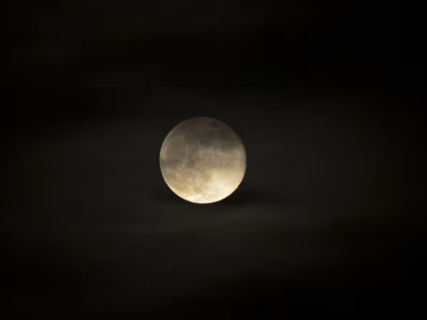

The next eclipse visible from Spain will occur during the early morning of Friday, August 28, 2026, just 16 days after the total solar eclipse that crossed part of the country. This time it will be a partial lunar eclipse, which can be observed from the entire national territory and will reach its maximum at 6:12 hours in the Peninsula and Balearic Islands.
The phenomenon will have a magnitude of 0.93, according to the National Geographic Institute (IGN). This means that the Moon will penetrate deeply into the shadow projected by the Earth and that a very large part of its surface will appear darkened during the central moment of the eclipse.
It will not technically be a “blood moon”, a popular name usually reserved for total lunar eclipses. However, the depth of this partial eclipse could allow for reddish or orange tones to be appreciated in the area covered by the Earth's shadow.
When is the next eclipse in Spain
The next eclipse in Spain will occur during the early morning of August 27 to 28, although all its main phases will take place on Friday, the 28th.
These are the general times in mainland Spain and the Balearic Islands:
| Eclipse phase | Mainland and Balearic Islands | Canary Islands |
|---|---|---|
| Beginning of the penumbral phase | 3:23 hours | 2:23 hours |
| Beginning of the partial eclipse | 4:33 hours | 3:33 hours |
| Maximum of the lunar eclipse | 6:12 hours | 5:12 hours |
| End of the partial eclipse | 7:51 hours | 6:51 hours |
| End of the penumbral phase | 9:01 hours | 8:01 hours |
Source: National Geographic Institute.
In the Canary Islands, all phases will occur one hour earlier: the partial eclipse will begin at 3:33 hours and will reach its maximum at 5:12 hours. The times correspond to the general astronomical development of the phenomenon. Its complete observation will depend on the time at which the Moon sets in each locality.
Where the lunar eclipse of August 28 can be seen
The National Geographic Institute confirms that the partial phase will be visible from all of Spain before the Moon sets. However, there will be significant differences between territories. In the center and east of the Peninsula, Balearic Islands, and Melilla, the Moon will hide before the partial phase ends. In the rest of the Peninsula, Canary Islands, and Ceuta, the Moon will set after that phase has finished.
The observation will be especially favorable in the western areas, where the Moon will remain longer above the horizon. To see it, it will be advisable to find a place with a clear view towards the west, as the satellite will be getting lower as the eclipse progresses.
How to see the partial lunar eclipse of August
Unlike a solar eclipse, the lunar eclipse on August 28 will be observable with the naked eye and without eye protection. Looking directly at the Moon during an eclipse poses no danger. It will also not be essential to have a telescope or binoculars, although these instruments will allow for a better distinction between the illuminated part and the area covered by the Earth's shadow.
The main factors will be cloud cover and the proximity of the Moon to the horizon. Buildings, trees, or mountains located to the west could hinder the observation of the final phases.
Why a lunar eclipse occurs
A lunar eclipse occurs when the Earth is positioned between the Sun and the Moon and casts its shadow on the satellite. For it to happen, the Moon must be in the full phase and sufficiently close to the plane of the Earth's orbit.
In a partial eclipse, only a part of the Moon enters the umbra, the darkest region of the Earth's shadow. The rest remains directly illuminated by the Sun or passes through the penumbra, where the reduction of brightness is much smoother. This eclipse will have a magnitude of 0.93, making it especially deep and visually close to a total eclipse, although a strip of the lunar disk will remain outside the umbra.
Will it be a 'blood moon'?
The eclipse on August 28 will not be a blood moon in the strict sense, because the Moon will not be completely submerged in the Earth's shadow. The term is often used to describe the reddish color of the Moon during total eclipses.
This hue appears because the Earth's atmosphere primarily scatters blue light and bends some of the red and orange light towards the Moon. In a deep partial eclipse like this, the eclipsed area can also acquire reddish tones, but the effect will not cover the entire disk.
The next 'blood moon' or total lunar eclipse visible from Spain will occur on December 31, 2028.
Two eclipses separated by only 16 days
The lunar eclipse of August 28 will close a pair of phenomena that began with the solar eclipse of August 12. This proximity is not a coincidence: solar and lunar eclipses tend to occur grouped in the so-called eclipse seasons.
The solar eclipse took place with a new moon, when the satellite was positioned between the Earth and the Sun. About 16 days later, with the full moon and the inverted alignment, it will be the Earth that casts its shadow on the lunar surface.