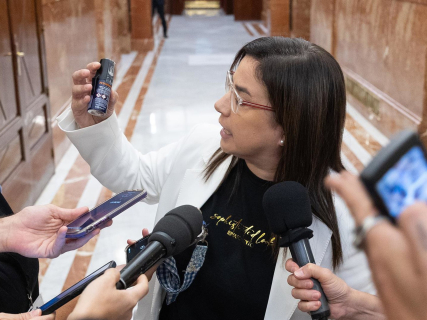
Ana Vázquez, the spokesperson of the PP in the Interior Commission who caused a stir in Congress by showing a can of pepper spray

The parliamentarian for Ourense adds eight legislatures in Congress, is national secretary of Interior of the PP, and has become one of the voices of the party most opposed to Grande-Marlaska.

2 minutes

fotonoticia 20260923113011 1920

fotonoticia 20260923113011 1920

Add DEMÓCRATA to Google

Ask FREN

Published

Last updated

2 minutes

Most read

A can of pepper spray has placed Ana Belén Vázquez Blanco at the center of the Government control session this Wednesday. The PP deputy showed it from her seat during her confrontation with Fernando Grande-Marlaska over the Ceuta crisis, an issue that in recent weeks has occupied a good part of the activity of someone who is, in addition, the spokesperson for the popular party in the Interior Commission.

At the end of the exchange, Armengol asked her to leave the hemicycle and deposit the can. The president invoked Article 101 of the Congress Regulations, related to the display of weapons in the parliamentary headquarters. The episode has focused attention on a deputy who precisely holds the popular spokesperson position in the Interior Commission.

From the mayoralty of Bande to Congress

Vázquez was born in 1975 in Bande, Ourense, a town of which she was mayor. She has a degree in Law and is a career civil servant. Her trajectory in Congress spans eight legislatures, from the VII to the current XV, with an interruption in the XI.

Within the PP, she is part of the National Executive Committee and is the national secretary of Interior. In Congress, she serves as spokesperson for the Interior Commission since December 2023, a position she also held in the previous legislature. She is, therefore, one of the party's voices responsible for confronting Grande-Marlaska's management.

Interior, a long-standing specialization

The spokesperson role for Interior is not an isolated responsibility within her trajectory. Security, National Police, Civil Guard, immigration, and borders occupy a prominent part of her parliamentary activity

The deputy has intervened this legislature and the previous ones on issues ranging from the situation of the State Security Forces and Corps to drug trafficking, immigration policy, or border management. Already in the previous legislature, she participated in debates of the Interior Commission on matters such as the coordination of local police, the resources of the Civil Guard, or the European Pact on Migration and Asylum.

A recurring confrontation with Marlaska

This specialization has made Vázquez one of the regular interlocutors of the PP against Grande-Marlaska. The confrontations between the two are much older than the Ceuta crisis and have occurred in control sessions and parliamentary appearances on various matters dependent on Interior.

One of the last episodes occurred in June, during Marlaska's appearance to explain the death of two civil guards and the injuries suffered by two other agents during the pursuit of a drug boat on the coasts of Huelva. Vázquez intervened on behalf of the PP in a debate focused on the fight against drug trafficking and the means and safety of the agents assigned to these operations.

The Ceuta crisis has opened a new front between both. Vázquez took the floor in the extraordinary appearance of Marlaska on August 28 before the Interior Commission to explain the management of the events that began in the autonomous city at the end of July.

Ceuta, one of its parliamentary fronts

The Ceuta crisis has concentrated several of his recent interventions. In August, he participated in Grande-Marlaska's appearance before the Interior Commission regarding the events that occurred in the city since the end of July. On September 9, during another control session, the PP spread its criticisms of the minister and its request for resignation due to the management of the crisis.

This Wednesday he asked him again about Ceuta. The display of the pepper spray ended up shifting the debate to the compliance with the rules of the hemicycle and with the deputy forced to leave the session to deposit it.

More key points, information and questions with FREN

AI-GENERATED CONTENT

What parliamentary procedures remain pending to amend the Congress Regulations regarding the display of objects considered weapons?

As of today, in the available parliamentary information, there is no specific reform of the Congress Regulations in process dedicated to the display of objects considered weapons in the chamber. The last major “Reform of the Congress Regulations” has already been approved and published in the Official State Gazette (BOE) on 07-28-2026, so that package of changes is concluded. Consequently, there is currently no active regulatory file on weapons in the Plenary, and therefore no specific pending procedures that can be pointed out for that modification. What can be explained precisely are the steps that would remain if such a reform were promoted or underway.

To regulate the display of objects that may be considered weapons in Congress, the ordinary route would be a proposal to reform the Regulations registered by one or more parliamentary groups or, if applicable, a proposal promoted by the Board itself. In both cases, the procedure is governed by the Second Final Provision and articles 124 and following of the Regulations. The first milestone is the qualification and admission for processing by the Congress Board, which decides whether the initiative meets the formal and material requirements to be processed. Once admitted, its publication is ordered in the Official Bulletin of the General Courts and the authors are notified.

After publication, the reform of the Regulations is sent to the Congress Plenary for debate. Unlike an ordinary law, the regulatory reform is the exclusive competence of the lower chamber and does not go through the Senate. In practice, what usually happens is:

  • Debate on consideration or total debate in Plenary, in which the groups present their general positions on the proposed reform, including – if applicable – the new regulation on the display of objects assimilable to weapons.
  • Voting on that initial text. If the Plenary rejects it, the reform fails; if it approves it, the processing continues.

When the Plenary agrees to proceed, the Board may entrust the study of the initiative to a competent committee, which works on the articles. If an express prohibition on displaying certain objects (for example, real weapons, realistic replicas, or objects likely to intimidate) were to be introduced, it is at this level that the wording would be refined: definitions, material scope (chamber, committees, hallways, press conferences), sanctioning regime, and powers of the Presidency to remove objects or expel deputies.

At this stage, the typical procedures to be completed would be:

  • Opening and closing of the amendment period, so that groups can propose changes to the text, whether to toughen, nuance, or soften the limitations on the display of objects.
  • Constitution of a subcommittee within the committee, responsible for drafting a compromise text that integrates, as far as possible, the accepted amendments.
  • Committee report, in which a definitive articulated text is approved to be sent to the Plenary. This report may already contain the final wording of the new provision on “objects considered weapons.”

The report is again submitted to the Congress Plenary, where the final debate takes place. There, live amendments may be recovered for individual voting, or the entire report may be voted on. Approval requires the majority established by the Regulations themselves (traditionally, an absolute majority in a final vote on the entire reform).

If the Plenary approves the text, the reform of the Regulations is definitively adopted. The last stage of the processing, more formal than political, includes:

  • The full publication of the reform in the Official Bulletin of the General Courts.
  • Its publication in the Official State Gazette as “Reform of the Congress Regulations,” as has already happened with the reform published on 07-28-2026.
  • The entry into force, which is usually set for the day after its publication in the Courts Bulletin, unless another date is established.

Only if the reform were effectively stalled at any of these points could there be talk of “pending” procedures in the strict sense: for example, that a committee report already exists and the Plenary vote is missing, or that the Plenary has approved the text and only its official publication remains. With the available data, the last general regulatory reform has already passed all these phases and is published in the BOE, and no specific open reform on the display of objects considered weapons is identified. Therefore, any additional change in this matter would require reopening the entire procedural itinerary described.

Can you explain in detail what exactly changes the reform of the Congress Regulations published in the BOE on 07-28-2026? What powers does the Presidency of the Congress have to order the removal of objects or the expulsion of deputies who disrupt order? Could you compare how other European parliamentary chambers regulate the display of symbols or potentially intimidating objects?

What are the powers and functions of the President of the Congress of Deputies according to Spanish legislation?

The President of the Congress of Deputies is the highest authority of the lower chamber and concentrates, according to the Constitution and the Congress Regulations, functions of institutional representation, direction of parliamentary work, guarantee of order and discipline, as well as key powers in relations with the Government, the Senate, and the Head of State. Many of these functions are exercised personally and others through the Board, which she presides over and coordinates.

1. Constitutional basis and position in the organization of the Chamber

The Constitution (art. 72 CE) recognizes the autonomy of the Chambers to elect their Presidents, approve their Regulations, and manage their own functioning. The Congress Regulations develop this provision and, in Title III, configure the Board as the governing body of the Chamber and establish that the Presidency of the Congress is part of it and directs and coordinates its action (art. 30.2 and 3). The Presidency of the Congress also holds the representation of the Chamber and ensures the smooth running of its work (art. 32.1).

2. Institutional representation and external relations

Externally, the President:

  • Represents the Congress in all acts she attends on behalf of the Chamber (art. 32.1, in connection with art. 30.1).
  • In the constitutive session, once elected, takes the oath or promise to uphold the Constitution and requests it from the other deputies, declares the Congress constituted, and adjourns the session; she also communicates the constitution of the Chamber to the King, the Senate, and the Government (art. 4).
  • Acts as a formal communication channel with public powers and constitutional bodies: for example, she sends to the judicial authority agreements of the Chamber on waivers of immunity and receives orders and sentences affecting deputies (art. 14), or addresses the Court of Auditors or the Ombudsman to request reports or actions (arts. 199 and 200).
3. Direction of work, debates, and votes

In directing internal work, the President:

  • Convenes the Board and directs its functioning, with the assistance of the General Secretariat (art. 35.1).
  • Convenes the Congress Plenary on her own initiative or at the request of two parliamentary groups or one-fifth of the deputies (art. 54).
  • Holds the presidency of the Permanent Deputation and convenes it ex officio or at the request of two groups or one-fifth of its members (art. 56.1 and 4).
  • Directs Plenary debates, maintains order in them, and organizes speaking turns and intervention times, often after consulting the Board of Spokespersons (art. 32.1 and numerous specific provisions; for example, she can set times and turns in debates on Government communications, reports, or appearances: arts. 197, 200, and 203).
  • Declares sessions open and adjourned, checks quorum, orders votes, and proclaims their results, according to general voting rules.
4. Order, discipline, and guarantees of deputies

As the highest authority of the Chamber, the President exercises powers of parliamentary order and discipline, which include:

  • Ensuring that deputies observe the Regulations, order, courtesy, and parliamentary discipline (art. 16, in connection with the order powers of art. 32.1).
  • Calling to order, withdrawing the right to speak, or, in serious cases, adopting disciplinary measures provided for in the Regulations in case of disturbances or disobedience.
  • Immediately adopting necessary measures to safeguard the rights and prerogatives of the Chamber and its members in the face of detentions or other actions that may hinder a deputy's mandate (art. 12).
5. Agenda, government oversight, and relations with the Senate and other bodies

Although the overall programming is decided by the Board, the President has a central role in setting and executing the agenda:

  • Participates, through the Board she presides, in programming the general lines of action of the Chamber and in setting the calendar of activities of the Plenary and Committees (art. 31.1.6), after hearing the Board of Spokespersons.
  • Channels, with the support of the Board, the processing of interpellations, questions, non-legislative proposals, communications, and Government appearances, ensuring their compliance with the Regulations and ordering their debates (arts. 31, 180 et seq., 193 et seq., 196 et seq., 203).
  • In the Permanent Deputation, which she presides, intervenes in the exercise of Congress powers when it is dissolved or out of session, including those related to decree-laws and states of alarm, exception, and siege (art. 57).
6. Investiture of the President of the Government, dissolution, and internal administration

Regarding investiture, the President directs, according to art. 99 CE and Title VIII of the Regulations, the investiture sessions: convenes the Plenary, orders debates with the candidate proposed by the King (arts. 170 et seq. of the Regulations), submits the confidence vote, and communicates the result to the Head of State. If investiture is not achieved within constitutional deadlines, she also intervenes in the procedure leading to the dissolution of the Cortes, according to art. 99 CE.

Internally and administratively, the President:

  • Orders Congress payments and may delegate this power (art. 32.1), within a budget prepared, directed, and controlled by the Board (art. 31.1.2 and 3).
  • Directs the General Secretariat and supervises the execution of Board agreements (art. 35.1).
  • Collaborates in organizing the personal and material resources of the Chamber, whose job positions list is approved by the Board (art. 60).

In sum, the President of the Congress concentrates a bundle of powers combining institutional representation, political and technical direction of parliamentary work, guarantee of deputies' rights, and custody of order and the Chamber's autonomy, always within the framework set by the Constitution, laws, and Regulations.

Could you detail with concrete examples how the President exercises her powers of order and discipline in the Plenary? What differences are there between the functions of the President of the Congress and those of the President of the Senate according to their respective regulations? How is an investiture session developed step by step under the direction of the President of the Congress?

What has been the complete political and professional trajectory of Fernando Grande-Marlaska before becoming Minister of the Interior?

Fernando Grande-Marlaska Gómez, born in Bilbao in 1962, arrived at the Ministry of the Interior in 2018 after a long career in the judiciary and a public profile linked to the fight against terrorism, management of major criminal cases, and defense of LGTBI rights. The institutional sources consulted present him, first and foremost, as a magistrate, and only later as a political leader of the Spanish Socialist Workers' Party (PSOE).

The databases of positions and parliamentary biographies indicate that his profile is that of a career jurist. The available biographical record summarizes that, before becoming minister, he developed a solid judicial career and became especially known for his work in the National Court, the central specialized court in terrorism, organized crime, and crimes of special significance. Although the consulted records do not detail year by year his assignments nor the exact dates of each appointment, they do highlight that much of his professional prestige is built precisely in that body.

In the National Court, sources emphasize his role in the fight against ETA and his participation in high-profile cases, with explicit mention of the Yak-42 accident case. Such matters, of great political and social sensitivity, require magistrates to have very specialized knowledge of criminal law, procedural law, and international judicial cooperation, placing those who investigate them at the center of public debate. The parliamentary biography presents Grande-Marlaska as one of those judges who, from the criminal jurisdiction of the National Court, take on cases that set the national agenda.

The biographical summary also indicates that, before entering the Government, his figure was perceived fundamentally as that of a justice professional, not a party politician. There is no evidence in the consulted institutional records that he had held elected political positions or notable organic posts in party structures before 2018. In fact, the only strictly political responsibilities appearing in the database (board memberships and spokesperson roles in various Congress of Deputies committees within the Socialist Parliamentary Group) are after his ministerial stage and correspond to the current phase of his career, so they fall outside the period you ask about.

Regarding possible responsibilities in judicial governing bodies, such as the General Council of the Judiciary, specific searches in administrative and appointment databases have not retrieved any structured position of Fernando Grande-Marlaska in that area. The administrative positions record only registers, as a high-level appointment, that of Minister of the Interior, and queries focused on Justice bodies (National Court, CGPJ, Ministry of Justice) do not return rows associated with him. This does not allow reconstructing precisely whether he performed specific functions in those bodies, beyond the general reference to his work in the National Court provided by the summarized biography.

Before arriving at the Ministry, his public profile was not limited to his technical performance as a judge. The biographical record itself highlights that Grande-Marlaska is openly homosexual and a figure linked to the defense of LGTBI rights. It is indicated that he has been married since 2005 and has participated in social campaigns, which helps position him as a symbolic reference of diversity within the judiciary and, later, Spanish politics. This civic dimension, although not an institutional position in the strict sense, is part of his trajectory prior to the Interior portfolio.

Another milestone before entering the Government is the publication, in 2016, of an autobiography. The parliamentary biography records it as a relevant element of his profile: a magistrate who decides to narrate his life and professional experience, which reinforces his media presence and public knowledge of his judicial decisions and his stance on issues such as terrorism, victims' memory, or fundamental rights. This editorial step consolidates the transition from a judge known in legal and journalistic circles to a figure recognizable to the general public.

In summary, and considering only the evidence available in the consulted sources, Fernando Grande-Marlaska's trajectory before becoming Minister of the Interior can be described as follows: career magistrate, with a central part of his professional life in the National Court, where he became visible for his role in the fight against ETA and in emblematic cases such as Yak-42; a public figure associated with the defense of LGTBI rights and personal testimony about his life and work, crystallized in an autobiography published in 2016; and without clearly documented institutional political positions before his appointment in 2018, when he began to hold a top-level government responsibility for the first time.

Can you explain in more detail what the National Court is and what types of cases like Yak-42 and ETA it handles? What role has Fernando Grande-Marlaska played in defending LGTBI rights and how has that influenced his public trajectory? After being Minister of the Interior, what positions and responsibilities has Fernando Grande-Marlaska assumed in Congress and the Government?

Play

Test your knowledge with FREN!

How much do you know about this topic? Answer the following 3 questions.

What object did Ana Belén Vázquez show during the government control session in Congress?

Question 1 of 3

Which article of the Congress Regulations did the president invoke to ask Ana Belén Vázquez to deposit the object?

Question 2 of 3

In which area is Ana Belén Vázquez specialized within her parliamentary activity?

Question 3 of 3

Hola, soy Fren. ¿Cómo te ayudo?