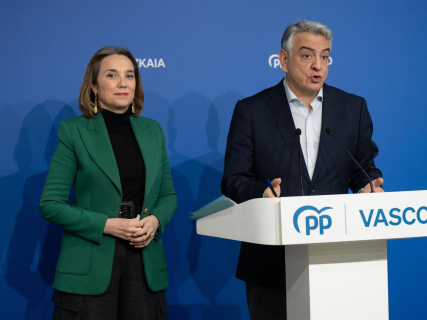

The president of the Basque PP, Javier de Andrés, has reiterated that his party would have "no possibility" of pushing through a possible Government in which the support of the PNV was essential, considering that the jeltzales are "one hundred percent committed to the PSOE" and that "it is a part of the Socialist Party".
In an interview on RNE, reported by Europa Press, De Andrés has pointed out that he is "aware that we cannot count in any case on the support of the PNV", underlining that that route is completely closed off for the Popular Party.
Regarding the Basque sociometer, the Popular leader has admitted that his party's goal is to "win the Gipuzkoa seat", a constituency in which they currently have no representation, and thus "achieve that in the three territories there would be representation of the Popular Party".
He recalled that "the reality is that Gipuzkoa, the six deputies it sends to Congress, the six support Pedro Sánchez and that pact with the PSOE, so really there is no other alternative than that of the PP", a situation he has regretted considering that it leaves no option for other political approaches.
Criticism of Óscar Puente and the political model
Asked about the continuity of the Minister of Transport and Sustainable Mobility, Óscar Puente, and whether he should resign or be dismissed, De Andrés has admitted that he is beginning to think that "maybe there is no one better than Mr. Puente to assume responsibility" for that department, since "because, if they have not already removed him with everything that has happened so far, one can think that maybe there is no one better in the entire Socialist Party".
From this reflection, he has defended that what is required is "a comprehensive change of the political model" and has pointed out that "there is an opportunity" for this in the upcoming elections, where, in his opinion, citizens will be able to express their rejection of the current course of the central Government.
Housing and questioning of private property
Regarding the housing decrees that the Executive intends to push through in the Permanent Deputation, Javier de Andrés considers that they "question private property" and has warned that "there is nothing worse than trusting in the political and economic system we have if private property is being questioned and the consequences of the social policy of a failed government are imposed on an individual".
As he explained, the housing crisis "has to be solved by building more, which is what has not been done, and by facilitating" administrative procedures, "also adjusting the tax cost, which is a third of the cost of a home." In his view, the solution lies in easing the tax burden and speeding up the promotion of new homes.
De Andrés has insisted that "if more housing is built, as the law of supply and demand always dictates, housing prices will fall and will consequently be more accessible for the whole of the citizenry, especially for all those young people who today find themselves without a home."
Strengthen the authority of the Ertzaintza
Lastly, he has claimed that the Ertzaintza "and in general the whole Police in Spain" need "a reinforcement of the sense of authority," and he has considered that this consideration "has been taken away" from the Basque police.
In his opinion, "it has lost the respect of part of the population, which, as we are seeing, acts in an absolutely unjustified manner," and he has denounced that "there are many cases in which the ertzainas themselves run ahead of the 'borrokas'," something which, in his view, "does not favor an image of authority".
In this line, he attributes an "undoubted political responsibility" to the Minister of Security, Bingen Zupiria, as well as to the "whole Basque Government and the Lehendakari himself," whom he holds responsible for the deterioration of the police "sense of authority" in Euskadi.