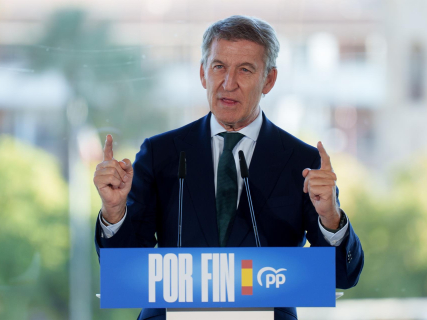

The president of the PP and candidate for the Presidency of the Government, Alberto Núñez Feijóo, has included in his lists for the general elections on November 29 nine regional councilors, which will force the heads of the Executives of Galicia, Castilla y León, Cantabria, Comunidad Valenciana, Murcia, Madrid, and La Rioja to make changes in their regional governments.
With an eye on a possible arrival at La Moncloa, Feijóo has chosen to surround himself with officials with extensive management experience, incorporating into his candidacies 11 public officials from nine regional governments (nine of them councilors) and 236 mayors, including six mayors of provincial capitals.
In detail, the leader of the PP has added the councilor of the Presidency of Cantabria, Isabel Urrutia (Congress); the councilor of Education of Castilla y León, María Pardo (Congress); the councilor of Social Services, Family, and Childhood of the Generalitat Valenciana, Elena Albalat (Congress); and the councilor of Social Policy of the Xunta de Galicia, Fabiola García (Congress).
The councilor of Interior of the Community of Madrid, Carlos Novillo (Congress); the councilor of Tourism of the Region of Murcia, Carmen Conesa (Congress); the councilor of Education of La Rioja, Alberto Galiana (Congress); the councilor of Urbanism and Transport of Ceuta, Rafael Martínez Peñalver (Congress); and the councilor of Culture, Tourism, and Sports of Cantabria, Luis Venancio Martínez Abad (Senate) are also included in the lists.
These movements require changes in their cabinets for Alfonso Rueda (Galicia), Alfonso Fernández Mañueco (Castilla y León), María José Sáenz de Buruaga (Cantabria), Juanfran Pérez Llorca (Comunidad Valenciana), Fernando López Miras (Murcia), and Isabel Díaz Ayuso (Community of Madrid). The president of Ceuta, Juan Jesús Vivas, will also have to face a government crisis after the departure of one of his councilors to occupy a seat in the new Chambers of the XVI legislature, whose constitution is scheduled for December 23.
SUSANA CAMARERO GOES TO THE SENATE BUT WILL REMAIN IN THE CONSELL
The Organic Law of General Electoral Regime (LOREG) establishes the incompatibility between serving as a regional councilor and running as a candidate for the Congress of Deputies, so those listed for the Lower House must abandon their responsibilities in the regional executives.
On the other hand, the rule is more lenient regarding the Senate, as it is the chamber of territorial representation. Thus, the first vice president and councilor of Housing, Employment, Youth, and Equality of the Valencian Community, Susana Camarero, will continue to be part of the Consell and will maintain her competencies despite heading the PP list for the Senate for Valencia, as confirmed to Europa Press by sources from the Generalitat.
SOME CHANGES HAVE ALREADY BEEN MADE
The president of the Community of Madrid, Isabel Díaz Ayuso, has been the last to announce a restructuring of her Executive. She has modified three ministries following the incorporation of councilor Carlos Novillo and deputy councilor José Antonio Sánchez to the PP candidacy for Madrid led by Feijóo. The replacement of Novillo in Environment, Agriculture, and Interior will be Jorge Rodrigo, who leaves his functions in Housing and Transport.
In Castilla y León, the replacement has already been completed: this Monday, María del Valle Ares, until now the general secretary of the Ministry of Education, has taken office, replacing María Pardo, head of the PP list for Valladolid.
There are also variations in the Government of the Canary Islands, presided over by Fernando Clavijo (CC), supported by the PP, after Feijóo chose Gustavo González de Vega, deputy councilor of Economy in the islands, to lead the list for Congress for the province of Santa Cruz de Tenerife.
In the candidacy for Congress for the Balearic Islands, led by the president of the PP of Eivissa, José Vicente Marí Bosó, the "number two" will be Antònia Roca, current first vice president of the Consell of Mallorca and island councilor of Culture and Heritage, which will also imply a reorganization in that island body.
NUMEROUS MAYORS ON FEIJÓO'S LISTS
In addition to regional councilors, Feijóo has included 236 mayors in his lists for Congress and the Senate, several of them from large municipalities. The first name to be announced was that of Xavier García Albiol, mayor of Badalona (Barcelona), who will be "number one" of the PP for Congress for Barcelona.
Likewise, the mayor of Valencia, María José Catalá, the mayor of Huelva, Pilar Miranda, and the mayor of Toledo, Carlos Velázquez, lead the lists for Congress for their respective provinces.
In the Upper Chamber, several councilors will also accompany Feijóo in the general elections of November, such as the mayor of Santander, Gemma Igual, the mayor of Teruel, Emma Buj, or the mayor of Valladolid, Jesús Julio Carnero, who heads the party's list for his province to the Senate again.
Likewise, the four presidents of the provincial councils of Córdoba, Málaga, Ávila, and Soria appear on the lists, who will become part of the next Popular Parliamentary Group in the Senate.
The City Council of Madrid will also have a presence in the PP's candidacy for the Upper Chamber, with the deputy mayor Inmaculada Sanz as "number two" on the Senate list behind Pedro Rollán.
RENEWAL OF 60% IN THE HEADS OF LIST FOR CONGRESS
The Electoral Committee of the PP, chaired by the Galician Diego Calvo, has given the green light this Monday to the lists for the Congress of Deputies and the Senate with which the party will run in the general elections, on the deadline to register candidacies.
In these lists, 31 of the 52 heads of list for Congress are renewed, which represents 60%. In the Senate, of the 58 "number 1s" of the PP, 41 are new, so there has been a renewal of more than 70% of the main candidates for the Upper Chamber, according to the formation in a note.
In that statement, the PP specified that the criterion of the Electoral Committee for configuring the candidacies has been to incorporate people with "an extensive political career, as well as a proven experience in public management and in the private sector."
The party has emphasized that, given the significance of these elections, "the most decisive since the Transition due to the drift in which the Government has placed Spain," a broad renewal of the lists has been promoted, adding profiles that, "due to their political background, broaden and enrich the project presided over by Alberto Núñez Feijóo."
"These candidacies have been crafted with unity and thinking only of forming solid parliamentary groups to provide the best service to Spaniards from the General Courts," adds the statement, in which it is emphasized that the Electoral Committee has chosen representatives who "know the challenges and needs of the citizens of their constituency and who will defend their interests."