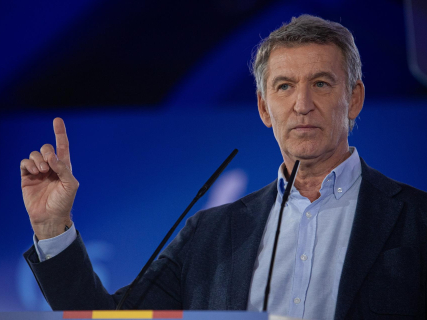

The president of the Popular Party, Alberto Núñez Feijóo, on Monday, November 2, directed one of his harshest rebukes at the Minister of Transport, Óscar Puente, over his statements following the Urda (Toledo) railway accident. During his speech before the PP National Executive Committee, the opposition leader questioned the minister for speaking of the political "calvary" that awaits him after the tragedy and reminded him of the suffering of the relatives of the 69 people who died.
"No, Mr. Minister. The calvary is not being suffered by you; it belongs to the families waiting for a body, to those who will never see a loved one again, to an entire town", Feijóo stated, in reference to the words spoken by Puente during his appearance last Friday. The Popular leader made remembrance of the victims the axis of a speech in which he also demanded political responsibility for the Adamuz and Urda accidents, which total 115 fatalities, and questioned the management of the railway system in recent years.
The meeting of the PP's highest governing body between congresses began with a minute of silence in memory of the victims of Urda. The meeting, held at the party's national headquarters on Calle Génova, marks the resumption of the Populars' political activity after the three days of official mourning and serves to define the strategy ahead of the general elections next November 29.
Feijóo responds to Puente's "calvary": "This attitude is infame, it is mean"
Óscar Puente's statements last Friday have centered an important part of the PP leader's criticisms. During that appearance, the Minister of Transport ruled out resigning and said he was prepared to bear the political consequences of the accident, including personal attacks and demands for responsibility during the electoral campaign.
"I know the calvary they are going to subject me to, on top of that in an electoral campaign", Puente stated, who also explained that leaving office did not fit with his way of facing responsibilities and that it was not what Pedro Sánchez had asked him for either. The minister defended that his duty was to keep giving explanations, clarify what happened and work to improve the safety of the railway system.
Asked about the possibility that his resignation would comfort those affected, Puente responded by questioning to what extent that gesture would alleviate the suffering of a person who had lost a child, a father or a leg.
Feijóo has rejected this approach and has accused the Government of interpreting the tragedy from the perspective of its own political survival. In his speech he argued that the Executive has striven from the very first moment to find a culprit to whom to transfer responsibility for the accident, instead of assuming the political consequences of railway management.
"It is as if political responsibility did not exist in the face of two successive accidents with 115 dead on the same line after everything that could fail failed," he denounced. The PP president raised the tone even further by stating: "It is no longer just that it is evident that they are not good managers, I doubt that they are also good people. This attitude is infamous, is vile".
The leader of the opposition wanted to expressly differentiate between the responsibilities of political leaders and those of railway professionals. "All our support for the drivers, the controllers and the employees of Adif and Renfe", he noted, after questioning that workers could end up individually assuming the consequences of deficiencies he considers structural.
"The wall is the only promise this Government has fulfilled"
The criticism of railway management has served Feijóo to broaden his speech against the entire Pedro Sánchez Executive. The PP leader has accused the Government president of having turned his stay in Moncloa into the main objective of his political action, relegating the management of public services and the needs of citizens to the background.
"The wall is the only promise this Government has fulfilled and managing has ceased to be important", lamented the PP leader, recovering one of the expressions he has been using to question the political confrontation strategy that he attributes to Sánchez.
"When power is the end, any concession is admissible, anything goes as long as one stays. But eight years later the question is unavoidable: what has power used in this way been for?", he added during his speech.
Feijóo maintains that the tragedy of Urda has brought to light, in his opinion, the consequences of a model of Government more concerned with maintaining its parliamentary support than with guaranteeing the functioning of essential infrastructures. In this regard, he has again placed management as one of the main elements of differentiation between the PP and the PSOE.
These assessments are part of the political discourse of the opposition leader. The technical causes of the accident and the possible individual or institutional responsibilities remain pending the corresponding investigations, so there is still no definitive conclusion that allows the mishap to be attributed to a specific Government decision.
Feijóo accuses the Government of being more concerned with "the narrative than with the victims"
Before the meeting of the National Executive Committee, Feijóo had already anticipated his criticism during an interview granted this Monday to Telecinco, reported by Europa Press. In it he has assured that the Government "is more interested in the narrative than in the victims" and has reproached it for the fact that no resignation has yet occurred after the railway accidents recorded this year.
The Popular leader has compared the actions of the Transport ministers appointed during Sánchez's governments, José Luis Ábalos and Óscar Puente, with the management experience he claims for himself and for the regional leaders of his party.
Feijóo has also warned that there is a loss of confidence in the Spanish railway system and has extended his concern to other public services and strategic areas, such as the power grid, roads, or border security. In his opinion, the Executive has neglected the basic operating criteria of these infrastructures.
During the interview he insisted that, if he reaches the Presidency of the Government, he will promote an audit of public spending and another specifically railway one, with the aim of reviewing the state of the facilities, learning about the investments carried out, and determining what actions should be undertaken.
"I am not a cardboard character. I am not coming to dance. I am coming to manage", Feijóo has stated, who has defended that positions of responsibility should be occupied by professionals with experience and accredited knowledge.
The PP promises to audit the railway network and prioritize maintenance
The proposals announced by Feijóo are part of a strategy that the popular president began to flesh out last Friday, after holding a meeting with experts in infrastructure and railway safety at the party headquarters.
The PP defends an independent technical review of the Spanish railway network and an emergency plan focused on the safety, maintenance, and conservation of the facilities. Feijóo has also proposed strengthening the security areas of Adif and Renfe, as well as reviewing the selection procedures for the technical heads of these organizations.
The popular leader considers that the Urda accident cannot be analyzed as an isolated episode after the Adamuz disaster, which occurred in January. In his previous statements he had accused the Government of not renewing certain safety systems in time and had questioned the destination of the investments intended to improve the Madrid-Andalusia railway corridor.
He had also announced that, if he governs, he will give priority to the conservation of existing infrastructure over the construction of new lines, a decision that he presents as necessary to restore travelers' confidence.
In parallel, the Partido Popular announced this Sunday that it will appear in the judicial case opened by the railway accident in Urda, with the declared purpose of promoting the clarification of the facts and demanding that the possible responsibilities be investigated.
Puente rejects having blamed a worker and accuses Feijóo of applying a double standard
The confrontation between Feijóo and Puente also extends to the interpretation of the known data about the accident. The PP leader maintains that the Government has tried to shift attention toward a worker from the railway control center of Atocha, after the communications maintained before the collision were made public.
Puente, for his part, has denied having blamed a specific person for the disaster. In an interview given on Friday to the program Malas Lenguas, on TVE, he maintained that his action had been limited to presenting the facts and the available evidence, and he rejected the notion that the investigation was being focused exclusively on an operator.
The minister also accused Feijóo of applying a "double standard" when comparing his current demands for political responsibilities with his position on the railway accident in Angrois, which occurred in 2013.
As for the term "calvary," Puente later clarified that he was referring to the insults, disqualifications, and personal attacks he expected to receive during the coming weeks, and he did not intend to equate that situation with the suffering of the victims.
The tragedy of Urda marks the final stretch toward the 29N elections
Feijóo’s intervention comes less than four weeks before the general elections of November 29, in a political scenario conditioned by the railway accidents of Adamuz and Urda. The PP had suspended its main pre-campaign events during the official mourning period and has chosen an internal meeting of its leadership to resume activity.
The Popular leader has announced that he will not change the central axis of his campaign, based on contrasting his management experience with the actions of the Socialist Executive. As he explained, he will ask the leaders of his party to maintain rigor in their interventions and avoid entering into what he calls the PSOE's "tricks" and "stories."
Meanwhile, Óscar Puente is scheduled to appear this Tuesday, November 3, before the Permanent Deputation of the Congress of Deputies to offer new explanations about the Urda accident. The minister will also take part in the press conference after the Council of Ministers, which is expected to approve a decree of aid for the victims and their relatives.
The appearance will take place in a context of growing parliamentary pressure on Transport, with several groups calling for the minister's resignation. The Government maintains for now its support for Puente, while the judicial investigation into the accident continues.
Feijóo has thus closed a new phase of his political offensive against Sánchez and Puente, with responsibility for the railway tragedy and the management of public services at the center of the electoral debate. His message before the National Executive Committee places the suffering of the families as the main argument of his criticism of the minister, while presenting the review of railway safety as one of the commitments of his Government alternative.