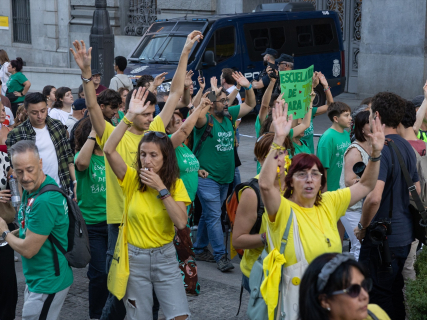
New week of strikes in Madrid education with a demonstration on Thursday in front of the Ministry.

The Madrid teaching staff faces its second week of indefinite strike with new mobilizations and without progress in negotiations with Ayuso's Government. The unions maintain their demands regarding salaries, teaching hours, and resources for public education.

EuropaPress 7845529 grupo personas concentracion motivo huelga indefinida educacion 14 octubre

EuropaPress 7845529 grupo personas concentracion motivo huelga indefinida educacion 14 octubre

Add DEMÓCRATA to Google

Ask FREN

Published

Last updated

3 minutes

Most read

España vota · Congreso y Senado

Elecciones generales 29 de noviembre de 2026

Se eligen 350 diputados y los senadores de elección directa. Encuestas, calendario, candidaturas, programas y todo lo que necesitas saber para votar.

Faltan 40 días y 23 horas para que abran los colegios electorales.Hasta que abran los colegios, el domingo 29 a las 09:00 (hora peninsular).
Entra en el especial

Próximas fechas

  1. Presentación de candidaturas al Congreso y al Senado21–26 oct · Fecha prevista
  2. Voto desde el extranjero (CERA): envío de la documentación24–30 oct · Fecha prevista
  3. Publicación de las candidaturas presentadasFecha prevista
  4. Proclamación de candidaturasFecha prevista
Calendario completo

The indefinite strike of public education in Madrid continues this Monday, October 19, after three days of strikes and demonstrations without the convening unions and the Government of Isabel Díaz Ayuso reaching an agreement. The teachers have organized new protests for the next five days, including a demonstration on Thursday through the center of the capital, while insisting on their demands regarding salaries, teaching hours, and staffing in public centers.

The second week of the strike has begun with a traffic blockade on the A-3, at the height of Moratalaz, where a group of teachers has placed desks and chairs on the roadway. The unions have also called for a concentration this noon in front of the Ministry of Education, demanding that it negotiate the labor and organizational improvements they consider necessary for the functioning of public education.

The strikes, which began last Wednesday, October 14, are called by CCOO, CGT, CNT, Solidaridad Obrera, STEM, and UGT, along with the platforms Dignified Special Education, Less Teaching Hours, and We Want Vocational Training. The organizations demand concrete commitments from the regional government and, although they have announced mobilizations until Friday, they have not set a date to end the strike.

Five days of protests and a demonstration on Thursday

The unions have organized different activities for this week, with concentrations in front of regional institutions and assemblies in educational centers. After the protest this Monday in front of the Ministry, on Tuesday, October 20, the so-called "Green Tuesday" will be held, during which the teachers will meet to discuss their demands and the evolution of the strikes.

On Wednesday, October 21, the mobilizations will take place in different parts of the region, with territorial assemblies and decentralized actions. The goal of the conveners is to facilitate the participation of workers from different centers and municipalities, in addition to coordinating the protests of the coming days.

On Thursday, October 22, the teachers will concentrate between 10:00 AM and 2:00 PM in front of the Assembly of Madrid, before returning to demonstrate in the afternoon through the center of the capital. The march will begin at 6:00 PM in Atocha and will end in front of the Ministry of Education.

The unions have called for Friday the 23rd, at 12:00 hours, a unitary assembly in the Plaza de Oriente, where teachers will discuss the continuation of the strike and the upcoming mobilizations.

A first week of strike with disparate follow-up figures

The protests began on Wednesday, October 14, and during its first three days brought together teachers from different educational stages, from Early Childhood and Primary to Secondary, Baccalaureate, and Vocational Training. The demonstrations traversed several streets in the center of Madrid and were accompanied by gatherings in front of the Ministry and other actions organized by the workers.

The unions estimated the participation in the strike at 70% during the first day, held on Wednesday, October 14, compared to the 44% reported by the Ministry of Education. This gap between figures was repeated on Thursday, when the union organizations placed participation at 60%, while the regional government lowered it to 26.7%.

During the first days, early childhood educators blocked traffic on Paseo de la Castellana and teachers organized a human chain in front of the Ministry of Education. On Friday, thousands of teachers demonstrated from Atocha to Puerta del Sol, in a march after which the unions announced that the strike would continue the following week.

The Ministry has questioned the motivations for the call and considers that there is a political and electoral component in the mobilizations. The union organizations reject that interpretation and argue that their demands respond to labor and educational problems that they have been raising with the regional government for some time.

The reduction of teaching hours and the improvement of staff, among the main demands

The teachers demand a reduction of teaching hours that allows them to dedicate more time to class preparation, coordination with other professionals, and individualized attention to students. The unions believe that the current distribution of the day, along with the volume of administrative tasks, hinders the development of these functions and increases the workload.

They also demand salary improvements, a decrease in the student-to-class ratios, and the hiring of more professionals, especially in those centers that need to strengthen support for students with specific educational support needs.

The unions also demand improvements in the facilities of educational centers, more material resources, and a reduction of the bureaucratic burden on teachers. These demands are joined by those of the Special Education and Vocational Training platforms, which call for specific measures for their respective educational stages.

The unions link these demands to both the working conditions of teachers and the quality of education that students receive, and they consider that any agreement with the Administration must include improvements in both areas.

More key points, information and questions with FREN

AI-GENERATED CONTENT

What parliamentary procedures are necessary to modify the working conditions of teaching staff in the Community of Madrid?

Not every modification of the working conditions of teaching staff requires a law or a parliamentary vote. In the Community of Madrid, the procedure depends on which condition is to be changed, the regulation governing it, and the autonomous competencies. When a law is necessary, its approval corresponds to the Assembly of Madrid.

1. Determine if parliamentary intervention is needed

Before starting a reform, it is necessary to distinguish between civil servant teachers, labor personnel, and teachers from private or chartered centers: they do not necessarily share the same legal regime. It must also be identified whether the intention is to modify working hours, leave, remuneration, job access, or job stability.

The essential distinction is the rank of the regulation: a regulation cannot modify what a law establishes, except by express legal authorization. However, aspects that can be regulated by administrative provisions do not require the approval of a law in the Assembly. Collective bargaining and agreements with teacher representatives also do not replace legal reform when it is necessary. Madrid must also respect the applicable state framework.

2. Present the legislative initiative

Article 139 of the Assembly Regulations recognizes several routes:

  • Government Council bill. The regional executive promotes the reform and submits the text to the Assembly.
  • Bill proposal by deputies or parliamentary groups. Allows promoting changes from the Chamber, through the corresponding regulatory procedure.
  • Citizen or municipal initiative. Can be exercised through a bill proposal, complying with the requirements and limits of its specific legislation.

Parliamentary proposals go through a consideration phase: the Chamber decides whether to start processing them. This procedure is not required for bills submitted by the Government.

3. Admission, publication, and amendments

For bills, Article 140 requires an articulated text, statement of reasons, and necessary background to pronounce on it. The Assembly Board qualifies it, orders its publication in the Official Bulletin of the Assembly of Madrid, opens the amendment periods, and refers it to the competent committee.

Article 141 distinguishes two modalities:

  • Amendments to the entirety: parliamentary groups may request the return of the bill to the Government or present a complete alternative text. The deadline is ten days from its publication.
  • Amendments to the articles: deputies and groups may propose deletions, modifications, or additions within twenty days following publication.

During the first ten days of the article amendment period, citizens of the Community may submit written considerations. These are forwarded to the groups; they do not equate to parliamentary amendments. This procedure does not apply to the budget bill or statutory reform.

4. Debate, drafting of the text, and approval

If amendments to the entirety are presented, the Plenary holds the debate provided for in Article 142, with intervention from the Government and the groups. If the bill continues, the ordinary procedure includes the work of the committee, the debate in committee, and the drafting of the report submitted to the Plenary.

Groups may negotiate and vote on changes during this processing. The approval of an ordinary law is generally governed by a simple majority, without prejudice to quorum requirements and special majorities that may apply. After approval, promulgation and official publication follow; application will begin according to its entry into force clause.

In short: the parliamentary process is necessary when the modification requires legal rank. To specify this, the working condition and the provision to be changed must first be identified.

What competencies does the Ministry of Education of the Community of Madrid have regarding collective bargaining and regulation of working conditions?

The Ministry of Education of the Community of Madrid can negotiate and specify working conditions of personnel within its scope, especially non-university public teaching staff. However, it cannot freely modify state legislation nor unilaterally approve all agreed improvements: the Government Council, bodies competent in public function and Treasury, and when appropriate, the Assembly of Madrid also intervene.

1. Personnel management and autonomous development

The framework combines the Statute of Autonomy, the Law 1/1986 on Public Function, and the Basic Statute of the Public Employee —EBEP—. Madrid can develop the regime of its civil servants within the state bases; this autonomous competence does not equate to attributing all decisions to Education.

Within its scope, the Ministry manages teaching staff needs, staffing, assignments, provision of positions, leave, licenses, and organization of educational services. It can prepare proposals and issue provisions and instructions within its powers, but an instruction cannot contradict a law, a superior regulation, or a binding agreement.

2. Collective bargaining: what can be negotiated

Article 33 of the EBEP requires legality, budget coverage, obligatoriness, and good faith, as well as publicity and transparency. Therefore, negotiation is not only a political possibility: there is an obligation when decisions are made on matters legally subject to negotiation, although this does not oblige reaching an agreement.

The Sectoral Board of Non-University Teaching Staff is the specific channel for civil servant teachers. According to Article 34 of the EBEP, it addresses sector matters not decided by the General Board, or those referred or delegated to it. Conditions common to the entire public employment correspond to the competent general boards.

Within the legal margin, educational negotiation may include working hours and schedules, leave, work-life balance, training, risk prevention, provision criteria, career progression, and complementary remuneration. As a precedent, the agreement approved in January 2018 included staffing, leave, six-year increments, and conditions of interim staff.

3. What can be regulated and with what limits

  • Working hours and organization: it can negotiate and specify the distribution of teaching work and teaching hours within the applicable framework. Reducing class hours does not necessarily mean reducing the total working day.
  • Remuneration: it can promote improvements in regional complements, but cannot freely alter basic remuneration. Article 21 of the EBEP prevents globally exceeding state limits on salary mass increases.
  • Leave and licenses: it manages their granting and can promote improvements within the spaces allowed by regulations, without replacing or reducing legally established rights.
  • Administrative organization: it retains powers to organize centers and distribute resources, but these do not allow evading negotiation obligations regarding their effects on working conditions.

4. Who approves and which personnel it affects

Negotiating, signing, and approving are different actions. Agreements affecting competencies of governing bodies require their express and formal approval. An example is the educational agreement signed on April 4, 2025, and approved by the Government Council on April 23, regarding reduction of teaching hours and incorporation of teachers.

Additionally, civil servant teachers must be distinguished from labor and non-teaching personnel: the latter are governed by their own rules, agreements, and negotiation scopes, not automatically by the teaching board.

In chartered education, public funding does not make the Ministry the employer. Labor relations fall under the Workers' Statute and applicable agreements. Education can intervene through funding and agreements with employers' associations and unions, but cannot unilaterally replace that negotiation.

What legal requirements must be met to call and maintain an indefinite strike in the public education sector in Spain?

Insufficient information was found in the consulted sources to provide you with a verified legal answer regarding the requirements to call and maintain an indefinite strike in public education. To avoid attributing deadlines, obligations, or exceptions to the legislation without support, I indicate the points that this verification must cover before making decisions.

The following is a checklist, not a confirmation that a specific call complies with the regulations. The review must distinguish both the initial call and the conditions affecting its continuity.

1. Personnel and scope of the call

First, it is necessary to identify to whom it is addressed: civil servant teaching staff, interim staff, labor personnel, administrative and service staff, or contractor company workers. It is also advisable to specify whether it affects university or non-university centers, one autonomous community or several. It should not be assumed that all these groups have the same legal regime or the same employer.

2. Who calls and how the agreement is adopted

The review must determine who is legitimized to call and what procedure corresponds according to the caller. It must be reviewed how the agreement is accredited, who signs it, and what representation they hold. If the decision comes from an assembly, the applicable rules for its holding, participation, and voting must be verified, without automatically transferring the requirements of one type of call to another.

3. Prior communication and indefinite duration

The applicable notice period and its recipients must be contrasted, especially since it is a public service. The communication must be reviewed regarding its content: reasons, scope, start date, modality, duration, and persons responsible for interlocution. It must also be clarified how the indefinite nature is expressed and whether any subsequent modification requires a new communication. It would not be prudent to set a number of days here without verifying its basis and application to the affected group.

4. Objectives and development of the strike

Another essential point is to check the purpose of the demands and the circumstances that could affect the legality of the call or certain actions during its development. The review must separate participation in the strike from specific behaviors: information, gatherings, access to centers, or actions affecting those not participating. An eventual individual irregularity should not be confused with a legal assessment of the entire strike.

5. Minimum services and safety

Any resolution establishing minimum services for that call must be located and examined regarding who issues it, its motivation, scope, and individual designations. It is important to distinguish these services from security or conservation tasks that may correspond. The channels and deadlines for challenging must also be checked: questioning a resolution and determining which obligations remain enforceable while it is resolved are different matters.

6. Continuity, negotiation, and termination

To maintain the strike, the review must address interlocution with the Administration, applicable negotiation obligations, and the way to communicate agreements, suspensions, or call-offs. The consequences on remuneration, administrative incidents, and treatment of individual situations must also be clarified. Indefinite duration alone does not allow deducing which procedures must be repeated or which remain in force.

To turn this checklist into a conclusive answer, it is necessary to contrast the current regulations and, if there is a specific call, its notice and minimum services resolution. The autonomous community, type of center, and personnel link are the most useful data to specify this review.

Play

Test your knowledge with FREN!

How much do you know about this topic? Answer the following 3 questions.

What action is planned for Thursday, October 22 as part of the teachers' protests in Madrid?

Question 1 of 3

What percentage of strike participation did the Ministry of Education report during the first day?

Question 2 of 3

What do the public education unions in Madrid demand in their claims?

Question 3 of 3