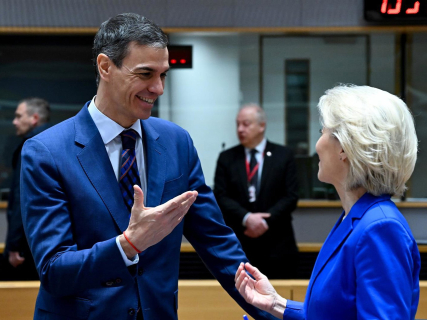
Sánchez proposes Mallorca to host the European firefighting center.

The president of the Government has sent a letter to Ursula von der Leyen to install an operational center for the western Mediterranean at the Son Sant Joan airbase.

2 minutes

fotonoticia 20260506090055 1920

fotonoticia 20260506090055 1920

Add DEMÓCRATA to Google

Ask FREN

Published

Last updated

2 minutes

Most read

Pedro Sánchez has asked the European Commission for Mallorca to host the future European center for fighting forest fires in the western Mediterranean. The proposal suggests locating the facilities at the Son Sant Joan airbase and complementing the device that Brussels is promoting in Cyprus.

Sánchez proposes Mallorca as the European headquarters against fires

The President of the Government, Pedro Sánchez, has sent a letter to the President of the European Commission, Ursula von der Leyen, to propose that Mallorca host the future European center against fires intended for the western Mediterranean, according to information released by La Moncloa.

Sánchez announced the initiative after holding the traditional summer meeting with King Felipe VI at the Royal Palace of Almudaina, in Palma. The head of the Executive explained that he had also conveyed the proposal to the monarch and to the President of the Balearic Islands, Marga Prohens.

The Son Sant Joan airbase, proposed location

The Government proposes to install the center at the Son Sant Joan airbase, located next to Palma airport. The new site would cover the western Mediterranean and complement the regional station that the European Union has decided to establish in Cyprus to strengthen the response to fires in the eastern Mediterranean.

The Cyprus station will have the capacity to keep up to six planes ready and host training activities for civil protection professionals. Brussels has conceived this network as part of the European reinforcement against increasingly frequent and destructive forest fires.

Sánchez's request will now be evaluated by the European Commission, which has not yet confirmed the selection of a headquarters for the western Mediterranean device.

Fires focus the meeting with the king

The situation of forest fires occupied a good part of the meeting between Sánchez and Felipe VI. The president informed the monarch that Spain was facing ten active fires and urged the population to take extra precautions due to the high temperatures, low humidity, and strong gusts of wind.

During the meeting, they also addressed the evolution of the Spanish economy, job creation, and the international situation, with special attention to Ukraine, the Middle East, and Latin America. Before the meeting, Sánchez met with Prohens to discuss migration pressure in the Balearic Islands, regional financing, and access to housing.

More key points, information and questions with FREN

AI-GENERATED CONTENT

What are the procedures that the proposal must follow for the European Commission to officially approve the headquarters of the fire-fighting center in Mallorca?

At this moment, I do not have specific and verified information about the exact procedures that the proposal must follow for the European Commission to officially approve the headquarters of the fire-fighting center in Mallorca. Furthermore, my specialization is focused on the Spanish political and regulatory context, not on the internal procedure of the European Commission for establishing headquarters of centers or agencies. Therefore, I cannot rigorously describe the formal phases or the exact legal acts involved in that specific decision. However, I can explain why I cannot go further and what types of issues related to Spain I can address in detail.

Scope of my specialization

I am specifically designed to handle topics related to Spanish politics: activities of the Government and the Cortes Generales, state legislative initiatives, parliamentary debates, Spanish political parties and their positions on various issues, as well as political and social news from Spain. I can also manage, with some detail, issues related to the Spanish legislative procedure (for example, how a bill or legislative proposal is processed in the Congress and the Senate, the stages of amendments, committee reports, plenary voting, etc.).

The information I currently have available refers precisely to how legislative initiatives in Spain are processed, that is, the steps a bill or legislative proposal follows from its presentation to its final approval: admission for processing by the Board, publication in the chamber's bulletin, amendment deadlines, committee report, plenary vote, passage to the other chamber, and finally sanction, promulgation, and publication in the Official State Gazette (BOE). All this is part of the ordinary Spanish legislative procedure.

However, your question focuses on a decision process of the European Commission regarding the location of the headquarters of a specific center (a fire-fighting center in Mallorca). This is an area of European policy and procedure for which I am not the specialized tool, and for which I also do not have concrete documentation in the sources consulted.

Limitations regarding EU politics and procedures

Although Spain is part of the European Union, the details of the internal procedures of the European Commission (how the headquarters of a center or agency is proposed, negotiated, and officially decided, what type of legal act is adopted, what participation the Council or the European Parliament has, etc.) fall within the category of EU politics and law. When it comes to purely European processes and searches do not provide specific information, I must indicate that I am not specialized in that area and avoid describing procedures that are not supported by sources.

In this case, the sources I have access to do not offer any details about:

  • Whether the designation of the headquarters of that fire-fighting center in Mallorca requires a specific regulation, decision, or interinstitutional agreement.
  • Which Commission services (directorates-general, competent commissioners) formally intervene in the proposal and approval.
  • What role the Council of the EU and/or the European Parliament would have in this particular file.
  • Whether a specific headquarters agreement between the European Union and the Kingdom of Spain is necessary for that center.
  • Indicative deadlines and internal administrative phases within the European Commission to reach an official decision.

There is also no contextual information about the “fire-fighting center in Mallorca” project itself: neither its legal nature (whether it would be a new agency, a coordination center, an operational center dependent on an existing agency, etc.), nor the current status of talks with European institutions. Without that basis, any attempt to detail specific procedures would risk being inaccurate or outright wrong.

What I can help you understand from the Spanish perspective

Although I cannot describe the internal procedure of the European Commission to approve the headquarters, I could help you, if interested, analyze:

  • What role the Government of Spain and, in particular, the involved ministries (for example, if there were involvement of Ecological Transition, Interior, or Foreign Affairs) have in proposing and defending Mallorca's candidacy before the EU.
  • How the Cortes Generales or the Parliament of the Balearic Islands might express themselves: through non-legislative proposals, motions, or institutional declarations supporting the headquarters in Mallorca.
  • What internal political implications it would have for state and regional parties, and how they could use the Spanish parliamentary route to strengthen the Government's position before Brussels.

If you specify the level (Congress, Senate, Balearic Government, affected municipalities) or the Spanish political actor you are interested in (for example, a party or a specific official), I can help you explore the political and parliamentary tools available in Spain to support that proposal before the European Union, always within my area of specialization.

What are the powers of the President of the Government of Spain in civil protection and international cooperation?

The President of the Government does not directly manage emergency devices or development aid programs, but has a key role of political leadership, high-level coordination, and final decision-making in both areas. In civil protection, Law 17/2015 places operational responsibility in the Ministry of the Interior, “under the political leadership and superior coordination of the Government,” of which the President is the head. In international cooperation, Laws 2/2014 and 1/2023 assign him the determination of the guidelines of foreign policy, within which the policy of development cooperation and humanitarian action is integrated. Additionally, he presides over and uses collegiate bodies such as the Foreign Policy Council, which advise him in these decisions.

1. General framework: Constitution, Government Law, and legal regime

The Spanish Constitution assigns the Government the direction of internal and external policy, and the President the direction of the Government's action and coordination of its members (principle of “presidential leadership,” developed in Law 50/1997 and later adjusted by Law 40/2015). The preamble of Law 50/1997, of the Government, recalls that one of the basic principles is precisely presidential leadership, which grants the President the competence to set general political guidelines, including those related to civil protection and foreign action.

Law 50/1997 specifies that the President:

  • Leads the Government's action and coordinates the functions of the ministers.
  • Determines the guidelines of internal and external policy and ensures their compliance.
  • Represents the Government and proposes, directs, or endorses key decisions adopted in the Council of Ministers.

Law 40/2015 reinforces this framework by regulating the institutional public sector and the delegated commissions and support bodies that the President can use to coordinate complex policies such as civil protection and international cooperation.

2. Powers in civil protection and emergencies

The basic regulation is Law 17/2015, of the National Civil Protection System. Its preamble and Title IV establish that fundamental responsibility in civil protection corresponds to the Ministry of the Interior, but “under the political leadership and superior coordination of the Government.” This means that:

  • The President sets the general strategy of the National Civil Protection System and political priorities (prevention, resources, inter-administrative coordination).
  • He leads, through the Council of Ministers, key decisions such as the declaration of “area severely affected by a civil protection emergency”, regulated in Law 17/2015 itself (recovery chapter), which enables packages of fiscal, labor, and Social Security measures.
  • He supervises major state instruments: the State General Emergency Plan approved by Council of Ministers Agreement (2020 resolution) or the Basic Civil Protection Standard approved by Royal Decree 524/2023, as well as the National Civil Protection Strategy published by Order PJC/1430/2024.

Additionally, the President politically leads the response in emergencies of special impact, supported by the Directorate General of Civil Protection and Emergencies and the National Monitoring and Coordination Center, whose coordination function in emergencies of national interest is detailed in Law 17/2015. The practical application of these powers is seen in development regulations that execute Council of Ministers agreements for catastrophic zones, such as the orders issued after Storm Filomena (Royal Decree-law 10/2021, Order TES/1223/2021, Order ISM/707/2021) or recent fires and floods (Order TES/443/2022).

3. Powers in foreign action, cooperation, and humanitarian aid

The legal axis of foreign action is Law 2/2014, on the State's Foreign Action and Service. This law establishes that:

  • The Government directs Foreign Policy, approves the Foreign Action Strategy and the Master Plan of Spanish Cooperation.
  • In its article on subjects and bodies, it specifies that it corresponds to the President of the Government to determine the guidelines of Foreign Policy and ensure their compliance, and that he represents Spain, without the need for full powers, in the conclusion of international treaties.
  • The Foreign Policy Council is a “collegiate body of support and advice to the President of the Government” in his function of direction and coordination of foreign policy, including monitoring Foreign Action and organizing the means of the Foreign Service (embassies, consulates, etc.).

Development cooperation is currently regulated by Law 1/2023, on Sustainable Development Cooperation and Global Solidarity, which declares conformity with Law 2/2014. This law configures cooperation as a state policy integrated into foreign action, and establishes strategic planning (Master Plan, Country Partnership Frameworks, thematic strategies) whose approval corresponds to the Council of Ministers, that is, the body presided over by the President of the Government.

Regarding humanitarian action, Law 1/2023 assigns coordination on behalf of the Government to the Ministry of Foreign Affairs, European Union and Cooperation, and to AECID as the executing agency, but within the framework of foreign policy guidelines set by the President (articles on strategic planning and humanitarian action, around legal text positions 61294 and 91574). The international dimension of the response to humanitarian crises is complemented by regulations and practice within the European Union (for example, Regulation (EC) 1257/96 on humanitarian aid).

Finally, Law 2/2014 foresees that, in crises affecting Spaniards abroad, a consular emergency group — dependent on the Foreign Policy Council — makes recommendations to the President of the Government on measures to be taken, which reinforces his decision-making role also in the “external” civil protection aspect (evacuations, consular assistance, use of State means abroad).

In summary, the powers of the President of the Government in civil protection and international cooperation are of a strategic, political leadership, and final decision-making nature within the Council of Ministers, while execution mainly corresponds to sectoral ministries (Interior, Foreign Affairs, and others) and specialized system bodies.

How many seats did the PSOE obtain in the last general elections and what weight does it have in the Congress compared to other political forces?

In the last general elections (July 23, 2023), the PSOE obtained 121 seats in the Congress of Deputies, according to various subsequent analyses comparing current polls with the 23J result. This placed it as the second force in the chamber behind the PP, which reached 137 deputies, in a Congress of 350 seats. In terms of weight, the Socialist Group controls around 34.5% of the seats, making it the axis of Pedro Sánchez's investiture bloc, against a right-wing bloc (PP, Vox, and UPN) that sums 171 deputies, as detailed in the parliamentary analysis by Demócrata. The PSOE's position is therefore very relevant: it is not the largest group, but it is essential for any alternative majority to the PP.

23J Results: PSOE seats and other parties

Various polls published after 23J use the actual result of those elections as a reference. Several polling pieces repeat that the PSOE achieved 31.7% of the votes and 121 deputies, compared to the PP with 33.1% and 137 seats, and that Vox and Sumar obtained respectively 33 and 31 seats. That figure of “121 deputies” for the PSOE appears, among others, in analyses by Sigma Dos, GAD3, Ipsos, GESOP, NC Report, polling averages and in the aggregate of voting intention by Demócrata.

Regarding other forces, the analysis on the “investiture bloc” published by Demócrata (focused on the composition of the XV Legislature) includes the distribution of seats that allows Sánchez's investiture, based on the 23J results and the subsequent group formation:

  • PP: 137 seats.
  • PSOE: 121 seats.
  • Vox: 33 seats.
  • Sumar (plurinational group): 31 seats.
  • ERC: 7 seats.
  • Junts: 7 seats.
  • EH Bildu: 6 seats.
  • PNV: 5 seats.
  • Podemos (already outside Sumar): 5 seats, according to the distribution described after the split within the left space of the PSOE.
  • BNG: 1 seat.
  • Canary Coalition: 1 seat.
  • UPN: 1 seat.

This arithmetic is explained in detail in Demócrata's report on investiture partners and the new balance of forces in Congress, accessible in this analysis. Other contents of the newspaper that contextualize the parliamentary situation and the internal organization of the chamber include, for example, the report on seat transfers to form groups, pieces on advisors in Congress and temporary staff, or the profile of deputy turnover in the hemicycle (one in eight has resigned and almost one in ten seats has been renewed).

PSOE's weight in Congress and block dynamics

With 121 of 350 deputies, the PSOE is a central actor but insufficient alone to build majorities. Demócrata's article on the investiture bloc estimates at 179 seats the sum of parties that supported Sánchez's re-election (PSOE, Sumar, ERC, Junts, EH Bildu, PNV, BNG, CC, and Podemos), against the 171 deputies grouped by PP, Vox, and UPN in opposition. This implies that, although the Socialist group is the largest in the government bloc, it must negotiate almost all relevant texts with several nationalist forces and with Sumar/Podemos to avoid being defeated in the Plenary.

In comparative terms, the PSOE's weight can be summarized as follows:

  • It is the second group in the chamber (behind the PP), but the first of the left-wing and plurinational bloc.
  • Its gap with the PP (137 versus 121) makes it impossible to govern alone with “small” partners: it needs almost the entire investiture bloc in every important vote.
  • Without the PSOE, no other actor can build a progressive majority, while the PP could only govern if it adds Vox and, eventually, other right-wing forces, as repeatedly shown by polls collected by Demócrata, from NC Report (example) to averages like those of September 2025.

In summary, the PSOE is today a decisive minority: it does not dominate Congress, but no stable majority can be formed without counting on its 121 seats.

For context, some of the other references included in the research, although they do not change the core data about 23J, are the agreement of the Central Electoral Board on the European elections (BOE and its correction in another resolution), political analyses such as those by ConSalud or Gaceta Médica on the European elections, and historical and parliamentary memory pieces from Demócrata, such as the review of the Amnesty Law, the 1991 debate, or the 2004 general election result (Zapatero's investiture), which help compare the current situation with other legislatures.

How exactly is Sánchez's investiture bloc distributed by parties and what majority does each sum with the PSOE? In which key Congress votes has the PSOE been most conditioned by its partners since the start of this legislature? What do the latest polls published in Demócrata say about how many seats the PSOE would retain today compared to the PP and Vox?

Play

Test your knowledge with FREN!

How much do you know about this topic? Answer the following 3 questions.

To whom has Pedro Sánchez sent a letter proposing Mallorca as the headquarters of the European fire-fighting center?

Question 1 of 3

At which air base is the future European fire-fighting center in the western Mediterranean proposed to be installed?

Question 2 of 3

Which regional station would complement the proposed center in Mallorca according to the news?

Question 3 of 3

Hola, soy Fren. ¿Cómo te ayudo?