

The Government suffered a hard parliamentary setback this Friday. Congress overturned the two housing decrees approved on Tuesday in the Council of Ministers with which the Executive sought to respond to both the demands of the street and its partners. After the Plenary, the president of the Government, Pedro Sánchez, who in an unusual intervention in the hemicycle was the last of the parliamentarians to defend the texts being examined, left the Cortes and took the weekend to assess his next steps.
The defeat opens a scenario that until just a few days ago Moncloa refused to contemplate. The electoral advance has ceased to be a hypothesis to become a possibility that is being analyzed. Sources from the Government consulted by DEMÓCRATA on Friday also no longer close that door. "In Moncloa we are calm, it is time to think and reflect. The decision is known only by one person, and that is Sánchez himself. We do not rule anything out, but he decides and it is time to reflect", they indicated.
And in the meantime, the street demands answers. While the deputies voted on the repeal of both royal decrees, hundreds of people demonstrated at the doors of a Congress guarded by a strong police presence to demand that those gathered in the hemicycle push forward the Executive's texts. With the 'no' from their lordships, the uncertainty lies in Sánchez's decision, with a backdrop of thousands of people camped in Madrid's Puerta del Sol who this Saturday at 12 are scheduled to start a march called by the Tenants' Union to demand a general strike.

Featured story
When do the housing decrees cease to be in force after their rejection in Congress?
3 minutes
Another reflection, but only for a weekend
This new period of "reflection" inevitably refers to April 2024. Then, Sánchez published a letter to the citizens and suspended his public agenda for five days to decide whether to continue as president of the Government due to the judicial investigation opened against his wife, Begoña Gómez. He finally appeared in Moncloa to announce that he remained at the head of the Executive.
Now there is no letter and the five days he dedicated then to reflecting on his continuity at the head of the Presidency of the Government are reduced to a weekend. The uncertainty that hangs over these two days is how long he wants to prolong the legislature after losing a vote that the Government itself had turned into a matter of primary importance in its legislature, such as housing.
If you want to keep open one of the dates being considered for a possible electoral advance - November 29 appears among the contemplated possibilities - the calendar would force you to start the call practically immediately. The reflection, therefore, has an hourglass that is consumed with every passing minute.
Sánchez thinks and the street remains mobilized
But during that weekend something more will happen. The mobilization for housing that has accompanied the entire processing of the decrees does not end with its parliamentary defeat.
This Friday, after the vote, protests returned to Puerta del Sol, where a General Assembly was planned to decide the future of a camp that continues to occupy the kilometer 0 of the country. The organization has made a call to convene a general strike for housing. Precisely this Saturday at 12:00 hours a demonstration is planned in Madrid for this reason.
The major unions CCOO and UGT are also analyzing different formulas for mobilization after the fall of the decrees.
Featured story
When do the housing decrees cease to be in force after their rejection in Congress?
3 minutes
Among the socialist leaders in favor of bringing forward the elections, there are even voices that suggest waiting to see the turnout of the demonstrations this weekend before activating a possible call.
However, this does not mean that Sánchez has conditioned his decision on the response from the street. The mobilizations will take place during the hours when the president will be assessing what to do with the legislature. Something that, ultimately, is his decision.
The risk of placing oneself behind a mobilization that was born in the street
The protests for housing did not originate in Moncloa. The Executive has tried to respond to a mobilization that accelerated after the eviction of Maricarmen and that ended up concentrating much of its pressure on the two decrees approved this week.
The parliamentary defeat now allows the PSOE to direct responsibility towards the parties that voted against. The party harshly accused PP, Vox, Junts, and UPN this Friday of having caused the fall of measures aimed at protecting tenants.
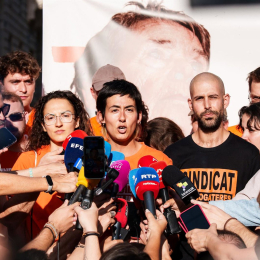
But the mobilized organizations have not handed over the direction of the protests to the Government either. The Tenants' Union maintains that a new stage of mobilization begins and keeps demands that go beyond the measures included in the rejected decrees.
The challenge now for Sánchez consists precisely in interpreting a protest that the Government does not control, but whose evolution can modify the political scenario in which he would have to decide on elections.
The Government's signals point to an advance
The electoral scenario has gained weight throughout the day. Some leaders of the PSOE and members of the Government advocate for a call and place a very high expectation of an advance before the end of the year around the president.
There are, therefore, internal signals favorable to the advance. The Government itself took care that Friday to keep all options open. Sources from Moncloa requested "calm" and "prudence" after the votes and conveyed that now it is time to analyze how to respond to the housing problem.
A reflection with a question difficult to explain
The argument he will have to resolve over the weekend is quite different from that of 2024. Back then he had to decide whether to continue personally. Now he has to determine if the parliamentary defeat on housing represents a change sufficiently deep to end the legislature early.
If the Government's diagnosis is that Spain faces a social problem of sufficient seriousness to have approved two royal decree-laws and to demand their validation by appealing directly to the lives of millions of citizens, the question will be to explain why the defeat of those measures leads to elections or, on the contrary, why it allows continuing to govern.
Sánchez will have to choose between both answers. And this time the reflection will take place while outside Moncloa a mobilization continues that precisely demands immediate solutions. The first Saturday of Sánchez's new reflection will be a Saturday with protests for housing and a Government waiting to decide if there is still room for the legislature.
The outcome of that reflection in 2024 was continuity. The outcome of this one is known, for now, only to Pedro Sánchez.