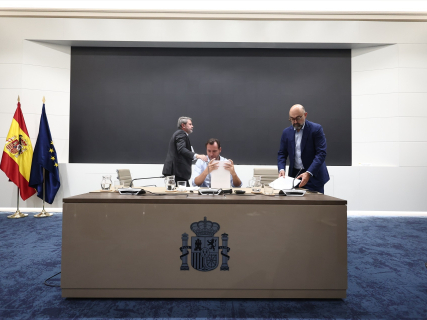

Óscar Puente has scheduled an appearance before the Permanent Deputation of the Congress on Tuesday, November 3, at 5:00 p.m., to explain the Urda train accident. He requested it on his own initiative after several parties called for his presence. That circumstance matters: his intervention is posed as the explanation of the Transport Minister, not as the testimony of a former minister before a parliamentary inquiry.
The appointment places Pedro Sánchez before a dilemma that is not resolved solely by deciding whether to keep or replace the minister. It also matters when he does so, who offers the explanations, and what measures accompany any decision.
Puente has said that he put his position at the president's disposal and that he rejected his departure, considering it "unjust." According to information from Europa Press, that conversation was recounted by the minister himself to journalists. It is, therefore, a version attributed to Puente about a private exchange, not a direct public statement by Sánchez in those terms.
Appearing as minister: ability to respond, but greater shared wear and tear
The main advantage of Puente going as minister is institutional: he can explain the decisions taken, answer for the department's actions, and commit measures from the office that allows them to be carried out.
For the Government, that sequence makes it possible to argue that the responsible official appears before other decisions are taken. It also avoids giving the opposition an immediate argument: that the replacement has been used to remove the interlocutor who was supposed to answer.
But keeping him has a cost. The more explicit Sánchez's decision to support him is, the harder it becomes to separate the minister's wear and tear from the judgment on the president. Puente can focus the questions, but his continuity also becomes a political decision by whoever keeps him in place.
From that perspective, the idea of the "firebreak" has a limit: that a minister assumes public exposure does not prove that he manages to protect the president. If the explanations are insufficient, the pressure may extend to Sánchez. In fact, the PP has already called for the appearance of the head of the Executive and considers that of the Transport Minister insufficient.
Dismiss Puente before: a gesture of responsibility that does not replace the explanations
An earlier replacement would allow the president to present a decision on political responsibilities without waiting for the technical investigation to close. Both issues must be distinguished: replacing a minister does not in itself establish personal responsibility for the causes of the accident.
However, a dismissal a few days before the appearance could also be interpreted as an attempt to prevent Puente from answering from the Government. That risk would be greater if the departure came accompanied by the cancellation of the explanations, without a clear alternative.
The successor could report on the measures he adopts, but he would have an obvious limitation: he was not heading the department when the previous decisions were taken. The replacement of the person responsible does not automatically resolve the questions about his management.
For that reason, from a political analysis, dismissing him and guaranteeing accountability is more solid than dismissing him and leaving a vacuum. Nor are there reasons to delay a dismissal solely because of the parliamentary calendar if sufficiently serious new facts were to emerge.
Would he still have to appear if he stops being minister?
It cannot be assumed that he would. The Constitution contemplates the calling of the presence of members of the Government. If Puente were to actually cease belonging to the Executive, the condition under which this appearance had been envisaged would change. It would not automatically become a personal obligation to attend as a former minister.
In addition, the Diputación Permanente has limited powers after the dissolution of the Cortes. The Congress's own legal explanation warns that it is not equivalent to a Chamber in ordinary operation and sets out restrictions and exceptional precedents regarding appearances. Therefore, the eventual intervention of a Puente who has already been removed would require examining the specific agreement and the parliamentary procedure that could be enabled. It is not enough to state that “he had already been summoned.”
The situation is different in a committee of inquiry. The law establishes the obligation to appear for duly required persons, regardless of whether they continue to hold the office for which their conduct is being investigated. Being a former minister would not, by itself, be an exemption. That is not the nature of the session announced for Tuesday.
Not attending without offering another response: the hardest option to defend
Politically, the most vulnerable alternative would be for Puente not to appear and for the Government also not to provide equivalent explanations. The debate would cease to focus only on his continuity to incorporate a new question: why there is no response before Parliament.
With the known data, the most defensible sequence is for the official to give explanations, answer the questions and specify measures. The decision on his continuity must be justified by the assessment of his management and by the available facts, not presented as a simple calendar operation.
For Sánchez, keeping Puente can preserve the continuity of the department, but it does not guarantee containing the wear and tear. Dismissing the minister can show a reaction, but it also does not guarantee closing the crisis. The difference lies in whether the decision increases the Government’s transparency and response capacity or leaves more questions open.