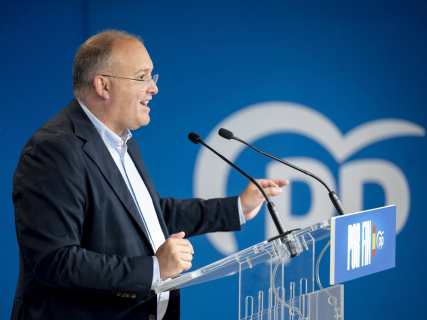

The general secretary of the Popular Party, Miguel Tellado, returned this Tuesday to La Hora de La 1 almost a year after his last interview with Silvia Intxaurrondo, with whom he has again starred in several tense exchanges regarding the political responsibilities for the railway accident in Urda (Toledo), the actions of Carlos Mazón during the DANA and the news coverage of RTVE.
The criticisms of the Popular leader of the lack of pluralism of the public television have run through much of the conversation, during which he has also defended the electoral agreement with Vox for the Senate, has expressly asked for the vote for Santiago Abascal's party in three provinces and has explained some of the economic proposals of Alberto Núñez Feijóo.
Tellado's last interview on the program dated back to November 21, 2025, when the Popular leader and the journalist staged another clash regarding the conviction of the then attorney general of the State, Álvaro García Ortiz, and the public television news coverage. Almost a year later, the disagreements over the pluralism of RTVE have again run through a conversation that, despite the moments of tension, has concluded with a note of humor.
Tellado blames Sánchez for the Urda accident
With the situation of the railway network after the tragedy of Urda as the first issue of the interview, Tellado has accused the Government of ignoring the warnings about safety problems and has questioned that the Minister of Transport, Óscar Puente, has focused his explanations on the actions of the personnel in charge of managing railway traffic.
According to the figures released last Friday by Óscar Puente in his appearance, the LZB safety system had suffered around 170 incidents during the year, a circumstance that, in Tellado's opinion, requires an audit of the network to determine the extent of the technical problems.
The Popular leader has argued that the system failure triggered an extraordinary situation in the control center whose consequences cannot be attributed exclusively to a human decision.
"The fault lies with the Government of Spain for having a Minister of Transport who should never have been appointed", he stated, before extending political responsibility to the head of the Executive for having entrusted the Transport portfolio both to José Luis Ábalos and to Óscar Puente.
In response to Intxaurrondo’s question about whether the PP would paralyze rail traffic in the event that safety deficiencies were detected, the Popular leader avoided committing to a generalized suspension of the service and deferred any decision of that nature to the judgment of the technicians, whose recommendations, he said, a possible Feijóo Government would heed.
In his diagnosis of the deterioration of public services, Tellado also pointed to the political appointments made during the socialist governments and called for the management of infrastructure to be in the hands of qualified professionals, regardless of their political affiliation.
The clash over Mazón and political responsibilities
The demand for accountability from the Executive led Intxaurrondo to ask the PP secretary general whether his party had applied the same criterion in the face of other tragedies, including the Angrois railway accident and the Valencia DANA.
In his response, Tellado defended that both episodes present circumstances different from those of Urda and, in the case of the Valencian catastrophe, attributed to the central Government the responsibility for the absence of sufficient warnings about the overflow of the ravine. As an example of assumption of political responsibility, he recalled that the then Valencian councillor for Emergencies resigned.
The journalist insisted on knowing whether the PP still supported Carlos Mazón’s actions during that day, a question on which Tellado avoided speaking directly.
Instead of assessing the decisions of the former Valencian president during the emergency, he argued that he had already assumed political responsibility with his resignation, in contrast to Óscar Puente’s remaining at the head of the Ministry of Transport.
The successive follow-up questions led to one of the tensest exchanges of the interview, during which Tellado asked the presenter to respect his answers and not alter the meaning of his explanations.
The PP calls for voting for Vox in three provinces for the Senate
Another of the most controversial issues in the conversation was the agreement reached between PP and Vox to coordinate their Senate candidacies in the general elections of next November 29, a decision that Tellado justified as a response to the electoral strategy of the PSOE and its allies.
The general secretary of the PP has accused the socialists of trying to retain control of the Upper House through joint candidacies and has argued that voters in favor of a change of Government should concentrate their votes to counter that strategy.
When Intxaurrondo asked him what Popular voters should do in the three provinces where the PP has renounced presenting candidates for the Senate, Tellado initially appealed to the useful vote and to the need to prevent a socialist majority, without expressly identifying the formation that those voters should support.
Only after the journalist repeated the question, Tellado ended up expressly asking those voters to support Vox, in the same way that he has requested support for Popular candidacies in those constituencies where it is Abascal's formation that renounces standing.
For the Popular leader, this electoral coordination responds to a shared objective in the composition of the Senate and does not imply that both organizations renounce their political differences.
The differences with Vox and social rights
Regarding those differences, Intxaurrondo has tried to specify what distinguishes the PP's political project from that defended by Vox, especially in matters related to gender violence and the rights of LGTBI people.
In his response, Tellado has vindicated the Popular Party as a state party, linked to the Constitution and with government experience, although he has avoided going into the programmatic discrepancies with Santiago Abascal's organization.
Faced with the possibility that future agreements between both formations could entail setbacks in social rights, the general secretary of the PP has rejected the accusations from the left, which he has attributed to an intention to generate fear among citizens, and has assured that an Executive headed by Feijóo would not cut the rights of any Spaniard.
"Feijóo's principles are neither for sale, nor for purchase, nor for rent", he replied when the journalist wanted to know what concessions the PP would be willing to accept in a possible negotiation with Vox.
Faced with questions about the differences between both formations, Tellado has preferred to insist on his party’s priorities, among which he has highlighted the recovery of the effectiveness of public services, the improvement of infrastructure, and respect for institutions and the rule of law.
A million homes and an annual increase in the minimum wage
In the economic section, the interview has allowed us to delve into some of the PP’s proposals on housing and wages, with special attention to the commitments announced by Feijóo for a possible legislature.
The secretary general of the conservatives has defended the goal of promoting the construction of a million homes in four years to correct the imbalance between supply and demand that, according to his diagnosis, explains much of the increase in the price of properties both in the sales market and in the rental market.
Despite Intxaurrondo’s insistence, Tellado has not specified what proportion of those homes would be allocated to rent or what prices could be considered affordable for families.
The journalist has asked him about the cost per square meter and the monthly rent that the PP would consider reasonable for a 80-square-meter home, but the leader has referred those calculations to specialists and to the particular conditions of each market.
His proposal is to increase the available supply to favor a moderation of prices, in addition to correcting legal uncertainty and the shortage of land that, in his view, have slowed housing construction in recent years.
In relation to the minimum interprofessional wage (SMI), Tellado has confirmed that a Feijóo Government would increase it annually in line with the CPI, although he has conditioned the way in which those updates would be applied on the restoration of dialogue between the Executive, employers, and unions.
The journalist has also asked him who would have the final say if employers rejected a wage increase, to which the PP secretary general has acknowledged that the final decision belongs to the Government, although he has defended that any increase should be negotiated beforehand with the social partners.
Criticism of RTVE and a congratulation for the name day
Throughout the different segments of the interview, Tellado's criticisms of RTVE's lack of pluralism have appeared repeatedly, with reproaches both to the news coverage of certain matters and to the political use that, according to what he has denounced, the Government makes of some public television programs.
During the conversation about the railway accident, the secretary general of the PP questioned that La Hora de La 1 had demanded, in his view, political responsibility from Carlos Mazón for the DANA and had not done so with Óscar Puente for the tragedies of Adamuz and Urda, a comparison with which he has tried to denounce unequal treatment toward the leaders of both parties.
The disagreements have reappeared during the segment devoted to the electoral agreement with Vox, when Tellado denounced that in the program supporters of the PP had been insulted without, according to his version, a sufficient correction being made by its hosts.
Already in the final stretch of the conversation, Intxaurrondo gave him the opportunity to develop his criticisms of RTVE before returning to current affairs.
The PP leader then wanted to distinguish between the professionalism of the corporation's workers, whom he said he respects, and the decisions of those who run public television, whom he reproached for allowing a partisan use of its content.
Tellado promised that a PP Government would depoliticize RTVE and rejected that public media become instruments of confrontation among citizens because of their political preferences.
Despite the disagreements accumulated during the conversation and the presenter’s numerous follow-up questions, the interview concluded with a relaxed exchange about Silvia Intxaurrondo’s name day. Tellado surprised the journalist by congratulating her on her saint’s day, a gesture she appreciated with jokes by pointing out that no one had congratulated her yet.
The presenter then took advantage of the coincidence to ask him, in a jocular tone, whether he had chosen precisely that day to return to the program because it was his name day. Tellado went along with the joke and attributed the circumstance to the coincidences of fate.
The congratulation has thus provided the counterpoint to an interview in which the questions about the political responsibilities and the PP's electoral commitments have followed one another amid reproaches to RTVE's news coverage. Almost a year after their previous television encounter, Tellado and Intxaurrondo have again disagreed both on the content of the answers and on the way the conversation was conducted.