Feijóo asks the unions to call off the strike after the railway tragedy: "Don't do it or you will be tied to Pedro Sánchez"

The leader of the PP considers "incomprehensible" maintaining a mobilization against the opposition after 69 deaths and warns of the damage it would mean for union credibility. He announces an audit of the entire State in his first hundred days of Government and reveals an internal Adif report that warns of the deterioration of the network until 2030

fotonoticia 20261103093804 1920

fotonoticia 20261103093804 1920

Add DEMÓCRATA to Google

Ask FREN

Published

Last updated

7 minutes

Most read

Elecciones 29N · Encuestas

La media de las encuestas

Media a 2 de noviembre de 2026 · 16 institutos

  • PP30,5 %
  • PSOE27,4 %
  • Vox19,1 %
  • Frente Amplio6,4 %
  • ERC2,4 %
  • Podemos2,4 %
010203040ene 2024jul 2024ene 2025jul 2025ene 2026jul 2026

Media del último estudio de cada instituto en 30 días y su evolución semanal desde el 23J. Partidos con al menos un 2 %.

Todas las encuestas

Elecciones generales del 29 de noviembre · Demócrata

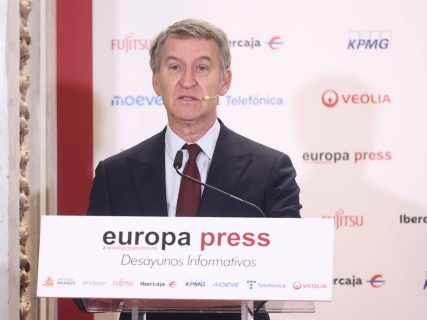
The president of the Popular Party, Alberto Núñez Feijóo, has asked the unions to reconsider and call off the strike announced against the opposition, especially after the railway tragedy that has shocked Spain. During an informative breakfast organized by Europa Press, the Popular leader has appealed to the responsibility of the trade union organizations in the face of a situation that, in his view, has exposed the fragility of the State and requires abandoning political confrontation.

"The strike must be called off in these circumstances", Feijóo has stated, who considers that the call already started from an erroneous approach. "Strikes are not called against those who do not govern", he has pointed out, before addressing the union representatives directly: "Reconsider that strike called against the opposition. It is incomprehensible with 69 deaths. Do not do it or you will be linked to Pedro Sánchez".

Feijóo has insisted that the priority must be to strengthen the institutions and restore confidence in public services, instead of using the situation to obtain political advantages. "This confrontation has to end. The obligation is to think about how to strengthen the nation and not take advantage of the situation", he has defended.

His intervention has taken place at a moment marked by the consequences of the railway accidents and by doubts about the maintenance and safety of the infrastructures. In that context, the president of the PP has called for a change in the way of governing and has requested a clear political mandate to undertake what he calls the "national reconstruction".

Feijóo appeals to the credibility of the unions: "I need interlocutors with whom I can sit down"

The Popular leader has returned to the call during the question period of the informative breakfast. He has explained that, when the strike was announced, he preferred to maintain a "respectful silence", although he already considered it mistaken to organize a mobilization directed against the opposition.

"When it was called I maintained a respectful silence. But in this situation that Spain is living through, making a strike against the opposition makes no sense", he has reiterated.

Feijóo has assured that he conveyed his reservations to some union leaders with whom he maintains relations and that now he wants to extend that message to all the organizations. "I need interlocutors with whom I can sit down. I do not want weak social agents," he stated, convinced that calling off the strike would help improve his credibility and reputation.

In his view, the impact of the tragedy and the doubts affecting trust in public services such as Adif make maintaining the protest even less comprehensible. The president of the PP has maintained, moreover, that there are doubts among the union members themselves about the appropriateness of the call.

"I am convinced that, if they call it off, the unions will be right," he added, before insisting that his purpose is to unite the country and not take advantage of the division to obtain political gain.

A general strike called for November 11

Feijóo's request refers to the general strike scheduled for next November 11, called by CCOO, UGT and other organizations around demands regarding housing, wages and the cost of living.

The unions have defended that the protest addresses the set of public administrations and employers' organizations, not exclusively a political party. Their general secretaries, Unai Sordo and Pepe Álvarez, have also acknowledged that they aspire for the mobilization to influence the electoral debate prior to the November 29 elections.

The call thus takes place, in the full election campaign period and after the railway accidents of Adamuz and Urda, which have placed the safety of infrastructure at the center of the political debate.

An audit of the entire State in the first hundred days

Beyond the request to the unions, Feijóo has announced that, if he reaches the Presidency of the Government, he will order a general audit of the State during his first hundred days in office. The objective, he has explained, will be to examine the use of public resources, review the money granted to the different bodies and determine whether there are irregularities that should be brought to the attention of Justice.

"Fraud will be reported," he assured.

The president of the PP has committed to incorporating the results of that review into the first General State Budgets of his Government. He has also announced a specific investigation into the railway system, separate from the general audit, so that citizens know the situation of the infrastructures and the management carried out during recent years.

"Spaniards will know the truth," he has promised, while calling for absolute respect for the infrastructures and a review of the criteria by which their managers are appointed.

Feijóo has defended that management positions should be filled by professional ability and not by political affinity. He has also called for listening to workers, whose warnings he considers essential to know the real problems of the system.

"There can be no incentives if management is a disaster," he stated, in a criticism of the remuneration and responsibility mechanisms of public managers.

An internal Adif report warns of a 39% drop in the reliability of the facilities

One of the most relevant statements in his intervention has been the reference to an internal Adif report that, according to Feijóo, the Government knows about and that warns of a deterioration in railway indicators with a horizon in 2030.

According to the data presented by the president of the PP, the document foresees a 39% drop in the reliability of the facilities and a 94% increase in accidents attributable to the infrastructure manager.

Feijóo has pointed out that the report was sent to the railway operators, who had the opportunity to submit allegations. The existence of those forecasts, according to his interpretation, would show that the Executive had information about the risks of deterioration of the network.

These are figures attributed by Feijóo to an internal document whose full content could not be independently verified. In addition, they are forecasts for 2030, not results already recorded. To determine their scope, it will be necessary to examine the report, its methodology, the indicators used, and the allegations of the operators.

Railway safety has acquired a particularly sensitive dimension after the accidents at Adamuz and Urda. In the latter, which has caused 69 deaths, the investigation into the functioning of the protection systems, the circulation procedures, and the decisions adopted after the technical incidents continues.

"I want to govern with institutions that tell me no"

Feijóo has placed institutional regeneration among the three major commitments of his political project: to recover decency in the exercise of power, to get the country to function, and to ensure that citizens’ effort once again is worth it.

The Popular leader has called for a conception of politics based on the personal responsibility of those who hold public office. "Each leader must assume responsibility for their subordinates," he has argued, considering that the absence of consequences for management mistakes sends a devastating message to society.

He has also reiterated his intention to promote legal reforms to strengthen institutional checks, even when they may limit the scope of action of his own Executive.

"I want to govern with institutions that tell me no," he declared, committing himself to accept checks and balances in the exercise of power.

In that context, he has reproached Pedro Sánchez for having, in his view, turned political activity into a succession of gestures and whims, instead of focusing on the problems of citizens. He has cited his interventions on personal, musical matters or matters unrelated to public management, as well as certain actions by the Minister of Transport, Óscar Puente.

"Where is the joke?", Feijóo asked himself, insisting that governing requires seriousness and accepting the consequences of decisions.

Housing, taxes and public services: the commitments of his project

The president of the PP has used the breakfast to present the main lines of his Government program. Among them, he has reiterated the commitment to promote the construction of one million homes, improve the availability of doctors and strengthen legal certainty so that citizens can develop their personal and professional projects.

He has also announced a review of fiscal policy with the aim of reducing taxes and favoring those who work, save or start businesses.

"Spaniards get up early, work, they are asked for more than ever, but they have fewer opportunities," he stated.

His goal, he explained, is to establish an economic and administrative framework in which effort allows progress and those who fulfill their obligations do not feel harmed in comparison with those who fail to fulfill them.

Feijóo has defended that Spain needs to recover trust in institutions and have a shared project that transcends partisan confrontation.

"Pedro Sánchez has been a mistake. Societies do not persist in mistakes, they correct them"

In the most political part of his speech, Feijóo has presented the elections of November 29 as an opportunity to rectify the course of the country.

"Pedro Sánchez has been a mistake. Societies do not persist in mistakes, they correct them," he has maintained.

The president of the PP has explained that his proposal for national reconstruction came before the railway tragedy, although he considers that the latest events have reinforced the need to change the way public services are managed.

"For me governing has never been a joke. Now it is even less so," he has stated.

Feijóo has asked for a clear mandate to undertake reforms from the institutions and recover respect for citizens. He has assured that he does not intend to feed indignation or turn the country's problems into an instrument of permanent confrontation.

"We are not facing a simple political decision. Reconstruction must be undertaken," he has pointed out.

The popular leader has closed his intervention by claiming a change of Government that will allow the functioning of public services to be recovered, the destination of the money to be reviewed, and pending problems to be addressed from day one.

"I propose a change in favor of Spain," he has summarized, before reiterating his request for a mandate to "recover the course, face the problems and get Spain moving".

More key points, information and questions with FREN

AI-GENERATED CONTENT

What is the status of the parliamentary processing of a possible reform to strengthen institutional controls proposed by Feijóo?

As of November 3, 2026, no single reform in parliamentary processing corresponding to Feijóo's announcement to strengthen institutional controls has been identified. The proposal appears as a set of regeneration commitments for a potential PP government. It is important to distinguish that announcement from the specific initiatives related to it: the reform of the election of the General Council of the Judiciary did reach Congress but was rejected.

The announcement does not equate to a registered law

The most direct reference is Feijóo's intervention in Salamanca on October 25, where he announced a general audit of public accounts and reforms to strengthen institutional control mechanisms. The published information presents these measures as part of the project he would develop if he reached La Moncloa, not as a legislative text already submitted to the Cortes (Demócrata, October 25).

Therefore, it is not appropriate to describe the set as a blocked law, pending amendments, or awaiting a vote. The consulted sources do not show a single file, an articulated text, or a parliamentary calendar associated with that announcement.

Which measures have parliamentary progress
  • Election of the CGPJ. The organic law bill from the Popular Group to modify the Organic Law of the Judiciary, presented on October 24, 2025, aimed for the twelve judicial-origin members to be elected directly by judges and magistrates. The located information indicates it was rejected in September 2026: it is no longer in active processing nor produced the announced change (Demócrata, CGPJ reform).
  • Limits on decree-laws and parliamentary blockage. Gamarra has proposed limiting the habitual use of decree-laws and reforming parliamentary functioning to avoid initiative blockages. No specific text of these reforms with open processing has been located; their status is proposals pending parliamentary specification (Demócrata, Gamarra's proposals).
  • Interest groups and conflicts of interest. The proposal of a mandatory and public registry, supervised by an independent authority with sanctioning capacity, is among the PP's announcements. No specific parliamentary initiative linked to that announcement is recorded (Demócrata, controls and transparency).
What remains as a political commitment

The independence of the Constitutional Court, the State Attorney General's Office, and regulators; spending audits; reduction of ministries, senior officials, and advisors; and calling elections after accumulating more than one budget extension were presented in the "Contract with Spain" on October 19. That presentation does not by itself prove that each measure has become a registered initiative (Demócrata, institutional commitments).

Additionally, the PP announced it would resume its plan for Constitutional Court regeneration if it reached government, including restrictions on access for people with recent political activity. The information from October 12 places that work in plan preparation, not in an approved legal reform (Demócrata, institutional plan).

The conclusion is that the general announcement remains pending legislative translation. There is no record of formal negotiation on the complete package nor a specific government response turning it into a parliamentary agreement. The relevant precision is this: there is an announced political agenda, but not a joint reform whose progress can currently be followed through parliamentary phases.

What are the legal powers and attributions of the president of the Popular Party regarding the calling of strikes in Spain?

Under Spanish legal regulations, the president of the Popular Party (or any other political party) does not have specific legal powers or attributions regarding the calling of strikes merely by holding that organizational position within a party. Their role is political, not legal-labor.

Constitutional and legal framework of the right to strike

The right to strike in Spain is recognized in Article 28.2 of the Constitution as a fundamental right of workers. Its basic regulation is mainly found:

  • In the Article 28.2 of the Constitution itself, which recognizes the right to strike.
  • In Royal Decree-Law 17/1977, of March 4, on labor relations, interpreted in light of the Constitution by the Constitutional Court's jurisprudence.

From this framework it follows that:

  • Workers, directly or through their representatives, exercise the right to strike.
  • The calling of a strike usually corresponds to:
    • Trade unions.
    • Works councils or staff delegates.
    • Workers' assemblies, according to established procedures.
  • The legal counterpart in a collective conflict is the employer (company, competent public administration), not political parties.

What can a political party formally do regarding a strike?

From a strictly legal-labor point of view, a political party:

  • Is not a legitimized subject under strike regulations to:
    • Call workers' strikes.
    • Negotiate collective agreements on behalf of workers.
    • Establish minimum services.
  • A political party can:
    • Politically support a strike (statements, internal resolutions, public calls of support).
    • Discourage or criticize a strike publicly.
    • Influence future strike regulation through the legislative activity of its parliamentarians.

However, all these are political or communication actions, not legal attributions regarding the technical calling of a strike. The strike will remain valid or invalid according to the Constitution, RDL 17/1977, and jurisprudence, regardless of the party's or its president's position.

Special situations: dual status of the party president

The only practical relevance may come from the other institutional position that the person who is president of the Popular Party may hold:

  • If they are simultaneously Prime Minister or a member of the Council of Ministers, they can:
    • Promote bills or reforms affecting the strike right regime.
    • Approve regulatory norms or royal decree-laws (if applicable), always within constitutional limits.
    • Direct the government's general policy in social conflicts.
  • If they are president of an Autonomous Community, they could have competencies in managing minimum services in certain public services within their scope, according to sectoral legislation and Constitutional Court doctrine.
  • If acting as employer or company representative, they would have obligations and powers typical of the employer side (negotiation, reaction to the strike, work organization, etc.). But this derives from their business status, not from being party president.

In all these cases, the competencies are not linked to the position of president of the Popular Party, but to the institutional position (Prime Minister, regional president, employer, etc.) that person additionally holds.

Responsibility and limits

The president of the Popular Party, like any other political leader, is subject to limits and possible responsibilities:

  • They cannot coercively prevent the exercise of the right to strike (workers) nor the right not to strike (workers who want to work), as they could incur criminal or administrative offenses if effective coercion occurred.
  • Their public calls, for or against a strike, are protected by freedom of expression and political participation, provided they do not become coercive or discriminatory conduct.

Conclusion

In summary, the president of the Popular Party does not have own and specific legal powers over the calling of strikes in Spain. They cannot, by virtue of being party president alone, call workers' strikes or regulate their exercise. Their role is: (a) political and opinion-based, supporting or criticizing strikes, and (b) possibly institutional, if they also hold a government or administrative position with normative or management powers that indirectly affect the framework in which strikes develop.

Which subjects are legally legitimized to call a strike in Spain and how must they do so? What role do the Government and autonomous communities have in setting minimum services during a strike? What legal and jurisprudential limits exist on the exercise of the right to strike in Spain?

What legal requirements must unions meet to call a general strike in Spain?

To call a general strike in Spain, unions must adopt a valid agreement, communicate it in writing in advance, specify its objectives and scope, designate a strike committee, and respect safety and essential service guarantees. No prior government authorization is needed nor is there a general minimum electoral representativeness percentage required to call it.

The main framework is Article 28.2 of the Constitution and Royal Decree-Law 17/1977, interpreted according to constitutional jurisprudence, especially STC 11/1981. It is important not to literally apply the 1977 restrictions that this ruling declared unconstitutional.

1. Union legitimacy and agreement

The call is not reserved for the most representative unions. The union must act within its scope and approve the call through the competent body according to its statutes. Workers' representatives or the workers themselves can also promote strikes through the corresponding channels.

In a general strike it is not required to ratify the call in each company or center. STC 11/1981 eliminated that requirement, as well as certain restrictive conditions for adopting the agreement. The call may include non-affiliated workers: each person freely decides whether to participate.

2. Written communication and deadlines

Articles 3 and 4 of the Royal Decree-Law require communicating the strike to the labor authority and affected employers. Public announcement alone is not enough. The minimum deadlines are:

  • Five calendar days before the start, as a general rule.
  • Ten calendar days when it affects companies in charge of public services. Additionally, sufficient publicity must be given to inform their users.

The communication must include the objectives, efforts made to resolve differences, start date, and composition of the strike committee. It must also sufficiently delimit the territorial and functional scope, the workers called, and the expected duration, or indicate that it is indefinite. It is advisable to keep proof of notifications and their dates.

3. Committee and negotiation

A strike committee must be designated to represent workers in the conflict. From the notice and during the strike, the committee and employers, or their respective representatives, must negotiate to try to reach an agreement.

There is no general obligation to exhaust an official negotiation beforehand. However, applicable conflict resolution procedures established by collective agreements must be respected, whose existence must be verified before calling.

4. Essential services and safety

When essential services for the community are affected, the competent governmental authority may establish minimum services. Its decision must be motivated and proportionate: it cannot impose normal functioning nor empty the right to strike. Unions may challenge it judicially.

These minimums differ from security and maintenance services necessary to protect people, facilities, and materials and allow subsequent work resumption. The committee must guarantee the latter; the designation of personnel does not correspond exclusively to the employer.

5. Lawful purpose and development

The strike must defend workers' professional interests. The prohibition of strikes with purposes unrelated to those interests does not allow considering unlawful any protest directed against public decisions. Solidarity strikes are not automatically illegal: the Constitutional Court eliminated the requirement of direct professional affectation.

Finally, the freedom of those not participating and the obligations of established services must be respected. Information and picketing must be peaceful, without violence or coercion. Abusive modalities and breaches of legal requirements may lead to judicial controversies about the strike's lawfulness.

Play

Test your knowledge with FREN!

How much do you know about this topic? Answer the following 3 questions.

Who has asked the unions to call off the strike after the railway tragedy?

Question 1 of 3

What measure did Feijóo announce he would take in the first 100 days if he becomes head of government?

Question 2 of 3

What percentage drop in the reliability of railway facilities does the internal Adif report cited by Feijóo foresee?

Question 3 of 3