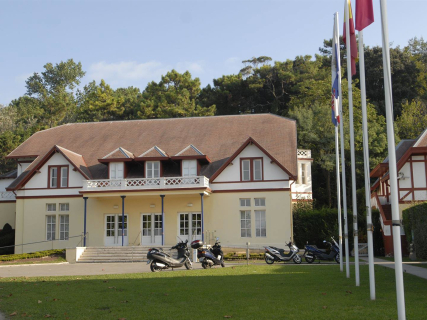

The Official State Bulletin has disseminated this Monday the resolution of the Secretary of State for Democratic Memory by which the old concentration camp of La Magdalena, located on the peninsula of the same name, in Santander, is recognized as a Place of Democratic Memory.
The declaration affects the property where the camp was installed, the former Stables of the Palace of La Magdalena, which currently function as a student residence.
The resolution will be communicated to the individuals and entities directly affected, and the property will be registered in the Inventory of Places of Democratic Memory.
The status of Place of Democratic Memory takes effect from this Monday the 26th, the date of publication in the BOE. Against the resolution --which was opposed by the Santander City Council--, which exhausts the administrative route, a motion for reconsideration may be presented before the same body within one month from its publication, or one may go directly to the contentious-administrative route before the Contentious-Administrative Chamber of the National Court.
In terms of protection, the text specifies that no specific measures other than the general guarantees to ensure the conservation of the place are established.
Additionally, with a commemorative, tribute, educational, and reparative objective, the General Administration of the State will promote the preparation of explanatory audiovisual and digital materials and will encourage the placement of plaques, panels, or interpretative memorial signs, as well as the signage of a recognition point for the victims, with the necessary data to facilitate public knowledge of what happened.
The website of the Secretary of State for Democratic Memory will collect its geolocation and a file with photographs and audiovisuals.
Furthermore, the Secretary of State for Democratic Memory will implement institutional mechanisms to incorporate this place of memory into international circuits linked to similar democratic memory construction processes.
The concentration camp of La Magdalena
The resolution of the Secretary of State for Democratic Memory recalls that the Francoist regime kept the old concentration camp of La Magdalena operational from the end of August 1937 until November 1939. At the end of the Civil War, there were 188 detention camps in Spain, and one of the most relevant was La Magdalena.
After the collapse of the Northern Front, isolated from the rest of the republican zone and with no way out to France, the sea became the only escape route. Thousands of defeated republican fighters were trapped in Cantabria and the magnitude of the surrenders - about 50,000 soldiers just in the province - exceeded the capacity of the Francoist forces.
In light of this situation, the Francoist authorities set up internment spaces in the main available venues in the capital, including the Peninsula of La Magdalena.
The camp was organized in the stables of the Palace of La Magdalena. Although its maximum capacity was 600 prisoners, it came to concentrate more than 1,600.
Living conditions were extremely harsh: the inmates suffered from hunger, cold, overcrowding, and diseases such as typhus, scabies, or tuberculosis. Mortality was high, and testimonies indicate that many corpses were abandoned on the shore for the currents to carry them away; others, possibly, were executed within the enclosure itself.
The La Magdalena camp played a strategic role: after the fall of Euskadi, it became the main internment center for suspected republican political and military figures, often without trial or guarantees. Prisoners could be held for months before being interrogated, and many died before reaching that moment.
It was also one of the first concentration camps created by Francoism and the most photographed, as it served as a model for the establishment of other similar facilities throughout the country. From its inception, the regime used it as a propaganda tool.