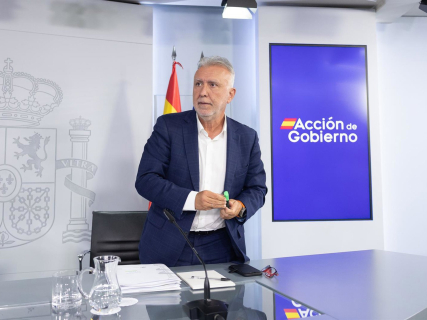
The Minister of Territorial Policy and Democratic Memory, Ángel Víctor Torres, announced this Wednesday that the single command activated to manage the crisis in Ceuta will hold a new meeting this Friday with the President of the Government, Pedro Sánchez. Torres announced the meeting during his appearance in Ceuta, where he is after formally assuming as functional authority of the State's response to the crisis.
Torres announces that the single command of Ceuta will meet with Pedro Sánchez on Friday
The Minister of Territorial Policy, Ángel Víctor Torres, and functional authority to manage the crisis has announced a meeting of the working group with the President of the Government to assess the initial actions deployed in the city.
1 minute
fotonoticia 20260826170731 1920
Most read
More key points, information and questions with FREN
AI-GENERATED CONTENTWhat is the status of the processing of new legislative measures for managing migration crises in Ceuta?
Currently, the management of the migration crisis in Ceuta relies mainly on the application of existing legal frameworks (National Security, Immigration, and minors) and some recent royal decrees, rather than on a new specific law for the city that is about to be approved in the Cortes.
1. Activation of the National Security Law for Ceuta
The most relevant change is the use of the Law 36/2015, on National Security:
- The Royal Decree 681/2026, of August 25, declares the state of interest for national security in the city of Ceuta, already published in the BOE (text in BOE).
- This royal decree identifies as a crisis to be managed the presence of a very high number of irregular migrant persons following the massive entry on July 30, 2026, which overwhelms the ordinary capacity for reception, assistance, and security in the city.
- In parallel, the Council of Ministers has approved a Royal Decree on Resource Declaration for this situation, whose draft has been presented as: “Royal Decree approving the Declaration of Resources to be used in the state of interest for national security in the city of Ceuta, pursuant to article 29 of Law 36/2015” (agreement of 08/25/2026, still in Council agreement phase, pending full development and execution).
From the perspective of processing, this means that:
- the state of interest for national security is already formally declared and in force.
- The Government must immediately inform the Congress of the measures adopted and their evolution (parliamentary control obligation provided in the National Security Law).
- A “functional authority” or unified command (Ángel Víctor Torres) has been appointed to coordinate the state response in Ceuta, with a committee including the Autonomous City and up to 11 ministries, as reported by the press and official notes.
These are regulatory measures (royal decrees) supported by an existing framework law; there is no need to process a new law to activate them, but they are subject to parliamentary control afterwards.
2. Reform of the Immigration and Minors Framework: what exists and what is underway
a) Royal Decree-law 2/2025 and its bill
-
In 2025, the Royal Decree‑law 2/2025, of March 18, was approved, on
urgent measures to guarantee the best interests of children and adolescents in extraordinary migration contingencies
(published in the BOE on 03/19/2025).
-
This decree-law applies especially to Canary Islands, Ceuta, and Melilla and
regulates, among other issues, the Solidarity Response Plan and the
procedure to relocate unaccompanied migrant minors when a certain threshold of places is exceeded.
-
The decree-law was ratified and its processing as a bill in Congress has been agreed (file 121/000055), with the amended deadline extended until September 2, 2026. That is, the development law remains in parliamentary processing.
b) Regulatory development and contingency declaration
-
The Royal Decree 743/2025 set the ordinary capacity of the
autonomous systems for the protection of unaccompanied foreign minors,
including the quotas for Ceuta.
-
In August 2025, the Minister of Youth and Childhood declared the
extraordinary migration contingency in Canary Islands, Ceuta, and Melilla
under this framework
(official note),
activating the planned relocation protocol.
-
Since then, agreements and resolutions have been approved developing
the relocation and financing system, directly affecting
Ceuta when its capacity exceeds 150 % of places.
c) Structural reform of the Immigration Law
-
In 2024, a bill to amend Organic Law 4/2000 (Immigration) was processed,
focused precisely on declaring “extraordinary migration contingency” situations in Canary Islands,
Ceuta, and Melilla and regulating a mandatory model for the referral of minors.
This initiative (122/000123) was rejected at the consideration stage in the Plenary of Congress (processing concluded).
-
According to the newspaper Demócrata, the Government and Canary Islands have continued
negotiating with the PP a new Immigration reform based on that text, but to date it is a political commitment under negotiation;
no new bill or proposal specifically referring to Ceuta is registered in an advanced phase.
3. Recent parliamentary initiatives related to Ceuta
- The Royal Decree 743/2025 set the ordinary capacity of the autonomous systems for the protection of unaccompanied foreign minors, including the quotas for Ceuta.
- In August 2025, the Minister of Youth and Childhood declared the extraordinary migration contingency in Canary Islands, Ceuta, and Melilla under this framework (official note), activating the planned relocation protocol.
- Since then, agreements and resolutions have been approved developing the relocation and financing system, directly affecting Ceuta when its capacity exceeds 150 % of places.
c) Structural reform of the Immigration Law
-
In 2024, a bill to amend Organic Law 4/2000 (Immigration) was processed,
focused precisely on declaring “extraordinary migration contingency” situations in Canary Islands,
Ceuta, and Melilla and regulating a mandatory model for the referral of minors.
This initiative (122/000123) was rejected at the consideration stage in the Plenary of Congress (processing concluded).
-
According to the newspaper Demócrata, the Government and Canary Islands have continued
negotiating with the PP a new Immigration reform based on that text, but to date it is a political commitment under negotiation;
no new bill or proposal specifically referring to Ceuta is registered in an advanced phase.
3. Recent parliamentary initiatives related to Ceuta
The July‑August 2026 crisis has generated intense parliamentary control and promotion activity:
- The Permanent Deputation of Congress debates calling extraordinary plenary sessions and commissions for the Prime Minister and several ministers to report on what happened in Ceuta and the measures to be adopted (Congress note).
- The PP has registered non-legislative motions and other initiatives requesting activation of the National Security Law, strengthening the border, deploying Frontex, urgently reforming the Immigration Law, or approving a 650 million plan for Ceuta and Melilla. These initiatives are in political debate phase and, although they may be approved, do not have direct normative effect.
4. Summary: the status of the “new” legislation for Ceuta
In summary, regarding “new legislative measures for managing migration crises in Ceuta”, the situation is:
- The declaration of a state of interest for national security in Ceuta by royal decree is already in force, with a unified command and a resource royal decree being deployed.
- The framework on migration contingencies and minors is consolidating: RDL 2/2025 is in bill processing phase, with the amendment period open.
- The structural reform of the Immigration Law that would fully affect Ceuta is still in a political negotiation phase, after the rejection of an initial bill.
Therefore, rather than a single “new law for Ceuta,” there is a package under construction: measures already activated via National Security, a decree-law on migration contingencies in the process of becoming law, and an organic Immigration reform still seeking parliamentary majorities.
What are the powers and functions of the Minister of Territorial Policy and Democratic Memory according to Spanish legislation?
According to the current regulations identified in the Official State Gazette, the powers of the Ministry of Territorial Policy and Democratic Memory —and, by extension, of the head of the department as the highest political authority— are mainly defined in the Royal Decree 829/2023, of November 20, which restructures ministerial departments (text in the BOE). This royal decree establishes the material scope of the Ministry's action, which is responsible for proposing and executing the Government's policy in several major areas: territorial policy and the territorial organization of the State, relations with autonomous communities and local entities, and historical and democratic memory.
Regarding territorial policy and the territorial organization of the State, the royal decree provides that this ministry is responsible for “proposing and executing the Government's policy in territorial policy, territorial organization of the State, and relations with autonomous communities and entities that make up local administration.” This places the minister as responsible for: promoting the definition of the Government's general policy on territorial articulation; coordinating, within the General State Administration, the positions of the different departments with territorial impact; and submitting to the Council of Ministers normative proposals, agreements, or actions affecting the distribution of powers or the functioning of the autonomous and local State. The existence of the State Secretariat for Territorial Policy, dependent on this ministry, reinforces that the head of the department politically directs the preparation and monitoring of these policies.
Concerning relations with autonomous communities and local entities, the same provision assigns the Ministry specific responsibility for these relations. On this basis, the minister assumes political leadership of the State's participation in the main bilateral and multilateral cooperation bodies with autonomous communities. Various ministerial orders demonstrate this function: for example, the Order TMD/453/2025, of May 5, publishing the Regulation of the Generalitat‑State Bilateral Commission (BOE-A-2025-9242) and the Order TMD/1217/2024, of October 29, on the State‑Basque Autonomous Community Bilateral Commission (BOE-A-2024-22918) show that the ministry—and ultimately its head— leads and supervises institutional cooperation with these territories. Likewise, the publication of royal decrees on transfer of functions and services, such as Royal Decree 173/2026, of March 4, on unemployment protection in the Basque Country (BOE-A-2026-5307), falls within an area where the minister directs political negotiation and administrative execution of transfers.
In the field of historical and democratic memory, the corresponding article of Royal Decree 829/2023 expressly adds that “the Ministry of Territorial Policy and Democratic Memory is responsible for proposing and executing the Government's policy on historical and democratic memory.” This implies that the minister is responsible for submitting normative projects, plans, and programs in this area to the Council of Ministers; coordinating the application of democratic memory legislation throughout the territory; and representing the Government in this field before other public powers, memorial associations, and international organizations. The creation of the State Secretariat for Democratic Memory as the ministry's senior body reinforces that the design and execution of policies of truth, reparation, recognition, and re-signification of spaces correspond to the ministry under the head's direction.
Besides these substantive functions, the minister exercises internal management and administrative leadership of the department. Various orders show how these powers are specified and partly delegated: the Order TMD/605/2024, of June 12, on setting limits for the administration of certain credits for expenses and delegation of powers (BOE-A-2024-12272) and its subsequent modification by Order TMD/841/2025 (BOE-A-2025-16133) show that the head of the department holds original powers regarding authorization and disposition of expenditure, as well as the capacity to delegate them to lower bodies. Similarly, Order TMD/369/2024, of April 24, on Contracting Boards and Committees (BOE-A-2024-8367), modified by Order TMD/901/2025 (BOE-A-2025-16601), and Order TMD/1036/2024, of September 23, on the Ministerial Commission for Digital Administration (BOE-A-2024-19488) show that the minister organizes contracting, digital administration, and other aspects of internal management, being able to create collegiate bodies and regulate their functioning.
In summary, the consulted legislation shows that the Minister of Territorial Policy and Democratic Memory is the highest authority responsible for: directing the Government's policy on territorial organization and relations with autonomous communities and local entities; leading the State's action in historical and democratic memory; and exercising leadership of the department in budgetary, contractual, and organizational matters, with broad powers to delegate to state secretariats and other senior and managerial bodies of the ministry.
What legal requirements must be met to activate a unified command in crisis situations in Spain?
In Spain, the activation of a unified command in a crisis situation always requires prior legal authorization and is framed within one of the exception or emergency regimes provided by the legal system. There is no purely political “red button”: the Government can only centralize the direction of the response if a law (ordinary or organic) allows it, with parliamentary controls and clear limits on fundamental rights and on the powers of autonomous communities and local entities.
1. Principle of legality and reservation of law
The starting point is the principle of legality: the Administration can only restrict rights or alter the ordinary distribution of powers if a norm with the rank of law authorizes it. When crisis action may affect fundamental rights (freedom of movement, assembly, inviolability of the home, etc.), the Constitution requires that such regulation be made by organic law and, in certain cases, that its suspension or restriction be approved with qualified majorities and reinforced procedures, as recalled in the rules on states of exception or siege.
Furthermore, the distribution of powers between State and autonomous communities established in the Constitution and autonomy statutes cannot be freely altered. The creation of a state unified command implies, at minimum, a strengthened coordination of regional and local resources, and only exceptionally a temporary substitution of their powers, always with express legal coverage.
2. Typical legal pathways for a unified command
In practice, the unified command is articulated through three main types of instruments:
- States of alarm, exception, and siege: the Constitution provides for these extraordinary regimes, developed by a specific organic law. In the state of alarm, the Government can assume unified direction of certain policies (for example, health, mobility, or civil protection), appointing a competent authority who coordinates all involved administrations. For states of exception and siege, the level of rights impact is greater, as are parliamentary requirements.
- Civil protection emergencies: the national civil protection system law foresees that, in the face of natural disasters, serious accidents, chemical emergencies, etc., a situation of national interest emergency can be declared, under the unified direction of a state authority (usually linked to the Ministry competent in Interior), integrating regional and local civil protection services.
- Health and national security crises: sectoral laws in health and national security allow declaring crisis situations that legitimize a coordination center or functional authority at the state level, with the capacity to issue binding instructions to other government levels when very serious risks to public health or national security occur.
3. Formal requirements to activate it
Although they vary depending on the specific instrument, common elements usually concur:
- Existence of a serious risk situation: an extraordinary danger to life, physical integrity, security, public health, or the basic functioning of essential services must be proven.
- Formal act of the Government: centralization is agreed by a collegiate decision of the Council of Ministers, usually through a royal decree declaring the situation (state of alarm, national interest emergency, state of interest for national security, etc.) and appointing the authority exercising the unified command.
- Publicity and delimitation: the act must be published in the corresponding official bulletin and precisely delimit the territorial, material (which sectors or services it covers), and temporal scope of the measure, as well as the specific powers of the unified command.
- Respect for powers: even when a unified command is configured, the general rule is that regional and local administrations remain responsible for execution, under instructions from the state coordination center. Direct substitution of regional authorities is only possible if the law expressly provides for it and under strict conditions.
4. Parliamentary controls and limits
Parliament exercises permanent political control over the activation and exercise of the unified command. Depending on the intensity of rights impact, parliamentary authorization or ratification with reinforced majorities may also be required.
Regarding parliamentary control, the Chambers may:
- Submit oral and written questions and interpellations to the Government about crisis management.
- Approve motions urging modification or lifting of the unified command.
- Call appearances of ministers and senior officials involved.
- Create investigation commissions on emergency management.
- Demand detailed information and documentation on decisions made.
- In extreme cases, pass a motion of no confidence against the Government if its actions are deemed unacceptable.
Regarding material limits, the unified command must adjust its actions to the principles of necessity, suitability, and proportionality; it cannot suspend rights outside the cases provided by the Constitution nor exceed what the enabling law allows. Its decisions are reviewable by courts, including the Constitutional Court, when fundamental rights violations or illegitimate invasions of regional powers are alleged.
Play
Test your knowledge with FREN!
How much do you know about this topic? Answer the following 3 questions.