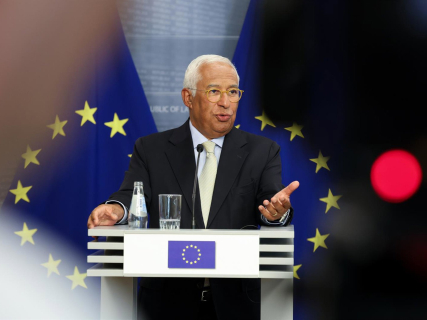

The president of the European Council, António Costa, has launched this week his already traditional "Tour of the capitals," a series of meetings with the heads of state and government of the European Union aimed at gathering their positions and paving the way for the upcoming summits, with a focus on the future long-term budget of the EU.
The journey, which will take place between August 25 and September 17 and will cover most of the Twenty-Seven, began on Monday with stops in Bratislava (Slovakia), where he met with Prime Minister Robert Fico, and in Tallinn (Estonia), where he held a meeting with the Estonian head of government, Kristen Michal.
The agenda continued this Tuesday in Riga (Latvia), with Prime Minister Andris Kulbergs, and in Vilnius (Lithuania), where he met with President Gitanas Nauseda. The next stop will be on August 27 in Prague, the Czech capital, where Costa will meet with Prime Minister Andrej Babis.
In these first four meetings, Costa has emphasized that this autumn will be "decisive" for reaching an agreement on the so-called multiannual financial framework, which, he has argued, must be based on pillars such as competitiveness, industrial transformation, defense, security, and strategic resilience, among other key areas.
The Portuguese socialist leader believes that the community budget for the coming years must also reflect "the demands of the difficult times we live in," so it "must have a completely different structure" from previous frameworks, while at the same time maintaining the continuity of resources allocated to the Cohesion Policy and the Common Agricultural Policy (CAP).
"One thing is for sure: we must reach an agreement before the end of the year. We cannot risk the interruption of EU funding in 2028. This would affect our farmers, our businesses, our students, researchers, and innovators; in short, our citizens. I know it will not be easy, but I am encouraged by the constructive spirit of the leaders and I trust that we can reach an agreement," said the president of the European Council.
In this context, Costa has referred to one of the most sensitive issues among the Twenty-Seven, the introduction of "own resources" to cover an increase in the community budget. "The new sources of income for the European Union will be an essential part of a global agreement," he emphasized.
Warning about hybrid threats and EU borders
In the early stages of the tour, Costa also took the opportunity to draw attention to "Russian hybrid threats" and drone incursions impacting the eastern flank and the Baltic region, calling for a reinforcement of air defense and border protection through a coordinated response at the European level.
The President of the European Council has also urged to accelerate the preparation of common defense for 2030, with a "360-degree" approach that covers all the borders of the bloc, as he warned, "the borders of Europe will only be secure if all our borders are secure."
In the same vein, he labeled the instrumentalization of migratory flows at the external borders of the EU in countries like Latvia and Lithuania as "totally unacceptable," explicitly citing Ceuta along with the Baltic area as examples of a shared challenge that requires "a joint European response" in support of the member states that are directly affected.