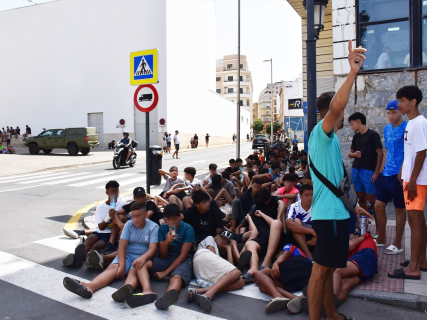

The migrant minors who remain in Ceuta are one of the main open fronts almost a month after the massive entry from Morocco. Interior has raised the number of identified children and adolescents to 2,500, but there is still no official figure on how many remain unregistered and outside the protection system.
The count has increased rapidly during August. On August 5, the National Police had identified 528 minors; two days later, Youth and Childhood raised the record to 1,342. On August 18, Interior reported 2,168 and five days later, Minister Elma Saiz placed the total at 2,500 identified minors.
How many remain unidentified
Here lies the main unknown. It cannot be calculated by subtracting the 2,500 identified from a supposed total figure because no administration still has a definitive census of all the minors who entered and remain in the city.
The Secretary of State for Youth and Childhood, Rubén Pérez, acknowledged on August 21 that there were "many more" minors outside the resources, still without record or registration. At that time, he estimated about 1,400 who were staying in reception facilities.
UNICEF has called for the process to be expedited and has warned that hundreds of minors continued to be in conditions of insecurity and unsanitary conditions. The organization considers it a priority to locate and correctly identify the children who are alone before deciding their future.
What happens when the Police locate a minor
The first step is their identification and record. Spanish legislation requires the registration of unaccompanied foreign minors in the corresponding registry and to make them available to protection services.
If there are reasonable doubts about the age of an undocumented person, an age determination procedure may be opened.
Once minority is confirmed, the legal priority is the protection of the minor, not treating them as an adult who is irregularly in Spain. The Immigration Law establishes that they must be made available to the minor protection system.
Can they be returned to Morocco?
Yes, but not automatically.
The legislation allows for the repatriation of an unaccompanied foreign minor if, after analyzing their individual situation, it is concluded that it responds to their best interest. This can be done through reunification with their family or handing them over to the protection services of the country of origin when adequate conditions exist.
First, their family circumstances must be investigated, listen to the minor when they have sufficient maturity, and gather reports from child protection services and the Public Prosecutor's Office.
The plan to relocate about 500 girls
While these procedures are being processed, Youth and Childhood is working on a specific solution for approximately 500 girls, considered one of the most vulnerable groups.
The Ministry is studying placing them in specialized resources of child protection organizations on the Peninsula, even without initially transferring guardianship to the autonomous communities. The figure of 500 is approximate and may vary as identification progresses.
The Government considers it possible to begin the first relocations "in a few weeks."
The meeting on Thursday
The Sectorial Conference on Childhood and Adolescence meets this Thursday, August 27.
On the table will be an extraordinary credit of 25 million euros for Ceuta intended for the care of migrant minors. Youth and Childhood also aims to address with the communities the response to the overflow of the Ceuta system.