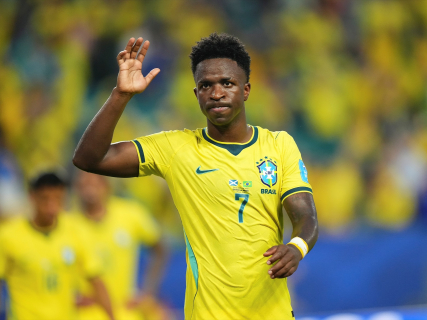

The visit of Brazil to India had a price in line with the expectation it generated. The team led by Carlo Ancelotti played this Saturday in Kolkata the first match in its history against the Indian team and ended up winning 4-0, with goals from Estêvão, Pedro, and a double from Samuel Lino. Vinícius Júnior was a starter and played the first half in front of a crowd that had been waiting for weeks for the arrival of one of the most popular teams in the Asian country.
Beyond the score, the match left some unusual economic figures for a friendly. According to Mint, which cites a source from the All India Football Federation (AIFF), the Confederação Brasileira de Futebol (CBF) would have agreed on a fee of between 35 and 40 crore rupees, that is, between 350 and 400 million rupees, solely for Brazil's participation. At the current exchange rate, that amount is approximately between 3.2 and 3.7 million euros. Neither the Indian nor the Brazilian federation has made the contract public, so it should be considered an estimate attributed to sources from the organization and not an officially audited figure.
Up to 80% of the budget would have been allocated to Brazil
The total cost expected to organize the India-Brazil match was around 500 million rupees, about 4.6 million euros at the current exchange rate. If the published amounts are confirmed, the payment to the CBF would have absorbed approximately between 70% and 80% of the entire budget for the match, before adding some of the logistical expenses associated with a delegation of this size.
One of those expenses was the travel. Estimates place the cost of the charter plane used for a Brazilian expedition of about 90 people at around 60 million rupees, in addition to accommodation, security, and other organizational expenses. The friendly was part of a much more expensive international window for the AIFF, which also scheduled matches against Uruguay and Panama, and whose combined expenditure was estimated between 800 and 900 million rupees.
The comparison helps to understand Brazil's commercial value. Uruguay would have agreed on about 125 million rupees for participating and Panama around 55 million, while the amount allocated to the CBF would alone approach the combined budget of a good part of the rest of the window. The presence of names like Vinícius, Endrick, Marquinhos, or Ancelotti himself was one of the main arguments used to justify the expense.
Vinícius, the great attraction in Calcutta
The figure of Vinícius Júnior had a special weight. Calcutta has maintained a very close relationship with Brazilian football for decades and the expectation around the Real Madrid forward was enormous since the arrival of the expedition. The CBF itself highlighted that Vini was returning to India ten years after having played there with Brazil U-17 in the 2016 BRICS Cup, a tournament in which he was champion and top scorer with five goals.
During the presale, almost 13,000 people coincided in the virtual queue to buy tickets and the cheapest seats sold out quickly. Prices started around 1,000 rupees and increased considerably in the premium areas, although the expectation did not end up completely filling the Salt Lake Stadium. Reuters counted about 51,000 spectators at the match.
The price of tickets became one of the points of debate. Some premium seats reached very high amounts for the local income level, which helps explain why a historic event did not fill all available capacity. The commercial interest, however, was broader than the box office: sponsors, corporate hospitality, audiovisual rights, and the impact of hosting Brazil were part of the value that the Indian federation expected to extract from the operation.
The box office is not the same as the money from the CBF
Here it is important to differentiate two figures. The money generated by the match does not necessarily equate to the money received by the CBF. The Brazilian federation would have primarily received the agreed fee for attending the friendly, while the revenues from ticket sales, sponsors, and commercial exploitation corresponded to the organizers according to the agreements reached between the parties.
That is why the information that speaks of more than four million dollars "generated" by Brazil should not be automatically interpreted as net profits for the CBF. The most solid reference available about the contract places the direct payment to the Brazilian federation in the range of 35-40 crore rupees, while the total budget for India-Brazil was around 50 crore.
Billing cannot be confused with profit either. From the amount that the federation receives, different costs associated with the tour may arise, while for the AIFF the final economic calculation will depend on how much has been recovered through tickets, sponsorships, television, and other commercial agreements. The Indian federation has maintained the confidentiality of the economic details of the contract.
A 4-0 with Vinícius not scoring
In sports, Brazil resolved the friendly after a start more equal than expected. Estêvão opened the scoring in the 28th minute and Pedro extended the lead before halftime. Samuel Lino, who replaced Vinícius, scored twice during the second half to close it at 4-0. The Real Madrid star did not find the goal and Ancelotti took advantage of the match to make numerous rotations.
The match also concluded Brazil's first concentration after the 2026 World Cup. The tour had begun with two friendlies against Australia, with a 1-1 draw and a 4-2 victory, and ended in Kolkata with the win against India. Ancelotti used these matches to test players and rejuvenate a group that was missing a good part of the World Cup squad.
Why India agreed to pay so much
For the Indian federation, the value of the match was not only in competing against a much superior rival. Brazil was the highest-ranked opponent in the FIFA ranking that India had faced since the creation of the world ranking in 1992, and the match allowed for the use of the enormous popularity of the Canarinha in the country to generate attention towards the local team. The AIFF presented the friendly as a historic event and an exceptional opportunity for its footballers.
The financial risk was considerable. Documents known before the match showed that the ordinary accounts of the AIFF had resources far lower than the total cost attributed to this international window, which had opened a debate within Indian football about the profitability of allocating so much money to prestigious friendlies.
For the CBF, on the other hand, the equation was much simpler. Traveling to Calcutta to face the number 138 team in the world would have brought in between 3.2 and 3.7 million euros just in terms of participation, in addition to opening one of the markets with the highest number of followers of Brazilian football. The result was a 4-0 without too many surprises and an operation that demonstrates that, in certain markets, bringing Vinícius and the yellow jersey onto the field can be worth several million even before the ball starts rolling.