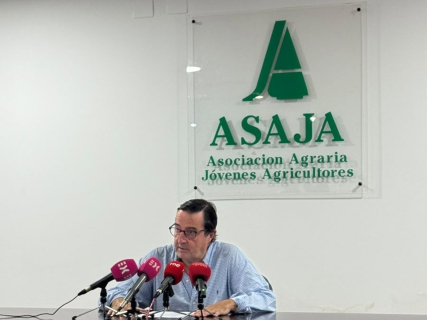

The president of Asaja Extremadura, Ángel García Blanco, has denounced that the trade agreements of Mercosur and other third countries with the European Union (EU) have left "eclipsed" about 6,200 beef cattle farmers in Extremadura. According to what he has stated, in just under two months the value of calves has decreased by almost 240 euros and, if this drop is applied to the 400,000 animals raised in Extremadura, the result is that producers in the region have stopped earning around 96 million euros.
García Blanco has warned of the severe damage that these treaties are causing to beef cattle in the community, to the point of placing many farms in "practical ruin."
In Spain, there is currently a census of about 2,390,000 beef cows. Of these, in the province of Cáceres, according to data from the Ministry of Agriculture, there are 287,865 cattle, which represents around 12% of the national total and makes it the first Spanish province in number of mothers. Following are Salamanca, with 277,855, and Badajoz, with about 176,000 heads.
This is a livestock farming that, "despite the extremely high production costs in most farms had a moderate viability and contributed to the settlement of the population in the territory and prevented the abandonment of the rural world," the agricultural leader recalled during a press conference held this Wednesday.
"In the blink of an eye, our government led by Pedro Sánchez and the president of the European Commission, Úrsula von der Leyen, have launched, despite the opposition of the European Parliament, the ruin of the sector under the Mercosur agreement," he stated.
With the progress of these first months of implementation, "the pain in the pocket and the probable ruin of many farmers have begun," he added. In just two months, calves have dropped in price by about 240 euros, and if we multiply this by the almost 400,000 calves produced annually in Extremadura, we are talking about a loss of 96 million euros.
"And while this is happening, the problems are increasing and the perfect storm is being prepared," says the president of Asaja. First of all, he detailed, prices have collapsed due to the excess supply generated by the arrival of channels that do not respect community regulations.
According to García Blanco, "the entry of Brazilian meat has had to be stopped until September for containing hormones prohibited in the European Union." Secondly, he explained that demand has slowed down because consumers do not know what meat they are purchasing "given that there is no labeling that makes sense."
"To complete the circle, a closure of exports to countries where we traditionally marketed, such as Morocco, has been caused," he added.
The Minister of Agriculture, who is in his withdrawal phase, has assured Ángel García Blanco, "has neglected the issue and on top of that the European Union does not apply the safeguard clauses that have been requested."
In light of this scenario, Asaja Extremadura demands "the suspension of the entry of meat from countries of dubious health and the reopening of currently closed markets, as well as a review of the disease protocols, so that animals do not enter without the sanitary rigor required of Europeans."
Brucellosis in Alburquerque farms
Regarding brucellosis, García Blanco has pointed out that "unfortunately and after six years in which Spain was officially declared free, two outbreaks have appeared in Alburquerque. Unlike tuberculosis, the problem with brucellosis is that all animals in the farm are sacrificed and, in this case, in one farm there are 323 animals (100 positive) and in another 144 (33 positive).
He also indicated that the Junta de Extremadura is conducting analyses and controls in all farms located within a ten-kilometer radius, awaiting the results. Usually, transmission occurs through the consumption of untreated dairy products. "We hope it is controlled soon and that the status of officially free is not lost," concluded the president of Asaja Extremadura.