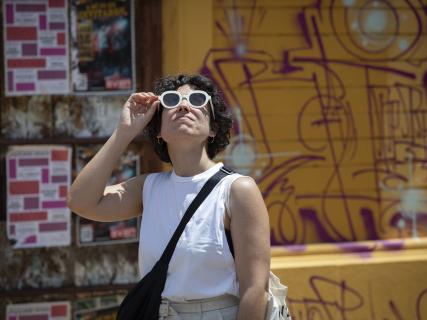

Spain is preparing for the total solar eclipse this Wednesday, August 12, and with the phenomenon just hours away, the demand for the necessary glasses to view it without endangering the eyes is increasing.
The proximity of the eclipse is causing availability problems in some opticians and pharmacies, so finding a glasses at the last minute may require checking several establishments. There are also options in large stores and specialized shops, although stock can change rapidly.
The price, however, should take a back seat. The fundamental thing before using any product is to check that it is really prepared for direct observation of the Sun and not to rely solely on the seller advertising it as "approved" glasses.
Where to buy glasses for the eclipse at the last minute
Specific glasses for observing eclipses can be found in opticians, establishments specialized in astronomy, and certain large stores, although availability depends on each establishment and is changing rapidly due to the increase in demand.
Among the verified options this August 11, El Corte Inglés is selling glasses for the eclipse with ISO 12312-2 certification for 3.99 euros, although stock may vary depending on the establishment.
At this point, the practical recommendation is to check availability before making a special trip to a store. Just because a chain sells the glasses does not guarantee that all its stores still have units available.
| Where to look | Price / modality | What to consider |
|---|---|---|
| El Corte Inglés | 3.99 € | ISO 12312-2 glasses. Availability may vary by establishment. |
| ONCE sales points | Free | 1.7 million units distributed within the campaign. Subject to availability. |
| Scientific centers and participating entities | Free | FECYT distributes 300,000 units among research centers, science museums, and other public entities. |
| Opticians and specialized shops | Variable | Check stock and verify EN ISO 12312-2:2015 and CE marking before purchasing. |
How to know if eclipse glasses are approved
The main reference that consumers should look for is the EN ISO 12312-2:2015 standard, intended for filters for direct observation of the Sun.
The National Eclipse Commission specifically warns that glasses indicating only ISO 12312-1 are not suitable for looking directly at the Sun. In products marketed in the European Union, the corresponding CE marking must also be checked.
Therefore, before buying glasses at the last minute, it is necessary to carefully review their labeling. It is not enough for the commercial advertisement to use words like "eclipse," "solar," or "approved" if the product does not allow for proper verification of its safety characteristics.
What you should look for written on the glasses
The safety information must be clearly identifiable on the product or in its documentation. The fundamental reference for this type of filter is EN ISO 12312-2:2015, along with the CE marking when applicable.
It is also advisable to check that there is information that allows for the correct identification of the product and its manufacturer. In case of doubts about the origin or safety of glasses purchased at the last minute, the prudent option is not to use them to look directly at the Sun.
This precaution becomes especially important with products of dubious origin or hastily purchased online. That a sales page claims that a pair of glasses meets a certain standard does not itself replace the checks that the consumer must carry out on the received product.
Two million free glasses to see the eclipse
Buying glasses is not the only option. The Ministry of Science, Innovation, and Universities and the ONCE Social Group launched a campaign to distribute two million safe glasses for observing the eclipse for free.
Of the total, the ONCE Social Group distributes 1.7 million units, while the other 300,000 correspond to the Ministry of Science through the Spanish Foundation for Science and Technology (FECYT).
The latter have been distributed among research centers, science museums, and other public entities linked to science, innovation, and universities. The campaign aims to reduce the ocular risks associated not only with the 2026 eclipse but also with the so-called Trio of Eclipses that will continue in Spain during 2027 and 2028.
The free glasses may also run out
The existence of two million units does not mean that it is guaranteed to obtain free glasses during the last hours before the eclipse. The distribution is subject to the availability at each point.
The enormous expectation generated by the phenomenon has raised the demand as August 12 approaches. Therefore, going to a distribution point does not guarantee that there are still units left.
Those who intend to obtain them during the last hours should avoid relying on a single alternative. Checking availability beforehand can prevent unnecessary trips and, above all, resorting later to unsafe homemade methods for not having found suitable glasses.
Check the glasses before putting them on
Certification is not the only necessary check. The glasses must be in perfect condition before using them and the filter must not show defects that could compromise protection.
Scratches, perforations, breaks, or visible damage are reasons not to use glasses to directly observe the eclipse. This should be checked both in newly purchased glasses and in those that have been stored previously.
It is also advisable to follow the instructions provided with the product and to properly wear the glasses before directing your gaze towards the Sun.
Regular sunglasses are not suitable for viewing the eclipse
Conventional sunglasses do not replace glasses specifically designed for solar observation, regardless of whether their lenses are particularly dark.
X-rays, smoked lenses, or other improvised materials should also not be used. Reducing the amount of visible light that reaches the eye does not guarantee that there is adequate protection for directly observing the Sun.
Therefore, if suitable glasses are not obtained at the last minute, the solution should not be to make a homemade filter. There are indirect observation methods that allow following the phenomenon without looking directly at the solar disk.
The glasses are also not suitable for looking through a telescope
Another especially dangerous mistake is to use eclipse glasses while observing the Sun through binoculars, telescopes, or cameras without specific solar filters.
Optical instruments concentrate solar radiation and require filters specifically designed for them, correctly installed at the front of the instrument.
Therefore, glasses suitable for looking directly at the eclipse with the naked eye do not make a telescope or binoculars without specific protection safe.
What to do if you don't find glasses for the eclipse tomorrow
If it is finally not possible to obtain safe glasses, it is still possible to follow the eclipse without risking eyesight. The alternative consists of resorting to indirect observation methods or broadcasts made using equipment prepared for the phenomenon.
What should never be done is to replace proper glasses with improvised material simply because the eclipse is about to begin. Sunglasses, X-rays, and smoked glasses do not provide the necessary protection to observe the Sun directly.
The eclipse on August 12 will be an exceptional event, but no photograph or a few seconds of observation justify risking eye health. If there is no certainty that the system used is safe, the appropriate option is not to look directly at the Sun.