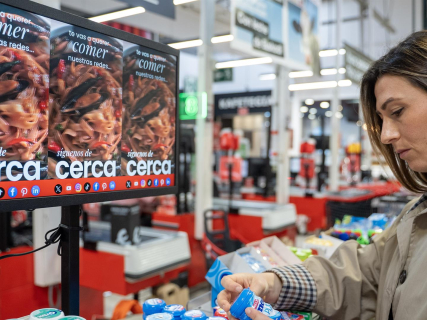

The distribution cooperative Eroski has given a new boost to its In-Store Retail Media model, a solution that links the knowledge of shopping habits with the activation of advertising campaigns within the store and the detailed measurement of their results.
The proposal has been developed through a co-creation process with manufacturers within the framework of AECOC and has involved the deployment of a renewed digital advertising infrastructure in 38 establishments of different formats: proximity supermarkets, attraction supermarkets, and hypermarkets, as reported by the company in a statement.
These supports are added to a network of more than 400 screens, which integrates both the new devices and the screens already installed in the rest of the stores.
The model crosses proprietary data from customers, stores, and assortments to locate the spaces and moments with the greatest affinity for each campaign, incorporating information about visit frequency, the categories that are consumed, or sensitivity to promotions.
Beyond simple advertising visibility
In this way, Eroski presents brands with a proposal that goes beyond mere advertising visibility and offers them the possibility of planning their actions based on specific objectives.
The campaigns tested during the validation phase show positive differentials compared to the so-called mirror stores, used as a comparative reference. Furthermore, 80% of the promoted actions have increased their share within the category, reinforcing the model's potential to boost brand business at the point of sale itself.
Eroski presented the conclusions of this phase and shared its "ambition roadmap" in Retail Media at the third edition of the AECOC Category Management Forum, held on October 15 in Madrid.
At this meeting, focused on innovation, omnichannelity, Retail Media, and collaboration between manufacturers and distributors, the company detailed how it integrates data, audiences, activation, and measurement in category management to detect growth opportunities and optimize commercial and media investment.
The reflection posed by AECOC after the forum supports this vision, as, according to its third CatMan Survey, nine out of ten companies are already working in category management, but only one in ten does so with a business plan and truly shared dashboards.
Collaboration and technology at the service of growth
The advance towards more collaborative models, supported by technology and oriented towards the joint growth of the categories, fits directly with Eroski's proposal.
Each campaign is built from the definition of the brand's objectives and the audience it wants to target, whether to support launches, reinforce promotions, gain notoriety, or activate certain categories.
Based on this, the recommendation model determines which stores, days, time slots, and supports are most suitable, considering purchasing patterns and the availability of the products to be communicated.
The activation is thus adjusted to the context of each establishment and category, through a network that integrates different digital formats, such as videowalls, screens in sections and counters, devices on the shelf, and screens located in the checkout areas.
The Director of Strategic Marketing Projects at Eroski has pointed out that in the cooperative they understand innovation as "a way to add value to people" and to "grow" alongside suppliers, and has highlighted that with this model they transfer customer knowledge to "concrete decisions about where, when, and how to communicate."
She added that their goal is for brands to discover new opportunities to connect with consumers and that the information in-store "is more useful and relevant."
In addition to measuring advertising impacts, Eroski analyzes the evolution of sales and category share, comparing the data with mirror stores and taking into account the history and context of each campaign. This analysis allows for extracting learnings and applying them in subsequent activations.
The co-creation phase has served to contrast the importance of coordinating the location of supports, visibility, segmentation, frequency, and budget, as well as adapting the content to the purchasing context and ensuring its correct execution at the point of sale.
Cuesta has emphasized that the value of Retail Media does not only reside in reaching an audience, but in doing so in a relevant context and knowing what results each action obtains, and has insisted that measurement allows "to learn with brands and improve the planning of subsequent campaigns."
As has been emphasized, that combination of knowledge, activation, and learning constitutes the basis of the cooperative's proposal and of "the roadmap" that they share with the sector at the AECOC forum.
The participation of manufacturers from different categories has allowed for the incorporation of diverse needs and goals into the design of the model, and this collaboration drives the digitalization of establishments and expands the communication options of brands at the moment of purchase decision.
For the clientele, the project aims to facilitate access to information about products, news, and promotions throughout their journey in the store.
The development of Retail Media In-Store is framed within Eroski's technological transformation and lays the foundations for "advancing towards a greater connection" between in-store activations and the rest of the channels in their communication and relationship ecosystem with the clientele.