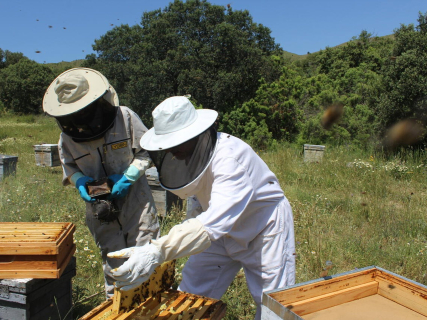

The Unió Llauradora i Ramadera has warned that the combination of prolonged drought and strong pressure from the bee-eater will cause a drop of more than 40% in honey production in the Comunitat Valenciana, in a particularly critical year for beekeeping operations.
According to the agricultural organization in a note, the scarce flowering, the higher mortality of bees, and the rising costs of feeding, management, transportation, and swarm replacement are putting the viability of many operations in question.
The Unió highlights that nearly 99% of Valencian hives are migratory, which exacerbates the problem for operations forced to continuously move their hives in search of flowering, assuming costs that keep growing.
"For every hive that dies, and these days in the Comunitat Valenciana thousands are dying, the beekeeper loses 120 euros," indicated the general secretary of La Unió, Carles Peris. Currently, there are 2,440 registered beekeeping operations and 271,557 hives in the Valencian territory.
The Unió, which has "again" conveyed to the Ministry of Agriculture the "serious and persistent" impact derived from the bee-eater, explains that in 2026 the pressure from this insectivorous bird has been unusually intense in certain areas, compromising the development of swarms, honey production, and other beekeeping products.
The entity recalls that it already brought this situation to the table in October 2023, when it requested prevention and compensation measures, as well as the approval of an official protocol. In February 2024, it insisted on the need for direct aid for affected operations. "Three years have passed since the first request and we still have no response," lamented the organization.
The continued presence of the bee-eater not only translates into direct predation of bees. It also causes a fear effect in the surroundings of the settlements, reducing foraging and, consequently, the entry of nectar and pollen into the hives. This forces the colonies to consume their reserves, diminishes the feeding of the brood, and gradually weakens the swarms, especially when they are already suffering from drought, lack of flowering, and other health and climatic factors.
They demand a protocol and specific aid
The Unió recalls that Order 8/2023, of April 20, which regulates intervention aids in the beekeeping sector of the Comunitat Valenciana, includes in its annex I, section 2.1.6, the option to finance preventive measures against the bee-eater as long as there is an officially authorized protocol. Therefore, it considers it essential for the Generalitat to develop and approve said protocol so that this possibility can be applied in a real way.
The organization insists that the protection of the bee-eater and the maintenance of beekeeping can be compatible, and advocates for a coexistence strategy based on authorized, selective, and non-harmful preventive measures, along with compensations for damages that cannot be avoided. LA UNIÓ emphasizes that it does not propose population controls or actions on the nests.
In this regard, it demands from the Generalitat an official protocol agreed upon with the sector, a stable line of aids to compensate for damages and cover preventive measures, prioritizing professional farms, as well as a research and monitoring program that allows identifying which deterrent systems are truly effective.
The organization also suggests that nets and protection structures, duly authorized acoustic or visual systems, and other tools compatible with the conservation of the bee-eater could be subsidized, in addition to an agile procedure to certify damages and process aids, specifically adapted to transhumant farms.
LA Unió considers that, after the repeated requests made since 2023, it is time to move from mere recognition of the problem to the effective implementation of solutions, as the economic burden derived from the mortality and weakening of hives cannot indefinitely fall on beekeepers.