

In my last article, I wrote about the crisis in Ceuta and about the European inability to face a border that, although Spanish, is also a border of the Union. I would not like to revisit what has already been said. But what happened left me with a question much more important than the migration crisis itself: what is Europe doing in the space that is immediately on the other side of its southern borders?
This time I am not talking about Ceuta. I am talking about the Western Mediterranean and the Maghreb as a European strategic space. Ceuta is barely a window through which to view a much deeper geopolitical change: Morocco is changing its position, Algeria is seeking its own, France and Italy are redefining their interests, and other actors -the United States, Turkey, Israel, and the Gulf countries- are expanding their influence. The result is a Mediterranean that is increasingly contested while Europe continues to talk about "southern neighborhood," as if it were a periphery. Perhaps the time has come to recognize that the South is not the periphery of Europe, it is one of the places where its future and security are at stake.
"The South is not the periphery of Europe: part of its future and security is at stake there"
Europe has been making Mediterranean policy for thirty years
It is worth starting with a clarification. It is not true that Europe has done nothing in the Mediterranean. It would be unfair and, moreover, not very rigorous.
In 1995, the Barcelona Process attempted to turn the Mediterranean into a common space of peace, stability, and prosperity. In 2008, the Union for the Mediterranean sought to relaunch that project. And in 2021, the European Union presented a new agenda for the Mediterranean with objectives ranging from development and digital transition to security, migration, and green transition.
The problem, therefore, is not that there are no initiatives, institutions, or documents. Europe has a long tradition of turning a strategic need into a European document, giving it an acronym, organizing a conference, and hoping the problem will disappear. The problem is that, after thirty years, Europe still has not managed to turn its Mediterranean policy into a true strategic priority and a power policy. And the Mediterranean is not going to wait.

For too long, for a good part of the Northern European countries, the Mediterranean has not had the same strategic importance as the East. For the Mediterranean countries, on the other hand, it has had it, but each one has tended to defend its own interests. France looks at the Maghreb from its history and its economic and security interests. Italy looks increasingly towards Africa from energy, immigration, and its economic expansion project. Spain has Morocco and Algeria in front of it, Ceuta and Melilla, the Canaries and the Strait. Everyone recognizes that the Mediterranean is strategic, but not everyone understands the same thing by strategy.
To this is added the Middle East. For decades, the Israeli-Palestinian conflict has contaminated numerous attempts at regional cooperation. The result is evident: cooperation frameworks abound, but the capacity to act jointly when strategic interests are at stake is scarce.
Morocco has understood the new world before Europe
Morocco deserves much greater attention than it receives in European capitals. Not because it is an enemy - it is not - but because it is a partner whose strategic importance is growing.
Rabat has understood something that Europe seems to comprehend with greater difficulty: in a world less dominated by a single power, it is not advisable to depend too much on anyone. Morocco maintains a privileged relationship with the United States, has deepened its ties with Israel in technological and security areas, is approaching Gulf countries, develops an increasingly ambitious African policy, and at the same time maintains an essential economic relationship with Europe. It has not chosen a dependency. It has chosen to diversify its dependencies.

Europe, on the other hand, continues to behave too often as if Morocco needed Europe much more than Europe needs Morocco. It is a dangerous illusion.
Morocco is not a pawn that Europe can place wherever it wants on its board. It is building its own maneuvering room and simultaneously playing with Washington, Brussels, Tel Aviv, the Gulf monarchies, and Africa. The question is not whether Morocco is moving away from Europe. The question is whether Europe is losing the ability to be Morocco's most important partner.
France, Italy, and Spain: three national interests
Here appears another of the European weaknesses.
France has decided to approach Rabat and support the Moroccan autonomy plan for Western Sahara. Paris is trying to regain influence in a Maghreb where its position has weakened. But this approach has consequences: Algeria cannot view it with indifference.
Spain knows this difficulty well. Morocco is an essential economic partner, an immediate neighbor, and a fundamental actor in migration and security matters. Algeria has been an indispensable energy partner for decades. Any imbalance between the two ends up affecting us.

Italy, for its part, has chosen to look towards Africa with an ambition that Spain and the European Union itself should observe closely. The Mattei Plan seeks to turn energy, investment, infrastructure, cooperation, and migration into instruments of foreign policy. We can discuss its results or its European dimension. But there is something that Rome seems to have understood: Africa is not managed from Brussels. One must be there.
And here lies the contradiction: France has its policy towards the Maghreb, Italy its African policy, and Spain its neighborhood policy. Then we try to wrap them all under the label of a European foreign policy. It does not work. Europe does not lack interests in the Mediterranean; it lacks a common hierarchy of those interests.
The Strait: where geography commands again
And then we return to Ceuta. Because Ceuta forces us to look at the Strait and the Strait forces us to look much further.
For too long we have treated Gibraltar, Ceuta, Melilla, and the western Mediterranean as separate issues. They are not. They are part of the same strategic space. To the west is Gibraltar; to the east, Ceuta and Melilla; to the south, Morocco. Beyond, Algeria and the Maghreb; inland, the Sahel and West Africa.
Geography does not solely determine politics. But ignoring it is one of the surest ways to go wrong in geopolitics.
"Geography does not solely determine politics. But ignoring it is one of the surest ways to go wrong in geopolitics"
Through the Strait circulate goods, energy, and people. It is the connection between the Atlantic and the Mediterranean and one of the essential maritime points for Europe. And yet, we continue to view it too often as a Spanish, British, or Moroccan issue, when its strategic dimension is indisputably European.
The Strait is not a blue line between two continents. It is one of the keys to Europe. And there arises an uncomfortable question: if Europe has been building cooperation instruments with its Mediterranean neighbors for thirty years, why does it still lack a true geopolitical vision of this space? We do not need another document full of words like "resilience," "sustainability," "cooperation," and "partnership," we need to know what European interests we want to defend.
Others are already playing
While Europe perfects its cooperation instruments, other actors have understood that the Mediterranean is also a space of power.
Turkey moves with extraordinary flexibility between the Mediterranean, the Middle East, Africa, and the Caucasus. Gulf countries multiply their investments and political relations. Israel has expanded its regional cooperation networks. The United States maintains a decisive presence. China builds, finances, and trades. Russia takes advantage of the spaces that others abandon. Not everyone has the same objectives, but they share something: they consider the Mediterranean a space where there are interests to defend and positions to conquer.
Europe should also consider it that way. Not to become a tutelary power of the South nor to impose a European vision on its neighbors, but to stop behaving as if economic power were enough to guarantee political influence. Power is not just about being rich. It consists of being present when decisions are made. And Europe is starting to be absent from too many places.
Spain should ask the uncomfortable question
Spain has an exceptional position to raise this debate. We are the southern border of the Union, but also a bridge between Europe, Africa, and the Atlantic. We have Ceuta and Melilla, the Canary Islands, the Balearic Islands, and the Strait. We have an extraordinarily intense economic and human relationship with Morocco, a fundamental energy relationship with Algeria, and a historical diplomatic experience and presence in Latin America and Africa, although today quite disoriented, dogmatic, and unilateral.
"Spain has an exceptional position to raise this debate. We are the southern border of the Union, but also a bridge between Europe, Africa, and the Atlantic."
Precisely for that reason, we should stop presenting the Mediterranean as a sum of Spanish problems that Europe must help us finance. Spain should demand more Europe in the South, but not in the form of another political declaration. It should promote a European strategy for the western Mediterranean that combines security, defense, energy, trade, infrastructure, technology, migration, and political influence. And it should do so by seeking an understanding with France and Italy, but without accepting that each one turns the Mediterranean into a mere appendix of their own foreign policy.
Europe also needs to assume that its relations with Morocco and Algeria cannot be reduced to containing immigration or guaranteeing energy supply. It needs to offer investment, technology, infrastructure, and trade, but also a political relationship among equals.
And here is a line that Spain and Europe should make very clear. Cooperating with Morocco and with the African Mediterranean countries does not mean depending on them, accepting their interests as our own, nor, much less, admitting blackmail, impositions, or threats. A relationship of neighborhood cannot become a relationship of subordination, nor can immigration, energy, security, or economic cooperation be used as instruments of political pressure.
Spain and Europe must be able to cooperate with Morocco from mutual respect, but also to clearly mark their own red lines and respond when they are crossed. Understanding the other does not mean submitting to the other. Dialoguing does not mean yielding. And cooperating does not mean accepting that anyone uses our vulnerability to impose their conditions on us. True strategic autonomy starts precisely there: in knowing what our interests are and having the political will to defend them.
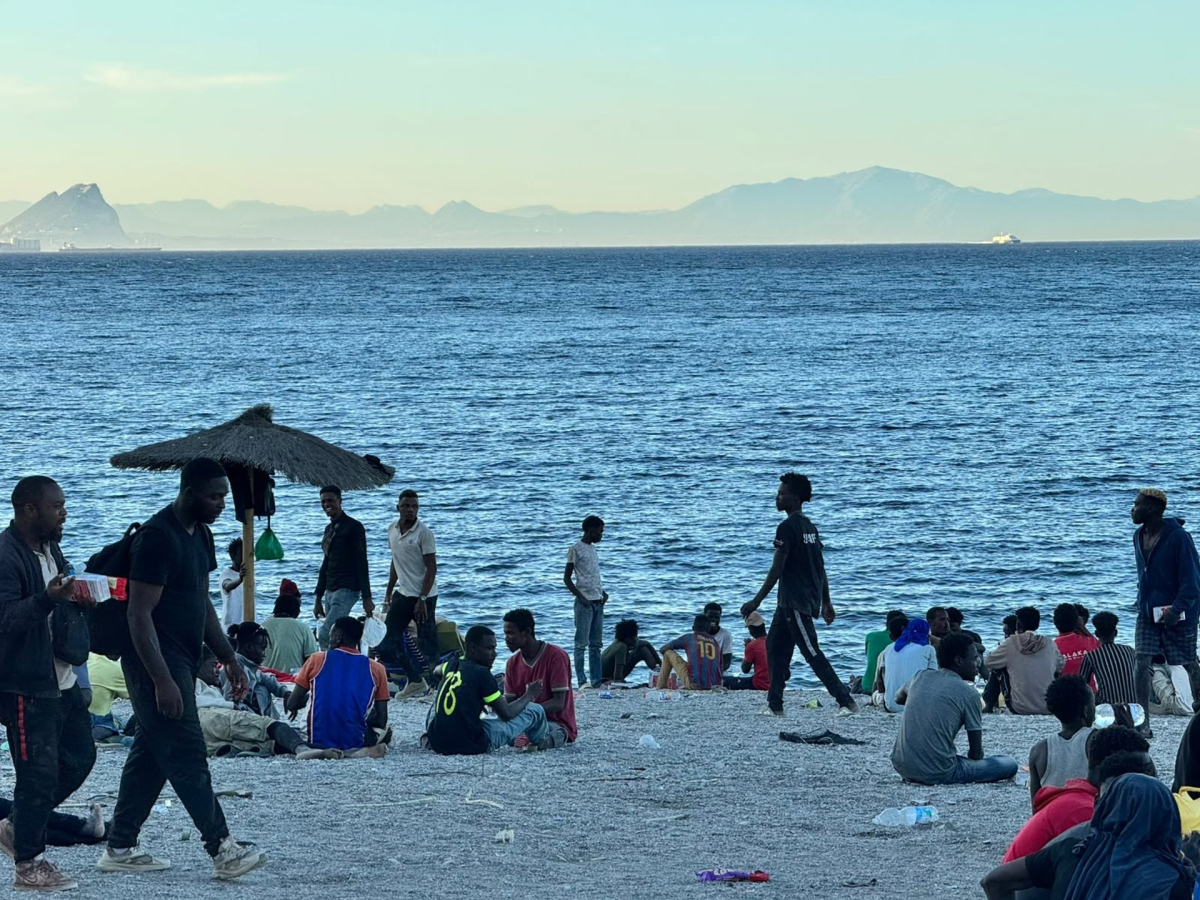
Ceuta has reminded us that our southern border exists. Morocco reminds us that medium-sized countries can also play with the great powers, France that member states continue to defend their national interests before the European ones, Italy that whoever wants to influence Africa must be in Africa, and the Strait that geography, that old lady whom Europe thought it had retired with the single market and globalization, has returned to collect all the outstanding bills.
Europe can continue to obsessively look to the East, but it cannot afford to keep glancing sideways to the South. Europe has been trying for thirty years to build a Mediterranean policy. Perhaps the time has come to finally turn it into a strategic policy. Because the Mediterranean is not Europe's border. It is one of its main spaces of power and security. And there Spain has something to say.