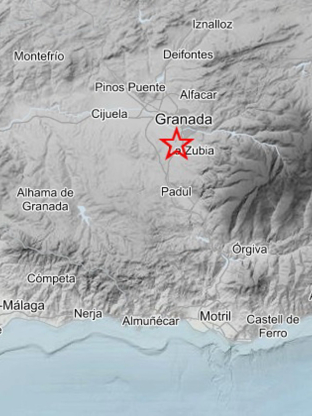
The IGN places the epicenter northeast of Alhendín and has already recorded dozens of aftershocks, while emergency services review cracks, landslides, and other material damages. There are no reported injuries and Juanma Moreno has asked for calm and special caution with damaged cornices and facades.
Granada has experienced one of its most agitated nights in recent years. An earthquake of magnitude 5 shook the capital and much of its metropolitan area at 01:04 hours this Saturday, August 15, waking thousands of residents and felt much further beyond the province.
The main movement had its epicenter northeast of Alhendín. The latest review from the National Geographic Institute sets its magnitude at 5.0, a maximum intensity of V-VI, and a depth currently calculated at 0 kilometers. The IGN itself warns that the parameters of recent earthquakes may change as the analysis of the seismic stations continues.
The earthquake has caused material damage in different municipalities, more than 200 alerts to 112, and numerous interventions by firefighters and police, but as of this morning, there is no record of personal injuries. The Junta de Andalucía has activated the emergency phase, operational situation 1, of the Plan for Seismic Risk.
Latest news on the Granada earthquake
- At 08:41 hours, these are the main confirmed data:
- The main earthquake occurred at 01:04:40 hours and reached a magnitude of 5.0.
- The epicenter is located northeast of Alhendín, in the metropolitan area of Granada.
- The maximum intensity calculated by the IGN is V-VI.
- The Junta has activated the emergency phase, operational situation 1.
- Emergencies 112 has managed more than 200 alerts.
- There are no reported injuries or victims.
- At least one building in Las Gabias has been evacuated preventively.
- Firefighters and police are reviewing cracks, facades, cornices, and other damaged elements.
- Granada has already accumulated more than 35 aftershocks after the main earthquake.
- The largest aftershock recorded until early hours reached a magnitude of 3.3 in Gójar at 06:34.
And the activity had not stopped by 08:00: the IGN recorded a new movement of magnitude 2.1 southwest of Gójar at 08:04.
More than 35 aftershocks after the magnitude 5 earthquake
The big shake has not been the end of seismic activity.
Granada Hoy counted already 37 small earthquakes until 07:06 hours after the main episode, concentrated mainly in Gójar, Ogíjares, La Zubia, Otura, Alhendín, Armilla, Dílar, and Churriana de la Vega.
The IGN has continued to incorporate new movements afterwards. Among the most recent is an earthquake of magnitude 2.0 southeast of Gójar at 07:33 and another of 2.1 southwest of the same municipality at 08:04.
The strongest aftershock recorded during the early morning occurred at 06:34 hours north of Gójar. It reached a magnitude of 3.3, intensity III-IV, and was clearly perceived again by a population that had been attentive to every movement for hours.
The exact number of aftershocks will continue to change throughout the day. The IGN catalog is continuously updated and reviewed, so this piece must remain live and be modified when a new significant movement appears.
The 3.7 earthquake in La Zubia was the first major warning
The magnitude 5 earthquake did not appear completely isolated.
The sequence had already begun during the afternoon of Friday. At 18:43 hours, the IGN recorded a movement of magnitude 3.7 northwest of La Zubia, at a depth of five kilometers and with intensity IV.
Then came another earthquake of magnitude 2.2 in Otura at 20:03 and one of 2.3 in Ogíjares at 00:04. Exactly one hour after this last one, the main earthquake of Alhendín occurred.
The chronology turns the 3.7 on Friday into the first notable movement of a sequence that ultimately led to the strongest earthquake during the early morning.
What damage has the Granada earthquake caused
The first assessments mainly show material damage.
112 has received more than 200 reports related to cracks, cornices, debris, walls, and other affected elements in buildings. Firefighters and police are inspecting and marking those points where there is a risk of new landslides.
The City Council of Granada has also received around a hundred calls directed to the Firefighters to request inspections of properties. The teams have attended to landslides, leaks, and rescues of people who had become trapped in elevators.
One of the most important episodes occurred in Las Gabias, where a building was evacuated preventively to check its condition after the shaking.
There have also been reports of damage to facades, roofs, and other construction elements in different points of the capital and the metropolitan area.
Are there any injuries from the Granada earthquake?
Until this morning, no.
The Junta de Andalucía confirms that there is no record of personal injuries despite the intensity of the earthquake and the high number of reported incidents.
It is one of the most relevant pieces of information from the early morning. The movement occurred at a time when thousands of people were sleeping inside their homes and caused landslides in different buildings, but so far the consequences are material.
This does not mean that the risk has ended. The authorities insist precisely that a cornice, wall, balcony, or element damaged during the earthquake may detach later.
Juanma Moreno calls for calm and caution
The president of the Junta de Andalucía, Juanma Moreno, reacted early and described a “night of fright and unease in Granada.”
Moreno has asked to remain calm and has particularly insisted on the risk that the affected elements of the buildings may represent: “Be very careful with any damaged cornice or facade that may still detach.”
He has also urged the population to follow the recommendations of the emergency services while inspections continue.
The warning coincides with the instructions transmitted by the Junta: to stay away from facades, cornices, balconies, walls, and posts that show damage and not to approach the marked areas to observe or take photographs.
The Junta activates the emergency phase, operational situation 1
The magnitude of the earthquake led the Junta to activate the emergency phase of the Plan for Seismic Risk during the early morning.
The operational situation 1 allows for enhanced monitoring, coordinating resources from the regional administration and working together with the Provincial Council and the affected municipalities in the evaluation of homes and buildings.
The Emergency Agency of Andalucía has also activated the Group of Volunteer Architects of Andalucía to assist in the evaluation and quantification of the damages caused to properties.
Firefighters and police remain deployed at the points where damages have been detected to prevent access to potentially dangerous areas.
Thousands of people left their homes during the early morning
The succession of tremors led hundreds of neighbors to voluntarily leave their homes and remain in streets, squares, and open spaces.
In the metropolitan area there were people who left with blankets, chairs, and basic items out of fear of another shake. The reaction was especially visible in areas with old buildings.
It was not a general evacuation order. It was fundamentally a spontaneous reaction to the earthquake at 01:04 and to the continuous aftershocks recorded afterwards.
The storm that fell hours later added even more tension to a dawn that much of the metropolitan area spent practically without sleeping.
Where the earthquake has been felt
The earthquake has been clearly perceived in practically the entire province of Granada and in wide areas of Andalusia.
112 received communications from all the Andalusian provinces except Huelva and Cádiz in the first report released by the Junta.
The shake was especially felt in Granada capital and its metropolitan belt, but also in the Costa Tropical, Málaga, Almería, Jaén, and Córdoba. The high perception at such a distance is related to the magnitude and the very shallow character currently calculated by the IGN.
Within the area close to the epicenter, Las Gabias, Cúllar Vega, Churriana de la Vega, Armilla, Cájar, Gójar, and Vegas del Genil are among the localities where some of the most notable effects were recorded.
Magnitude 5 and intensity V-VI: what it means
Magnitude and intensity are not the same.
Magnitude 5 measures the size of the earthquake based on the energy released. There is a magnitude for the event.
Intensity measures, on the other hand, how the earthquake has been perceived and the effects it has caused in different places. That is why it changes depending on the municipality and the distance from the epicenter.
The IGN currently assigns a maximum intensity V-VI to the main earthquake in Alhendín.
In addition, the depth initially reported during the early morning has been revised. The official catalog now places the main event at a depth of 0.0 kilometers, although the Institute warns that the recent parameters remain subject to review.
Could there be another strong earthquake?
It cannot be known.
Earthquakes cannot currently be predicted with precision regarding location, time, and magnitude. The existence of dozens of aftershocks is part of the usual evolution after certain movements, but it does not allow knowing in advance what the magnitude of the next one will be.
What can be confirmed is that seismic activity continues. At 08:04 hours, the IGN was still incorporating small movements in the vicinity of Gójar.
For this reason, the monitoring of the National Seismic Network remains active and the authorities maintain the emergency device.
Why does Granada shake so much
Granada is located in one of the seismically most active areas of the Iberian Peninsula.
The Granada Basin is traversed by different active faults and the metropolitan area records numerous earthquakes of low or moderate magnitude. In 2020 and 2021, the Vega area experienced a well-known seismic swarm with thousands of small movements.
The current episode does not allow concluding that such behavior will be repeated, but it reminds us that seismic activity is part of the geological reality of the province.
The earthquake this Saturday is notable for its magnitude, its shallow depth, and for occurring in a densely populated area of the metropolitan belt.
What to do in the coming hours
Emergencies recommends staying calm and not entering buildings that have suffered damage until technicians indicate that they are safe.
In the street, one should stay away from facades, cornices, balconies, walls, posts, and any element that may fall.
If a new aftershock occurs inside a building, one should protect themselves next to resistant structural elements and stay away from windows, glass, and objects that may fall. Elevators should also not be used after an earthquake if there is a possibility that the installation has been damaged.
The Junta also asks not to go to places with damage simply to observe them or take photographs and to keep access clear for emergency services.
What role does the National Geographic Institute have now
The IGN and its National Seismic Network are the official reference for determining where an earthquake has occurred, its magnitude, depth, and characteristics.
The catalog is continuously updated as new data arrives. In fact, during this morning, some parameters of the Alhendín earthquake have been revised.