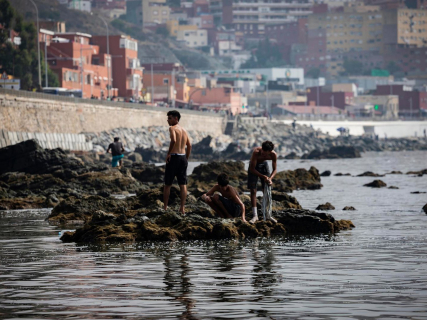
Ceuta faces August 15 with a border under maximum surveillance due to the threat of another migration crisis

Spain maintains about 1,600 national police and civil guards in the autonomous city in response to calls on social media to attempt a new crossing this Saturday.

8 minutes

fotonoticia 20260812171126 1920

fotonoticia 20260812171126 1920

Add DEMÓCRATA to Google

Ask FREN

Published

Last updated

8 minutes

Most read

Ceuta enters the hours prior to Saturday, August 15 with the border subjected to an extraordinary security device on both sides. The date has been circulating for days on Moroccan social networks as a moment to attempt a new collective crossing to the autonomous city and, although there is no certainty that the call will materialize nor what its scope would be, Spain and Morocco have reinforced their means to prevent the scenes of July 30 and 31 from repeating.

The image this Friday is very different from that of two weeks ago. In Ceuta, the Ministry of the Interior estimates the deployment at 880 national police and 714 civil guards: 1,594 agents between both bodies. That is about 500 more than before the crisis at the end of July. They are joined by the support of about 2,000 military personnel stationed in the autonomous city, while different specialized units of the Police and Civil Guard take care of the border, the streets, the coastline, the identification of those who remain in Ceuta, and the processing of immigration procedures.
In Morocco, the device has not been limited to the border crossing either. Hundreds of police, members of the Auxiliary Forces, and military personnel are deployed in Castillejos and its surroundings, where new lines of wire and concertinas have been placed, vehicles with water cannons have been positioned, and controls have been established on the roads leading to the border. Moroccan boats also patrol the coast.

All this occurs while small groups of young Moroccans and sub-Saharan migrants, including Sudanese citizens, continue to arrive in the surroundings of Castillejos after learning of the calls spread on the internet. The groups observed this Friday do not have, for now, dimensions comparable to the concentrations recorded during the previous crisis.

880 national police: 270 more than before the crisis

The latest balance provided by the Interior places the number of national police deployed in Ceuta at 880, compared to approximately 610 that made up the device before the events of July 30. That is, 270 more agents.

The overall figure allows for measuring the reinforcement, but behind it exists a device composed of units with very different functions.

After the start of the crisis, the National Police deployed five teams from the Police Intervention Units (UIP), with 225 agents from Seville, Málaga, and Madrid. Their mission has focused both on maintaining public order and on reinforcing surveillance of the beaches and other points considered sensitive, especially those where groups of migrants were installed after the massive entry.
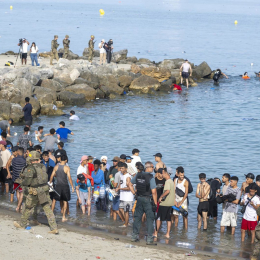
To those five teams were later incorporated another 45 agents from the UIP, in addition to the group from this unit that is already part of the staff in Ceuta. The citizen security forces of the city have also worked with reinforced shifts to increase police presence on the streets.

The Interior Ministry has also mobilized six agents from the General Information Police Station, the area responsible, among other competencies, for the fight against terrorism. Grande-Marlaska has denied that the crisis has caused an increase in the jihadist threat, although he has confirmed that the Security Forces are maintaining identification and surveillance tasks over the people who entered.

These units are part of the device accumulated since July 30 and should not be automatically added to the 880 agents as if they were additional forces, since there have been mobilizations, replacements, and reinforcements within the total number provided by the Interior Ministry.

Another 45 agents from the UPR for the streets

To this device, the Interior Ministry has added a new specific reinforcement in light of the situation in the city: 45 agents from the Prevention and Reaction Unit (UPR) from Madrid, Alicante, and Seville.

Another part of the police reinforcement does not have the direct mission of protecting the border, but rather to expedite the identification and administrative procedures of the thousands of people who remain in Ceuta.

Grande-Marlaska announced the sending of 20 agents from the Central Brigade of Immigration and Borders. They join six specialists from the Central Unit of Expulsions and Repatriations (UCER) sent immediately after the massive entry.

These teams work alongside the local staff in tasks of affiliation, fingerprinting, documentation, and processing of files, necessary steps before determining what legal procedure corresponds to each person.

Interior has made this issue one of its priorities. Marlaska estimates that about 5,000 people still remain in Ceuta, although the calculation of the city government is higher and has fluctuated in recent days between about 8,000 and more than 10,000.

714 civil guards, maritime and aerial surveillance

The second major component of the Interior device is the Civil Guard. Ceuta now has 714 agents from the armed institute, nearly 200 more than before the massive entry, according to data provided by the Ministry.

Their role is especially important because a good part of the entries at the end of July occurred by sea and along the El Tarajal pier, an area under the responsibility of the Civil Guard.

Likewise, maritime surveillance has become one of the fundamental elements of the new device. The Civil Guard has deployed to Ceuta two teams from the Special Underwater Activities Group (GEAS), made up of eight members, to reinforce the capacity for intervention in the water.

It has also sent the Duque de Ahumada, the largest ship of the armed institute, with a crew of 12 civil guards.

The aerial device has also been reinforced with a helicopter from the Air Service of the Civil Guard, aimed at increasing coastal surveillance and providing support from the air.

A maritime barrier at the El Tarajal pier

To the forces are added new physical obstacles. After the sea entries at the end of July, the El Tarajal pier has been reinforced with a floating maritime barrier, intended to physically delineate the border line over the water and facilitate the control of those attempting to swim around the pier.

The barrier protrudes between approximately 30 and 70 centimeters above the surface of the sea.

Its importance is not only physical. The maritime border delineation gained special relevance after the recent ruling of the Supreme Court regarding the conditions under which border rejections can be carried out, so the device aims for agents to be able to determine more clearly the point at which an entry attempt is occurring.

Melilla has also installed a similar barrier at its southern dock in anticipation of the possibility that migratory pressure may shift to the other autonomous city.

About 2,000 military personnel remain in support

The deployment is not limited to the bodies dependent on Interior.

Around 2,000 members of the Armed Forces stationed in Ceuta are carrying out support functions, especially after the mobilization activated during the previous crisis.

Their presence allows for support in security and logistics tasks, although police, border control, and immigration competencies continue to correspond to the competent bodies and authorities.

Morocco raises new fences and barbed wire

On the other side of the border, the change is also visible. Morocco has reinforced the perimeter of Castillejos with new lines of fencing and barbed wire, placed at points considered vulnerable on their side of the border.

There are hundreds of security forces and Moroccan military personnel deployed in the area, including police, riot units, Auxiliary Forces, and military personnel.

But the new barriers are not the only element of containment. Near the border, Morocco has positioned vehicles equipped with water cannons, in addition to riot units prepared to intervene in case of possible gatherings.

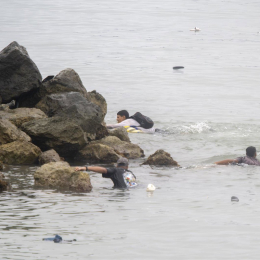
Surveillance has also extended to the coastline, with boats patrolling near the coast, precisely because the sea was the main route used during the entry at the end of July.

The objective of the new Moroccan scheme seems to be to prevent large groups from even reaching the border line.

Controls before reaching Castillejos

To this end, Rabat has also established controls on the roads and accesses leading to Castillejos and to the perimeter of Ceuta.

In this way, the first barrier is no longer only next to the fence: Moroccan forces are trying to intercept those moving towards the area before they can concentrate just a few meters from Spanish territory.

The Moroccan Ministry of the Interior confirmed this week that it had detected publications and messages of unknown origin encouraging the organization of collective attempts at irregular crossing towards Ceuta and Melilla, particularly around August 15.
Rabat claims to have adopted the necessary measures to prevent them and has also reported arrests and procedures against individuals accused of spreading messages intended to promote irregular migration.

A city that has not yet emerged from the previous crisis

Ceuta faces this new alert while still managing the consequences of the events of July 30 and 31.

Interior initially handled a figure of around 72,000 entries, although government sources have subsequently raised the estimate to approximately 80,000 people. The Government maintains that about 70,000 returned to Morocco during the first days.

The magnitude of the figures and the successive revisions suggest treating them as official estimates and not as a definitive count.

The situation of minors is especially complex. Vivas had initially estimated 1,300 migrant minors who were under care after the system went from about 180 before the crisis to around 800 in the days immediately preceding the massive entry.

The count later communicated by Interior is higher: Grande-Marlaska assured this Thursday that 1,898 minors had already been taken under guardianship.

The Minister of Equality, Ana Redondo, has assured this Friday that there is specific attention to the situation of girls and other minors and that spaces have been enabled to keep them protected.

Vivas calls for new legislation for future crises

In parallel to the security deployment, the political debate has shifted to the legal framework. The president of Ceuta, Juan Jesús Vivas, maintains that fifteen days after the massive entry, the situation continues to be "unsustainable" and of "maximum risk" for coexistence, public safety, public services, and, in his opinion, national security.

Vivas calls for the return to Morocco of those who entered irregularly and has requested the creation of a new regulatory framework that allows for quicker action in the face of episodes of this nature.

His proposal also involves preventing an irregular entry from automatically becoming a way to remain in Ceuta or subsequently access the Peninsula.

The president of the Senate, Pedro Rollán, who visited the autonomous city this Friday, has supported the need to address a reform and has demanded that the Cortes have a guaranteeing framework but capable of providing an immediate response in the event of a potential repetition of the crisis.

However, the Government has insisted that returns will be carried out with legal guarantees, while accelerating identification and immigration procedures.

More key points, information and questions with FREN

AI-GENERATED CONTENT

What are the upcoming parliamentary steps related to the management of migration crises in the autonomous cities?

In the coming weeks, the management of the migration crisis in Ceuta and Melilla will be played out on two different parliamentary levels: on one hand, the political control hearings in the Senate about what happened in Ceuta this summer; on the other, the processing and preparation of legal reforms that directly affect the reception and distribution of minors, the Immigration Law, and the financing and resources of the autonomous cities.

1. Short term: August, focus on the Senate and sectoral committees

The Congress is in recess, with no plenary sessions or specific migration committees scheduled between August 10 and 24. Immediate activity is concentrated in the Senate, where the PP, with an absolute majority, has promoted a series of special hearings on the Ceuta crisis:

  • Interior: Fernando Grande-Marlaska is summoned before the Interior Committee to explain the Ministry's actions regarding the massive entry of migrants in Ceuta, the deployment of Security Forces and Corps, and the application of the Immigration Law. Although the Government tries to concentrate explanations in the Congress at the end of the month, the Senate committees will continue to be the first major confrontation stage on resources, border rejections, and coordination with Morocco and the EU.
  • Defense: Margarita Robles has been called by the Defense Committee to detail the Armed Forces' mission in managing the crisis, logistical support, and the possible stable reinforcement of capabilities in Ceuta and Melilla. Some of these hearings have been rescheduled for late August or the ordinary period, anticipating that the military debate on migration crises will also extend into autumn.
  • Foreign Affairs: José Manuel Albares must report on the international dimension of the crisis, relations with Morocco, and the request for European support. According to Foreign Affairs, they will seek to “strengthen support for the autonomous cities” and emphasize their role as the external Schengen border (Moncloa note).

In parallel, the Government has registered requests for hearings in the Congress, in an extraordinary period, for Marlaska, Robles, Albares, and Bolaños for late August, and a Permanent Deputation is planned to decide whether to convene an extraordinary Plenary with Pedro Sánchez's presence to explain the Ceuta crisis, as demanded by the PP.

2. Legal reforms already in process related to migration crises

Beyond political control, initiatives with direct impact on the management of migration contingencies and, in particular, minors in saturated territories like Ceuta are already underway:

  • Draft Law on urgent measures for extraordinary migration contingencies (originating from Royal Decree-law 2/2025). It is processed in Congress as Draft Law 121/000055, referred to the Youth and Childhood Committee. Its objective is to guarantee the best interests of children and adolescents in the face of migration peaks, regulating the mechanism for transfer of unaccompanied foreign minors between autonomous communities when territories like the Canary Islands, Ceuta, or Melilla triple their ordinary capacity. Currently, the draft is in the amendment phase, with an extended deadline until September 2, 2026. The next steps will be:
    • final closure of the amendment period;
    • presentation and report by the Youth and Childhood Committee (with full legislative competence);
    • subsequent referral to the Senate.
    This text is the central piece the Government wants to use to provide a structural response to the distribution of minors from crises like Ceuta's.
  • Draft Law on age determination (121/000040). It regulates, in the Civil Procedure Law, a specific judicial procedure to determine the age of undocumented persons or those with reasonable doubts, key to deciding whether the minor or adult regime applies. The draft is processed by urgent procedure; after the amendment deadline, it moves to the presentation and report phase in the Justice Committee. Its approval will directly affect the management of minors arriving through Ceuta and Melilla.
  • Vox's Draft Law on registration and illegal immigration (122/000039). It aims to modify the Local Regime Bases Law to tighten registration in cases of occupation and irregular immigration. Although it has a general scope, it is part of the restrictive measures package that Vox links to migration pressure in border areas. It is in the amendment phase; the next milestone will be its possible debate for consideration or progress in committee.

3. Upcoming initiatives on Immigration Law, transfers, and financing to Ceuta/Melilla

Alongside ongoing regulations, groups have announced reforms that will likely enter the Congress agenda during autumn:

  • Reform of the Immigration Law. The Government has linked the Ceuta crisis with the need to adjust the Organic Immigration Law, particularly the regime of migration contingencies and distribution of minors. At the same time, the PP has already registered a reform to allow border rejection of those entering Ceuta and Melilla by swimming, following the Supreme Court ruling that limits this figure to fence crossings. This proposal, which still needs to be considered, will open a substantive debate on the balance between border control and guarantees.
  • Transfers to the peninsula. The project derived from Royal Decree-law 2/2025 and future Immigration Law reforms seek to legally shield the transfers of minors from Ceuta and Melilla to other communities. Meanwhile, the Government is using the current framework to promote relocations, facing resistance from several autonomous communities and groups like PP and Vox, which have already announced non-legislative proposals to limit or reverse these transfers.
  • Specific financing to Ceuta and Melilla. Economically, the Government has approved extraordinary credits (for example, 25 million for migrant minors in Ceuta) and is processing in Congress the Draft Law 122/000134 from the PP to recover employer Social Security contribution discounts in the two autonomous cities, currently also in the amendment phase until September 2, 2026. This and, above all, the upcoming General State Budgets will be the main channel to financially strengthen Ceuta and Melilla in their dual condition as border and territories especially strained by migration crises.

In summary, the short term will be dominated by hearings and political control over the Ceuta crisis, while the substantive changes — Immigration Law reform, minor distribution mechanisms, and permanent reinforcements of financing and resources for the autonomous cities — will concentrate in the resumption of the ordinary session period, starting in September, with several initiatives already underway in Congress.

What competencies does the Ministry of the Interior have regarding border control according to Spanish legislation?

The Ministry of the Interior is the key department in Spain for border control, although many of its functions are exercised through the National Police and the Civil Guard and in coordination with European Union (Schengen) regulations. Its competencies derive mainly from the Constitution, the Organic Law of Security Forces and Corps, immigration legislation, and rules on citizen security and maritime security.

General framework and Organic Law of Security Forces and Corps

The Organic Law 2/1986, on Security Forces and Corps assigns to the State — and, in practice, to the Ministry of the Interior — the functions of:

  • Surveillance of ports, airports, coasts, and borders.
  • Control of entry and exit from the national territory of Spaniards and foreigners.
  • Management of the general immigration regime, passports, and national identity documents.
  • Collaboration and assistance to foreign police forces.

Within this framework, the Interior Ministry exercises political and strategic direction over the Security Forces, which are the ones that materially carry out controls at land, sea, and airport border crossings.

Competencies in immigration and migration flow control

The Organic Law 4/2000, on the rights and freedoms of foreigners in Spain and its reforms (LO 8/2000, LO 2/2009, LO 10/2011) configure Interior as the central immigration authority in several aspects directly linked to borders:

  • Decision and execution of measures to control and limit the entry, stay, and exit of foreigners, in accordance with EU regulations and treaties.
  • Exceptional adoption, by resolution of the Minister of the Interior, of individual restrictive measures for public security reasons, including border exclusion when there are specific risks (articles on freedom of movement).
  • Organization and management of foreigners' internment centers (CIE), whose regime is developed in Royal Decree 162/2014, on the operation of CIEs (text in BOE).
  • Participation in return programs and border management with third countries, for example through agreements like the one signed with the IOM on “integrated border management” (BOE-A-2025-24835).

Citizen security and border rejection regime

The Organic Law 4/2015, on the protection of citizen security (BOE-A-2015-3442) strengthens Interior's role in the border area, especially in Ceuta and Melilla. Its first final provision regulates a special border rejection regime for these autonomous cities, executed by the Security Forces and Corps under the Ministry's dependency. This regime has been subject to constitutional control but remains in force with the interpretation set by the Constitutional Court.

Distribution of functions: National Police and Civil Guard

Under the Ministry of the Interior, competencies are practically distributed as follows, according to Organic Law 2/1986 and internal organic regulations (for example, Order INT/859/2023 on the structure of the Directorate General of Police, BOE-A-2023-17072):

  • National Police:
    • Control of entry and exit of persons at ports and airports enabled as border crossings, including document, visa, and security database checks.
    • Management of border posts in the Schengen area designated as the responsibility of the Directorate General of Police.
  • Civil Guard:
    • Surveillance of coasts and maritime borders, including detection and interception of irregular vessels, in coordination with the Maritime Security Strategy (BOE-A-2024-10762).
    • Control and surveillance of certain land borders and border areas (such as the Strait of Gibraltar, Alboran Sea, and adjacent waters), where Interior has created a specific Coordination Authority for irregular immigration (BOE-A-2018-11138).

Schengen and enabled border crossings

The Schengen Borders Code, as an EU directly applicable regulation, sets the rules on controls at external borders. The Ministry of the Interior is the national authority responsible for its operational execution in Spain, through the National Police and Civil Guard, and in coordination with other ministries (mainly Foreign Affairs and Transport).

Additionally, Interior participates in the designation and modification of enabled border posts, especially at airports, through orders such as those enabling the airports of Badajoz, Teruel, Logroño-Agoncillo, or Murcia as border crossings (Order PRE/1224/2014, Order PCI/7/2019, among others).

Overall, Spanish legislation configures the Ministry of the Interior as responsible for the planning, coordination, and strategic direction of border control, while the material execution is entrusted to the National Police and Civil Guard, within the framework of immigration, citizen security, and the Schengen system regulations.

What legal requirements must be met to carry out border rejections according to current regulations and recent court rulings?

The regime of so-called “border rejections” in Ceuta and Melilla today relies on the Tenth Additional Provision of Organic Law 4/2000, introduced by LO 4/2015 on citizen security (text in BOE), and has been defined by the Constitutional Court and, more recently, by the Supreme Court and several ordinary courts.

1. Basic legal framework

  • The Tenth Additional Provision (“Special regime of Ceuta and Melilla”) establishes that foreigners may be rejected if they are:
    • detected at the border line of Ceuta or Melilla,
    • while attempting to enter irregularly,
    • and trying to overcome border containment elements (fences or other physical elements).
  • The provision itself adds that:
    • the rejection must be carried out respecting international human rights and international protection regulations to which Spain is a party;
    • applications for international protection must be formalized at the authorized places at border crossings and processed according to the Asylum Law.
  • Organic Law 4/2000 also recognizes the right of foreigners in Spain to legal assistance and interpreter in procedures of denial of entry, return or expulsion, and in international protection matters; such assistance is free if they lack resources.

2. Conditions set by the Constitutional Court

The constitutionality of border rejection was examined in the Constitutional Court rulings on LO 4/2015, especially STC 172/2020 and STC 13/2021 (STC 172/2020 in BOE, STC 13/2021). The BOE itself states that the Constitutional Court declares the tenth additional provision “constitutional provided it is interpreted” according to three criteria:

  • Application to individualized entries: rejection cannot operate as an indiscriminate mechanism against mass groups without considering each person's circumstances. There must be a minimum individual identification and assessment.
  • Full judicial control: the Security Forces and Corps' actions in executing the rejection must be subject to court control (art. 106 CE), both in contentious-administrative and, if applicable, criminal proceedings.
  • Respect for international obligations: particularly the principle of non-refoulement and effective access to international protection, with reinforced attention to minors and vulnerable persons.

The doctrine summarized by recent analyses from Demócrata emphasizes that the Constitutional Court only accepts border rejection as constitutional when applied compatibly with these three guarantee blocks and not as a “blank check” for summary expulsions (explanatory article).

3. Recent contributions from the Supreme Court and ordinary courts

  • Material scope of border rejection:
    • A Supreme Court ruling of July 8, 2026, noted by several media, concludes that border rejection cannot be applied to those intercepted at sea, swimming to Ceuta or Melilla, because they are not overcoming a “border containment element” in the sense of the tenth additional provision (analysis on rejection, return, and expulsion).
    • In these cases, the ordinary return procedure of art. 58 LO 4/2000 must be used, which requires identification, hearing, possibility to claim asylum or vulnerability, and judicial review.
    • The Supreme Court itself indicates that border rejections by sea could apply if physical barriers are installed (buoys, pneumatic barriers) that constitute true containment elements, something Interior is beginning to do at the Tarajal breakwater (Ministry of Interior note).
  • Jurisprudence of the Andalusian High Court of Justice and Ceuta courts:
    • The Andalusian High Court of Justice has confirmed the illegality of immediate returns of people arriving by swimming to Ceuta, considering the tenth additional provision inapplicable at sea and requiring the return procedure with: administrative procedure, interpreter, and legal assistance (ruling covered by eldiario.es).

4. Contributions from the ECHR and European Law

The European Court of Human Rights has recalled, in a priority case on Sahrawi asylum seekers, that Spain must ensure the stay of those requesting international protection on its territory while their application is resolved, so that return cannot be executed violating asylum rights or the non-refoulement principle (summary of Spain's cases before the ECHR).

5. Summary of currently required conditions

Overall, for a border rejection to be legally admissible, the following must concur according to current regulations and recent jurisprudence:

  • The person is detected at the land border line of Ceuta or Melilla, attempting to enter irregularly by overcoming physical barriers (fences or other physical elements).
  • The action allows an individual assessment of each person's situation (age, possible asylum reasons, signs of trafficking, pregnancy, etc.).
  • There is a real possibility to apply for asylum at authorized crossings and no one is returned to a country where they face serious risk (principle of non-refoulement).
  • The measure is subject to effective judicial control, without zones of material impunity.
  • And, when the conditions of the tenth additional provision do not concur (for example, entries by swimming or intercepted in open sea), the ordinary return procedure applies, with legal assistance, interpreter, and access to contentious-administrative jurisdiction.

Play

Test your knowledge with FREN!

How much do you know about this topic? Answer the following 3 questions.

How many National Police officers are deployed in Ceuta after the reinforcement due to the migratory threat?

Question 1 of 3

What new physical measure has been implemented on the El Tarajal breakwater to reinforce the maritime border?

Question 2 of 3

Approximately how many military personnel are supporting the security device in Ceuta?

Question 3 of 3

Hola, soy Fren. ¿Cómo te ayudo?