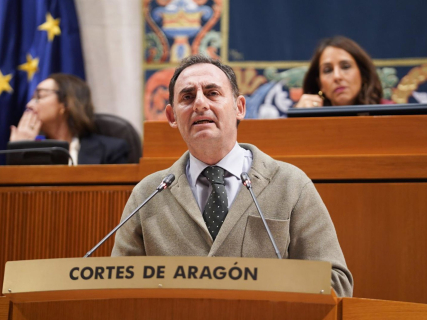

The Aragonese Parliament has given the green light this Thursday to a non-legislative proposal regarding insecurity and the situation of youth in Ceuta, promoted by Vox, in which it requests to guarantee "the effective control of the border and to prevent the consequences of the immigration invasion from falling on Ceuta families" and "the safety and health of educational centers," among other points. The proposal has progressed with the support of PP and Vox, despite the rejection of the rest of the groups in the Chamber.
The initiative to push the Government has been defended by Vox deputy Javier Valentín Alonso, in a debate in which José Luis Bancalero (PP), Fernando Sabés (PSOE), Mary Carmen Bozal (CHA), Pilar Buj (A-TE), and Marta Abengochea (IU) have also intervened.
With the approval of this non-legislative proposal, the Cortes urge the central Executive to "guarantee the effective control of the border and to prevent the consequences of the immigration invasion from falling on Ceuta families, placing the protection of childhood and Ceuta youth among the priorities of the State's action in Ceuta."
The Chamber also demands that the safety and health of educational centers and their access, as well as the spaces and daily routes of children, adolescents, and young people, be ensured, and that the educational, sports, and youth character of the facilities aimed at all Spaniards be maintained.
In the same way, the Cortes demand to allocate "sufficient resources for the prevention, early detection, and psychological and psychiatric care of children, adolescents, and young people in Ceuta, with special attention to the consequences that the situation of insecurity, uncertainty, and disruption of their routines may cause on their mental health and emotional well-being, ensuring adequate coordination between families, educational centers, and health and social services."
Another of the demands is to prevent "the fear or insecurity caused by the invasion from harming their attendance in classrooms and access to adequate and quality education."
Likewise, it is proposed to "establish a specific system for monitoring school absenteeism linked to the situation of insecurity or fear of families, adopting support measures that allow guaranteeing the educational continuity of the affected students."
The Courts also urge the Government of Spain to "guarantee periodic and transparent information about the impact that this invasion is having on the child and youth population of Ceuta through the accessible publication of reports and official studies on the impact of the immigration invasion and mass immigration on the educational reality, absenteeism, school failure, and other special educational needs, as well as on the exodus of young people to the peninsula or outside Spain and the loss of the Spanish population in Ceuta."
Furthermore, they recommend "strengthening security measures and the action of the State Security Forces and Corps to guarantee the integrity of the people of Ceuta and their safety on the streets and to combat the increase in criminality, carrying out the repatriation of foreigners who have entered illegally into Spain, the deportation of those who commit crimes or want to impose a way of life different from ours, and the remigration of those who remain in the national territory living off social assistance and not contributing to the welfare state."
Finally, the initiative proposes "compensating Ceuta families who are suffering the terrible consequences of the immigration invasion in the city through a fiscal plan that includes differentiated incentives, including special bonuses for personal income tax and property tax, as well as exemptions from the Tax on Production, Services, and Imports (IPSI), carrying out the necessary legislative modifications with urgency and extreme necessity."